
Demon Island: Exploring Megijima in Japan’s Seto Inland Sea
Archived Content: This article was published over 30 days ago. Travel rules and prices may have changed.Check official sources.
Visit Megijima near Takamatsu—linked to pirates, demons and the Momotaro legend, with caves, views and island art.
When people hear the word oni (鬼), the Japanese term for a demon, many think of Demon Slayer: Kimetsu no Yaiba. Others think of Momotaro, the hero of one of Japan’s most famous folktales. In the story, a boy born from a peach sets out for an island called Onigashima—literally “Demon Island”—accompanied by a monkey, a dog and a pheasant.
Together, they defeat demons who have attacked nearby villages. The tale has been passed down for generations across Japan. According to local tradition, the island where these demons lived may still exist in the Seto Inland Sea, just off the coast of Shikoku. This article follows a visit to that so-called Demon Island—Megijima, a real place you can still visit today.
A Demon Island Near Takamatsu
[

](http://cdn.gaijinpot.com/app/uploads/sites/4/2026/04/Pixta-Skylight-Megijima-Japan-Demons.jpeg)Oni abound.
Japan consists of four main islands, including Shikoku, the smallest of the four and located west of Osaka. In its northern prefecture, Kagawa, numerous small islands dot the coast. Among them is Onigashima, formally known as Megijima.
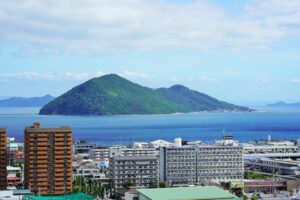
Megijima lies just 4 kilometers offshore from Takamatsu, the prefectural capital. On clear days, its distinctive silhouette is visible from the city’s waterfront, rising gently out of the Seto Inland Sea. According to residents, even wild boars swim across the narrow channel separating the island from the mainland.
The island is easily accessible, with ferries operating frequently—often once an hour during peak season.
Megijima was formed by volcanic activity. Granite forms its geological base, later covered by layers of volcanic ash and magma. The island’s highest point, Mount Washigamine, rises 186.6 meters above sea level.
Near the summit, a cave covers roughly 4,000 square meters. It was discovered in 1930 by Sentaro Hashimoto, then the principal of a local elementary school. The cave later became associated with the legend of oni and came to be regarded as their dwelling place.
From Legend to Reality
[

](http://cdn.gaijinpot.com/app/uploads/sites/4/2026/04/Peck-PIXTA-Megijima-Onigashima-shikoku.jpeg)Did the legend of Momotaro start here?
According to local tradition, fishermen once told stories of demons emerging from the sea to raid coastal villages—terrifying figures that appeared without warning and vanished just as quickly—to the scholar and statesman Sugawara no Michizane, who served as governor of Sanuki Province in the late ninth century. These accounts are thought to have helped shape early versions of the legend.
In reality, these “demons” were kaizoku (海賊)—pirates who attacked coastal communities, seized goods and took captives. Over time, these encounters were retold and reinterpreted, gradually taking on a more mythical form.
Some accounts suggest the stories were reshaped into a heroic narrative about Wakatakehiko no Mikoto, a legendary figure said to have defeated such enemies with the help of loyal retainers. As the story evolved, the pirates themselves were reimagined as demons, eventually becoming the oni of the well-known Momotaro folktale, in which a boy sets out to defeat them with three animal companions—a dog, a monkey and a pheasant.
Near the summit of Megijima lies a large natural cave, formed by volcanic activity and long predating the legend itself. In 1930, local elementary school principal Sentaro Hashimoto rediscovered the cave and proposed that it could be the dwelling place described in the story.
Since then, the island has been widely known as Onigashima—the place where demons once lived.
Inside the Demon Cave
[

](http://cdn.gaijinpot.com/app/uploads/sites/4/2026/04/Pixta-Peck-Megijima-Onigashima-Cave.jpeg)Inside Onigashima Cave.
The journey to the cave begins at Megijima Port, where shuttle buses connect with arriving ferries. While walking is possible, the steep climb makes the shuttle the more practical option.
After a winding ride up a narrow mountain road, visitors step off and climb a series of steep stone steps that feel sharper than they first appear. The entrance is low, forcing most adults to bend as they enter. Inside, the space opens into a network of chambers extending roughly 400 meters. Today, visitors can walk through the cave, which has been partially developed and labeled based on the legend.
The rooms are labeled according to local legend, including an entrance hall, guards’ waiting area, treasure room, meeting chamber and what is described as a hostage room—turning the cave into something halfway between a historical site and a staged retelling.
Standing in the dim light, it is easy to imagine a harsher reality behind the myth. For centuries, coastal communities in the Seto Inland Sea endured pirate raids. Historical records describe attacks on ships and shoreline villages, the seizure of goods and the taking of captives, including women and children.
To villagers watching from shore, sunburned and grime-covered raiders appearing suddenly from the sea may well have seemed like demons. What later generations described as oni may have grown from memories of very human violence.
In the cool darkness of the cave, the boundary between history and legend feels thin.
Art and Views on Megijima
[

](http://cdn.gaijinpot.com/app/uploads/sites/4/2026/04/mandegan-PIXTA-Public-art-at-Takamatsu-Port-Sunport-.jpeg)Public art at Takamatsu Port Sunport.
Beyond its cave, Megijima offers a range of attractions.
Near the summit, an observation deck provides wide views across the channel toward Takamatsu, with ferries moving slowly between scattered islands below. On clear days, the landscape—forested hills, calm waters and distant islands—stretches across the horizon.
Megijima is also one of the venues of the Setouchi International Art Festival, and contemporary artworks appear throughout the island.
As ferries approach the port, visitors may notice what look like seagulls perched along the breakwater—only on closer look do you realize they are sculptural weathervanes titled Parking for Seagulls by Takahito Kimura.
Near the port stands another installation, Memory of the 20th Century by Funjo Hagetaka—a surreal structure that blends the shape of a ship with a piano, sitting by the water as if it might drift out to sea.
A short walk from the port, a renovated building houses a cluster of imaginative spaces, united by the theme of temporary small shops. Inside are playful and fictional settings, including an imaginary hair salon, a laundry shop, a table tennis hall, a yoga studio and a small studio dedicated to drawing memories of clothing.
Though easily reached from the mainland, Megijima retains a quiet, almost remote atmosphere. That sense of distance adds to the experience of exploring both its art and its history.
Getting to Megijima
[

](http://cdn.gaijinpot.com/app/uploads/sites/4/2026/04/Pixta-mandegan-Megijima-Onigashima-shikoku.jpeg)The ferry to Megijima.
Megijima is a short trip from Takamatsu in Kagawa Prefecture, but reaching Takamatsu depends on where you’re coming from. From Tokyo, take the Tokaido/Sanyo Shinkansen to Okayama Station (around 3 hours 20 minutes), then transfer to the Marine Liner rapid train to Takamatsu (about 1 hour). From Osaka, take the Sanyo Shinkansen from Shin-Osaka to Okayama (around 45 minutes), then transfer to the Marine Liner. In total, the journey takes about 4.5 hours from Tokyo or 2–2.5 hours from Osaka.
From Takamatsu Station, it’s a 5–10 minute walk to Takamatsu Port. Ferries to Megijima take about 20 minutes and cost approximately ¥370 one-way. They run about once an hour, with more frequent departures during peak seasons.
From ancient demon legends to contemporary art installations, Megijima offers a broad spectrum of experiences. Easily accessible yet quietly removed from the mainland, it makes a rewarding—and slightly unusual—side trip for anyone exploring Shikoku.
Have you ever visited Megijima or another place tied to Japanese folklore? Let us know your experience in the comments below.
Note: This article content is being automatically formatted. For the original source formatting, visit the link below.
Original source:GaijinPot Blog ↗
More Japan News

Tokyo Area Events for June 2026
Experience June in Tokyo with hydrangea blooms, shrine festivals, firefly nights and food markets all around the city.

Osaka Area Events for June 2026
Check out our monthly event roundup for Osaka for June 2026.

Japan CBN Ban: What Residents and Tourists Need to Know
Japan banned CBN effective June 1, 2026. Here’s what tourists and foreign residents should know before traveling with cannabinoid products in Japan.