
Same-Sex Partnership Oath System in Japan
Archived Content: This article was published over 30 days ago. Travel rules and prices may have changed.Check official sources.
Here’s what same-sex partnership oaths provide in 2026 and where the legal fight for equality stands.

If you’ve been following the conversation around LGBTQ+ rights in Japan, you’ll know the momentum feels both historic and painfully slow. As of 2026, Japan is still the only G7 nation without nationwide marriage equality. Although several high court rulings have found the ban unconstitutional, local partnership oath systems remain the only form of recognition many couples can actually access. So, what does the same-sex partnership oath system in Japan actually mean for couples in 2026, and is it enough?
- Same-Sex Partnership Oath System in Japan
- What Does it Include?
- What Does it Leave Out?
- How Widespread is the System Today?
- The Current Status of Marriage Equality in Japan
- How to Apply
Same-Sex Partnership Oath System in Japan
[

](https://cdn.savvytokyo.com/app/uploads/2017/02/pixta_104820930_M.jpg)The same-sex partnership oath system serves as official proof at the local level
First introduced by Tokyo’s Shibuya Ward in 2015, a same-sex partnership acceptance certificate (patonashippu shomeisho) is an official document issued by a local government that recognizes two people of the same sex as being in a committed relationship.It is not a legal marriage and does not grant the rights that come with marriage under Japan’s Civil Code, nor does it change a couple’s status in the national family registry (koseki). Instead, it serves as proof of a relationship at the local level, which can help couples access certain public services or be acknowledged as family by institutions such as hospitals.
What Does it Include?
[

](https://cdn.savvytokyo.com/app/uploads/2017/02/pixta_113740049_M.jpg)It is recognized when applying for housing lotteries or some welfare programs
Since 2015, the practical value of partnership certificates has expanded. It’s still not uniform and often depends on the city, prefecture or private company you’re dealing with. However, compared to a decade ago, the difference is noticeable.
In everyday life, couples with a certificate may be able to:
-
Apply for public housing as a recognized household
-
Be treated as a family unit for certain municipal services, such as housing lotteries or some welfare programs
-
Visit a partner in the hospital and be acknowledged for next-of-kin communication
-
Apply for joint mortgages with major banks, including MUFG, Mizuho and SMBC
-
Name each other as beneficiaries with most large life insurance providers
-
Access workplace spousal benefits, such as relocation allowances or congratulatory leave
There have also been meaningful national shifts. In 2024, the Supreme Court ruled that same-sex partners are eligible for survivor benefits under the Crime Victim Benefit Law. It was one of the clearest signs that recognition is slowly extending beyond local governments and into national policy.
Partnership Familyship Systems
Some cities have taken things a step further. In 2021, Akashi in Hyogo became the first municipality to introduce what’s known as a “partnership familyship system” (パートナーシップ・ファミリーシップ制度). Since then, other areas, including Tokyo, have followed.
These systems expand recognition beyond the couple themselves to include children in the household. In practical terms, that can mean a non-biological parent being formally acknowledged as part of the family, allowed to pick up a child from school or kindergarten and more easily participate in school and administrative matters. It’s still not the same as full parental rights under national law. But for many families, it offers a layer of security and visibility that didn’t exist before.
What Does it Leave Out?
[

](https://cdn.savvytokyo.com/app/uploads/2017/02/iStock-1096310984.jpg)For international couples, a partnership certificate does not grant a “Spousal Visa.”
Since partnership certificates operate under local rules rather than national law, several fundamental rights that automatically come with marriage are still not included, such as:
-
Inheritance: You cannot automatically inherit your partner’s assets. Without a notarized will, assets go to the legal next of kin (parents or siblings).
-
Tax Deductions: Partners cannot claim the “spousal deduction” on national income tax.
-
**Joint Custody: **Same-sex couples cannot legally adopt a child together or have joint parental rights.
-
Spousal Visas: For international couples, a partnership certificate does not grant a “Spousal Visa.” Foreign partners must still rely on other visa types.
How Widespread is the System Today?
[

](https://cdn.savvytokyo.com/app/uploads/2017/02/iStock-532275336.jpg)There are now 532 municipalities and 31 of Japan’s 47 prefectures operating partnership systems
When Shibuya Ward introduced Japan’s first partnership certificate in 2015, it was labeled experimental. At the time, only a few municipalities followed its lead.
Fast-forward to 2026 and what started as a ward-level initiative has become part of mainstream local governance. There are now 532 municipalities and 31 of Japan’s 47 prefectures operating partnership systems, covering 92.7 percent of the population. Nationwide, 9,837 couples have registered so far and that figure continues to climb.
Tokyo has always led the way and in 2022, the Tokyo Metropolitan Government launched the country’s first prefecture-wide system, allowing couples to apply through a single metropolitan process. The certificate remains valid even if they move between Tokyo’s 23 wards, removing one layer of bureaucratic stress.
In other parts of Japan, municipalities have started recognizing certificates issued elsewhere, making it easier for couples to relocate without having to start from scratch.
The Status of Marriage Equality in Japan
[

](https://cdn.savvytokyo.com/app/uploads/2017/02/iStock-1240189653.jpg)Growing public support is steadily increasing the pressure for change
Japan is at a pivotal moment in its legal system. Although nationwide marriage equality has yet to be achieved, mounting court challenges and growing public support are steadily increasing the pressure for change.
Between 2021 and 2025, six major lawsuits challenged the constitutionality of the marriage ban. Most High Courts, including those in Sapporo, Nagoya and Osaka, ruled that prohibiting same-sex marriage violates Article 14, which guarantees equality under the law and Article 24, which protects individual dignity in marriage.Then, in November 2025, the Tokyo High Court went the other way, upholding the ban and overturning a lower court’s decision. The result is a split legal landscape and growing anticipation around a Supreme Court ruling expected this year. Many see it as a moment that could finally force the government to act, whether through marriage equality or an alternative national framework such as civil unions.
At the same time, political leadership remains a wildcard. Prime Minister Sanae Takaichi has publicly opposed legalizing same-sex marriage, arguing that the Constitution’s reference to the “consent of both sexes” leaves little room for reinterpretation, making reform extremely difficult under current law.
How to Apply
[
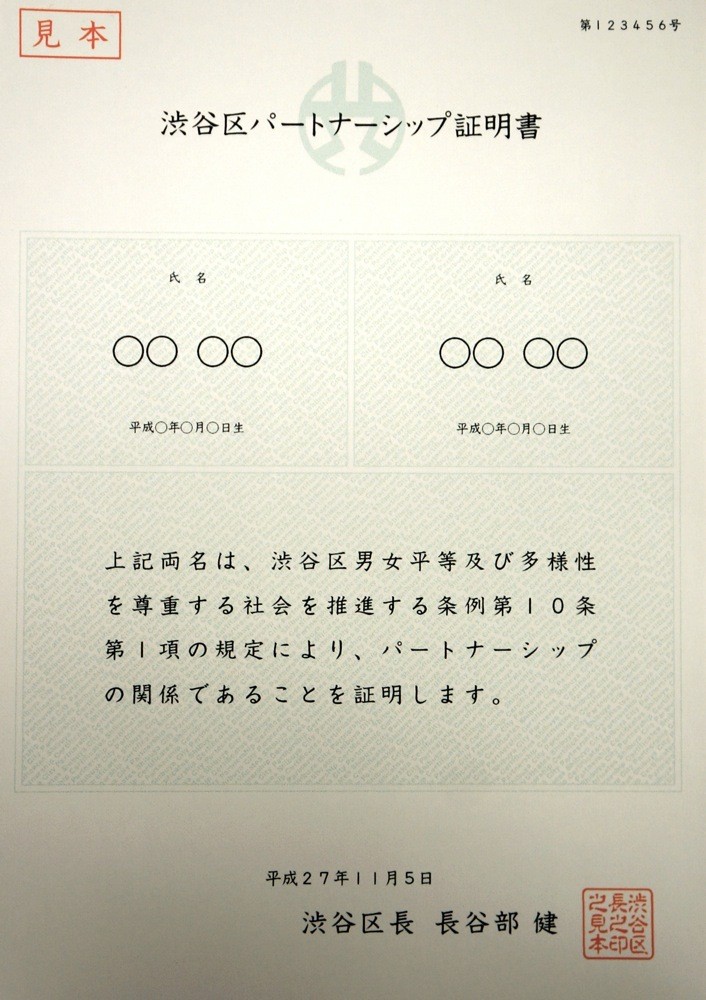
](https://cdn.savvytokyo.com/app/uploads/2017/02/original.jpg)A sample of Shibuya’s Same-sex Partnership Certificate
The application process is generally straightforward and similar across municipalities.
In most cases, both partners must:
-
Be 18 years or older
-
Be legally unmarried
-
Not be in another registered partnership
-
Not be close blood relatives
-
Be registered residents of the issuing municipality (prefectural systems may allow residents from anywhere within the prefecture)
-
Foreign residents can usually apply as well, provided they hold a valid residence status and can submit proof that neither partner is legally married in their home country.
Compared to a decade ago, the process is a lot more streamlined. Many municipalities allow online reservations or partially digital applications, though most still require at least one in-person visit for identity verification.
Documents Needed:
-
Proof of identity (Residence Card, My Number Card or passport)
-
A certificate of residence (juminhyo)
-
A signed declaration of partnership
-
In some cases, a notarized affidavit confirming single status
The application itself is usually free, though administrative document fees apply and issuing the certificate may cost a small fee, often around ¥300, depending on the municipality.
This article was written by L.F. Keehn in 2017 and updated by Kerri King in 2026.
Note: This article content is being automatically formatted. For the original source formatting, visit the link below.
Original source:Savvy Tokyo ↗
More Japan News

Will heat waves push European holidaymakers to ‘coolcations’?
The concept of "coolcations" — vacations in a cooler clime — has been gathering pace in recent years and appears to have exploded in 2026.

U.S. holds fire against Iran as reports emerge of stockpile concerns
The pause could reflect pressure on stockpiles of Patriot interceptors and other defensive weapons, U.S. media reports said.

Family Mart’s new Famima flagship in Tokyo has a hidden gem that most visitors miss
A must-try convenience store drink you won’t find anywhere else. Earlier this month, Family Mart shook up the convenience store scene by opening its first-ever flagship store, Famima Park Azabudai. Lo