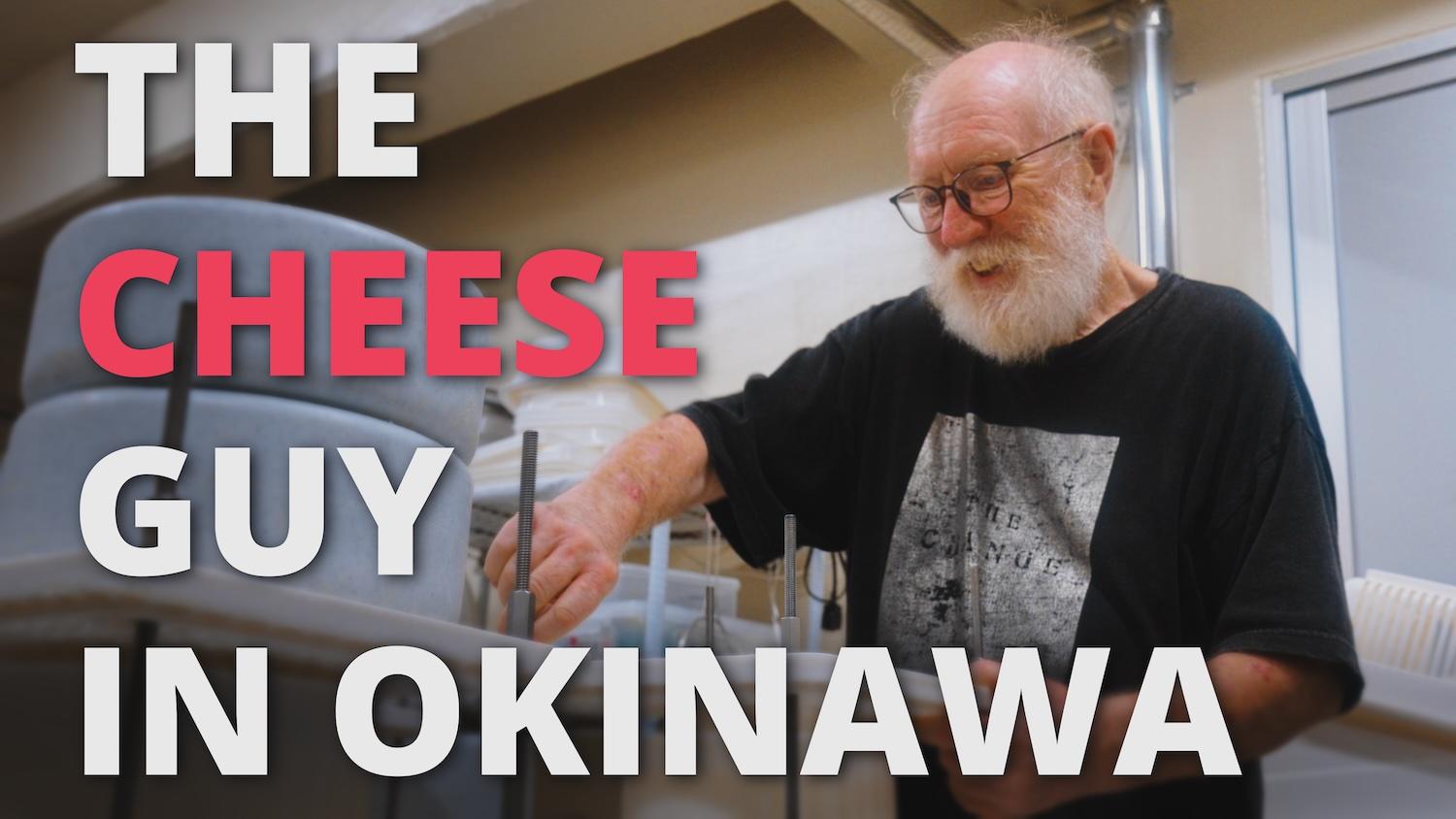
How a British Man Became Japan’s Cheese Guy in Okinawa
← Back to News
Visa

How a British Man Became Japan’s Cheese Guy in Okinawa

JP
By The Japanist Team
Source: GaijinPot Blog

Looking for the best cheese in Japan? Discover the story of John Davis, the cheese guy in Okinawa, and his artisan shop.

The Cheese Guy in Okinawa Japan

Look at a map of Okinawa, and you probably think of blue sea and palm trees. A little deeper, and perhaps you picture a glass of habushu (snake wine) and chinsuko cookies. However, what you do not typically think of is cheddar. Neither did John Davis, the Cheese Guy in Okinawa.

John arrived in Japan back in 1976 as a guy in his 20s looking for an adventure. He spent 30 years teaching English first in Tokyo and then in Sapporo. By the mid-2000s, he was ready to retire. He packed his car with a crate of wine and cheese, boarded a ferry south and sailed toward the warmth of Naha.

Life was good, but there was a massive, dairy-shaped hole in it. Okinawa, like much of Japan, was a total cheese desert. The stuff in the supermarkets was not up to snuff. Or, as John puts it, it had “as much character as airport background music.”

For a guy who spent his teenage years in Wiltshire, England, right near the actual town of Cheddar, this was his personal culinary crisis. His mother always kept the larder stocked with the sharp, real stuff, and the local Japanese supermarkets just weren’t cutting it.

With a lot of free time in retirement, John decided to fix the problem himself.

Learning the Craft from Scratch

[

The Cheese Guy in Okinawa Parmejohn

](http://cdn.gaijinpot.com/app/uploads/sites/4/2026/07/The-Cheese-Guy-in-Okinawa-Parmejohn.jpg)John’s “ParmeJohn.”

John realized that the island had hidden potential. Dairy farming itself was already established on the island—the cows were there, and Okinawan milk was already rich and creamy. 

John’s big realization was that nobody was using that great local milk to make real cheese, despite the climate being perfect for fermentation.

He started hunting down milk nearing its sell-by date and turning his kitchen into a makeshift laboratory. John sourced starter cultures— bacteria used to ferment milk and kickstart the flavor—and rennet, the enzyme that curdles the liquid milk into solid clumps. He bought trays and knives from Daiso and just started experimenting.

John admits the first two batches were edible, but nothing to write home about. The third attempt, however, was his breakthrough: a camembert infused with porcini mushrooms.

“My wife and I were in cheese heaven, and each had multiple ‘cheesegasms,'” John says. “We were hooked. This was far better than the cheese in any supermarket!”

Every morning became a quest for milk. John would make the same cheese day after day until he could make it without looking at the recipe; then he moved on to the next. Soon, his refrigerator was bursting. 

When a friend suggested hosting a “cheese night” at a local bar in Naha, the neighborhood went wild. It was a massive success, and John realized retirement was officially over.

The Nanjo Connection

[

Chura Nanjo cheese guy in okinawa

](http://cdn.gaijinpot.com/app/uploads/sites/4/2026/07/Chura-Nanjo-cheese-guy-in-okinawa.jpg)Delicious “Chura Nanjo” cheese.

To scale up the operation, John needed a reliable source of raw milk. Through a tangled web of local introductions, he found Kiyoshi, a dairy farmer in Nanjo who had a herd of Holstein cows. It turned out to be a perfect match. 

“He wanted to make cheese, but didn’t know how,” John says. “I needed raw milk, but didn’t know where to get it. We each had what the other wanted.”

They shook hands, and John built a rudimentary factory right on Kiyoshi’s farm for about ¥400,000. He had a local stainless steel fabricator build the heavy machinery to his exact specifications—which saved them a fortune compared to buying equipment online—and hit up Daiso again for the cheesecloth to strain the curds.

John likes to point out a brilliant bit of wordplay in the island’s old name. If you look at the word Ryukyu, right in the dead center are the initials UK. “This symbolizes what we are trying to do,” he explained. Using traditional British cheesemaking techniques and Okinawan ingredients to make original Okinawan cheese. 

From Okinawa With Love

[

The Cheese Guy in Okinawa Japan

](http://cdn.gaijinpot.com/app/uploads/sites/4/2026/07/The-Cheese-Guy-in-Okinawa-Japan.jpeg)John Davis, The Cheese Guy

This became the blueprint for his business. Though John is quick to clarify that he isn’t a homesick foreigner trying to force British traditions onto Japan. He is making something entirely local. 

Okinawa sits at the same latitude as Sicily and Oaxaca, meaning the humidity and temperature are ideal for fermentation. The cows drink the local water, breathe the island air and eat the local grass. John believes this distinct terroir goes straight into the milk, giving it “the special taste of the area.” 

From there, he infuses the flavors of his adopted home.

He creates his “Ryukyu Crown” using kuro koji, the black yeast used to brew awamori. He makes “Ozato Basil” and “Chura Nanjo” using herbs and spices named after the very regions where the farm sits. “What we are making is, there is no doubt about it, Okinawan cheese,” John says.

From The Farm To The Ritz

[

JOHN THE CHEESE GUY IN OKINAWA JAPAN MENU

](http://cdn.gaijinpot.com/app/uploads/sites/4/2026/07/JOHN-THE-CHEESE-GUY-IN-OKINAWA-JAPAN-MENU.jpeg)He’s called “The Cheese Guy” for a reason.

With the factory up and running, John started small, selling his creations at the local farmers’ market. But the operation didn’t stay small for long. A friend introduced him to a chef at the Ritz-Carlton, and from there, John says, “things just exploded.”

Suddenly, the guy who started out searching for marked-down milk in his kitchen was supplying the menus of the biggest luxury hotels right on the island.

To keep up with demand, he opened his physical cheese shop in Nanjo some ten years ago and launched an online store. 

Today, he regularly ships his cheeses to customers all over mainland Japan and all the way back up to Hokkaido—the very snowy island he left two decades ago.

No Plans To Slow Down

[

How a British Expat Became Japan’s Cheese Guy in Okinawa

](http://cdn.gaijinpot.com/app/uploads/sites/4/2026/07/How-a-British-Expat-Became-Japans-Cheese-Guy-in-Okinawa-0-6-screenshot.jpg)He still can’t find the E.

Alongside the cheese, he applies that same pure, local philosophy to a thick, concentrated yogurt made with nothing but raw milk straight from the farm. 

He recalls a customer once asking if the yogurt was gluten-free. “Of course,” John answered, “why wouldn’t it be? It’s yogurt!” Curious, he later checked a supermarket tub of commercial Greek yogurt only to find flour listed on the back. 

That is exactly the kind of bland, industrial imitation he is fighting against.

If you ask John about the hardships of running a business as a foreigner, he completely brushes them off. “It didn’t occur to me to think whether it was difficult or easy, I just did it step-by-step,” he says.

He believes that if you reach out and involve the community with something that genuinely benefits their lives, the locals will back you up. He credits the local government, the farmers’ markets and his neighbors for supporting him every step of the way.

At an age when most people are putting their feet up, John has zero interest in stopping. “I do not want to retire or stop this work at all,” he says. “I love this work and everything about it. Cheese makes people happy.” 

He loves watching people walk into his little shop in Nanjo, taste a sample of real cheese or yogurt, and immediately smile and laugh.

Yes, It Really Is That Good

[

The Cheese guy in okinawa dinner

](http://cdn.gaijinpot.com/app/uploads/sites/4/2026/07/The-Cheese-guy-in-okinawa-dinner.jpg)We were spoiled.

And, dear reader, before you consider it fluff, know that I, too, was personally, life-alteringly affected by John’s halloumi cheese. He grilled each piece right in front of the shop, and I was hit with that immediate, tragic realization that I wouldn’t be able to eat this cheese every single day.

I thought it couldn’t possibly get any better—until we were invited to his colleague’s restaurant, Yoshoku Taro, for our own private cheese party.

There, I ate halloumi tempura with matcha (green tea) salt and had a genuine spiritual awakening. So yes, you could say I’m a fan of John’s cheese. The rest of the meal was just as memorable. Potato mille-feuilles, a delicious beef stew with aligot—mashed potatoes and melted cheese and a light crème d’Anjou made with yogurt and passion fruit.

Watch the Documentary

Want to see John’s custom cheese workshop and hear more of his incredible stories firsthand? Check out our short documentary detailing his journey from retirement to becoming Japan’s ultimate cheese pioneer:

Watch it here!

If you aren’t currently hanging out in Okinawa, you can order John’s artisanal cheese directly from his online storefront for shipment anywhere in Japan. Love cheese? Hate cheese? (really?) Leave a comment below to let us know which is your favorite!

Note: This article content is being automatically formatted. For the original source formatting, visit the link below.

Original source:GaijinPot Blog