Japan’s Konbini, Explained: What 56,000 Convenience Stores Actually Do—and How to Use One Like a Local
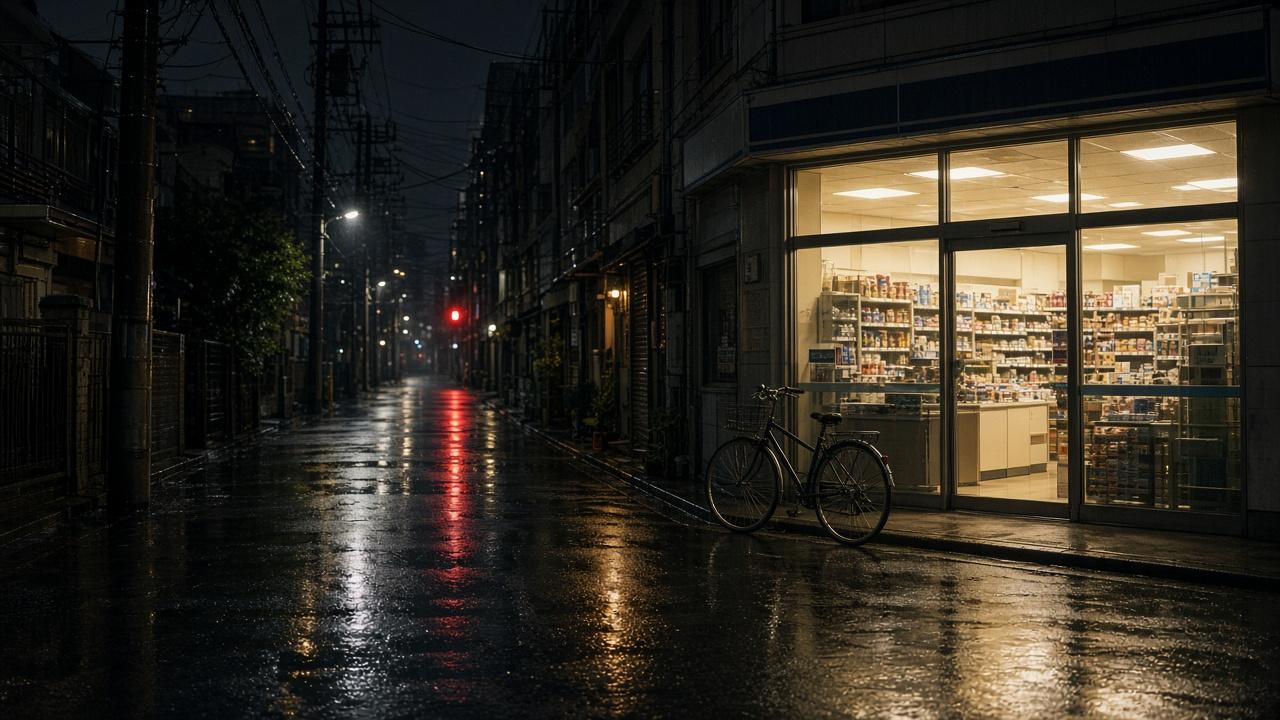
At the end of August 2026 Japan had 56,189 convenience stores, about one for every 2,200 people. Visitors know them for egg sandwiches and midnight onigiri. Residents know them as the place where the tax bill gets paid, the parcel gets sent, the concert ticket gets printed and the cash comes out of the wall. The konbini is arguably the most-used piece of civic infrastructure in Japan that the state does not run. This guide explains what it is, what you can actually do there, how to behave, and why the network has quietly stopped growing.
Every country has corner shops. Japan has something else. The konbini (コンビニ, short for konbiniensu sutoa) started as an American import in 1974. Fifty years later it works as a food hall, bank branch, post counter, ticket office, print shop and, for residents, a satellite of city hall. In 2025, Japan’s convenience stores recorded 16.34 billion customer visits (Japan Franchise Association, 2025 annual summary). That works out to roughly 44.8 million visits a day, or the equivalent of more than a third of the country walking through the automatic doors every day (our calculation, using the Statistics Bureau’s September 2026 population estimate of 122.65 million).
The Japanist reads the konbini the way we read any national institution: through official numbers first, then through what they mean for someone standing at the counter. Whether you are here for ten days or ten years, knowing what these stores can do will save you time, money and at least one trip to a bank that closes at 3 p.m.
The short answer
A konbini is a small, usually 24-hour, franchise-run store selling fresh ready meals, drinks and daily goods. It also handles a remarkable range of services: cash withdrawals, bill and tax payments, parcel shipping, event tickets, printing and, for registered residents, official certificates. Three chains run about 94% of the stores. For visitors the practical headline is simple: the nearest 7-Eleven is usually the easiest place to withdraw yen with a foreign card, and almost every other errand you might need has a konbini version.
-
56,189 stores
Convenience stores in the JFA survey of seven major chains, end of August 2026 (+0.5% year on year).
-
~1 per 2,200 people
Our calculation from the JFA count and a population of 122.65 million (September 2026 estimate).
-
¥12.06 trillion
Sales in 2025, from 16.34 billion visits at an average spend of ¥737.9 (JFA).
-
1 billion+ payments a year
Utility bills, taxes and online-shopping invoices paid at the counter: about 1.09 billion payments worth about ¥13 trillion in FY2022.
-
85.3% of visitors
Share of overseas visitors who shopped at a konbini in 2025, ahead of every other kind of shop (Japan Tourism Agency).
(JFA monthly report, August 2026; JFA 2025 annual summary; JFA and Japan Public Affairs Association, Regulatory Reform Council material, October 2024; Japan Tourism Agency, Inbound Consumption Survey 2025)
How a corner shop became national infrastructure
The first 7-Eleven in Japan opened in May 1974 in Toyosu, Kōtō Ward, Tokyo. It was a franchise from day one. By the company’s own account, the first thing it sold was a pair of sunglasses, to a man who turned up before opening time. Early stores ran from 7 a.m. to 11 p.m., as the name promised. The first 24-hour 7-Eleven opened in 1975 in Fukushima Prefecture (Seven-Eleven Japan 50th anniversary archive).
What turned an American format into a Japanese institution was food. Seven-Eleven Japan says its early wrapped onigiri sold two or three a day before the crisp-seaweed packaging caught on. Counter oden followed in 1979. In the company’s own words, rice balls went from something you made to something you bought. Behind the counter sat a logistics rethink. Before 7-Eleven persuaded suppliers to share trucks, a single store could receive as many as 70 deliveries a day (same archive). Shared delivery, together with sales data from every till, is what lets a small shop stock fresh food several times a day.
Then came the services. Paying bills over the counter, known as shūnō daikō (収納代行), sounds dull. It is the reason the konbini became part of the state’s plumbing. The industry told the government’s Regulatory Reform Council in 2024 that convenience stores handle more than a billion payments a year. It put FY2022 at about 1.09 billion payments worth roughly ¥13 trillion (JFA and Japan Public Affairs Association). 7-Eleven alone processed 527 million payments worth ¥6.27 trillion in the year to February 2026 (Seven & i Holdings IR).
Japan stopped adding konbini around 2017
Convenience stores in the JFA survey at the end of each December, 2005–2025, and at the end of August 2026. Bars start at zero.
+33%
Store count, December 2005 to December 2015
+1.0%
December 2019 to August 2026: the network has effectively stopped growing
Source: Japan Franchise Association (JFA), convenience store statistics time series 2005–2016 and 2017–2025, and August 2026 monthly report (published 2026-09-24). JFA member chains: seven today; more in earlier years.
The chart shows the other half of the story. From 2005 to 2015 the JFA’s store count rose by about a third, from 39,966 to 53,004. Since 2019 it has barely moved: 55,620 then, 56,189 in August 2026 (JFA time series, 2005–2016; 2017–2025). Japan did not stop needing konbini. It ran out of places to put new ones.
The big three, and why the chain matters
Most visitors assume one konbini is as good as another. For snacks, that is broadly true. For services it is not, because each chain has its own ATM network, parcel partner and in-store kiosk.
Who runs Japan’s konbini
Domestic stores by chain at the end of February 2026 (total 56,149). Shares calculated by The Japanist.
7-Eleven
incl. Okinawa · Seven Bank ATMs
21,927
39.1%
FamilyMart
Famima ATM rollout since June 2026
16,415
29.2%
Lawson
Loppi kiosk · Yu-Pack
14,697
26.2%
All other chains
Ministop, Seicomart, Daily Yamazaki, Poplar and others
3,110
5.5%
The big three run 53,039 of 56,149 stores (94.5%). The chain decides which ATM, parcel service and ticket kiosk you will find.
Source: Seven & i Holdings IR, 主要コンビニエンスストアチェーンの国内店舗数の推移 (FY2025), citing the JFA monthly survey and company disclosures. The JFA’s August 2026 total (56,189) is a later month.
At the end of February 2026, 7-Eleven had 21,927 domestic stores, FamilyMart 16,415 and Lawson 14,697. Every other chain combined had 3,110 (Seven & i Holdings IR, citing JFA and company data). The smaller members of the JFA survey are Ministop, Seicomart, Daily Yamazaki and Poplar (JFA). You will meet Seicomart mostly in Hokkaido.
What the chain decides for you:
| ATM | Seven Bank; accepts many foreign-issued cards | Seven Bank “Famima ATM” rolling out since June 2026 | Lawson Bank; some machines accept foreign cards |
|---|---|---|---|
| Parcels | Yamato (Kuroneko) | Yamato (Kuroneko) | Japan Post Yu-Pack; post box and stamps |
| Kiosk / copier | Multi-copy machine | Multi-copy machine | Loppi terminal + multi-copy machine |
(Sources: Seven Bank; FamilyMart, 1 June 2026; Lawson Bank FAQ; Yamato Transport FAQ; Lawson Yu-Pack service; National Tax Agency)
What you can actually do at a konbini
For visitors
-
Withdraw yen with a foreign card
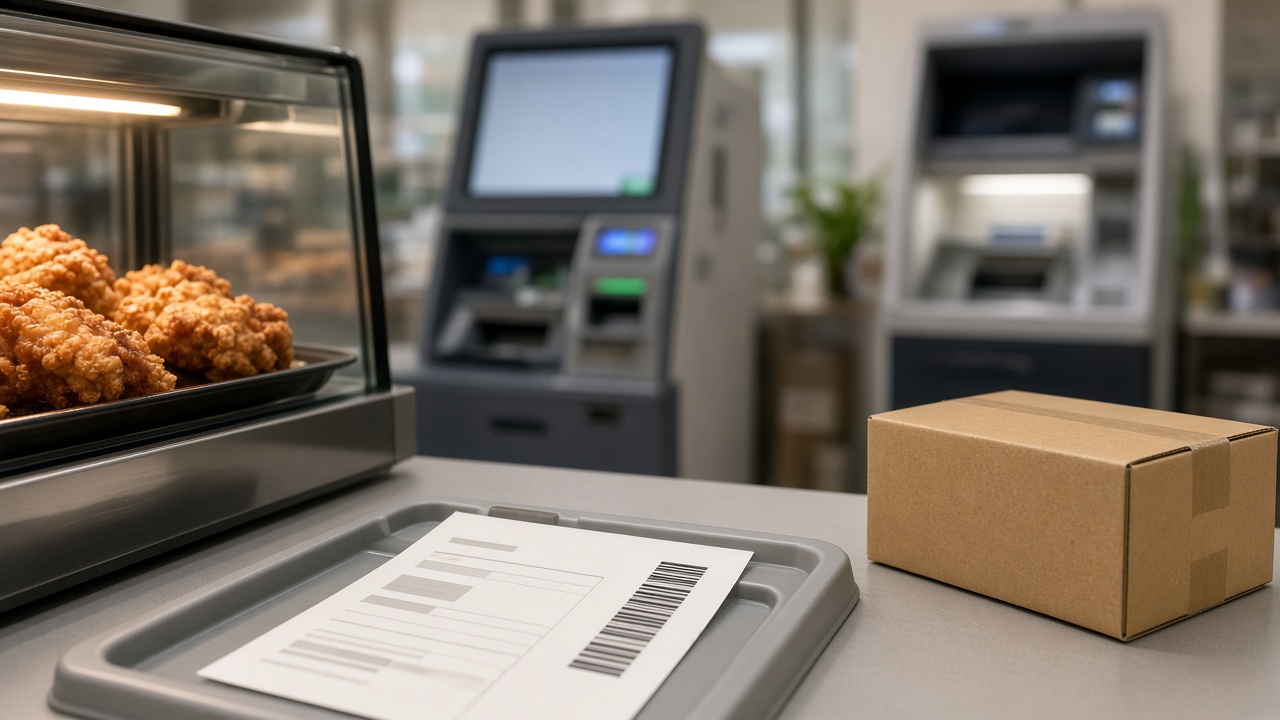
Seven Bank had 28,689 ATMs at the end of August 2026, mostly inside 7-Eleven stores. It says they accept many foreign-issued cards around the clock, though some cards with the right logos still fail. Since 1 June 2026, Seven Bank machines branded “Famima ATM” have been going into FamilyMart stores, starting in Tokyo and Saitama. About 16,000 are planned over roughly four years, and they also take foreign cards. Some Lawson Bank ATMs accept overseas Visa, Mastercard, JCB and UnionPay cards.
-
Eat well, cheaply, at any hour
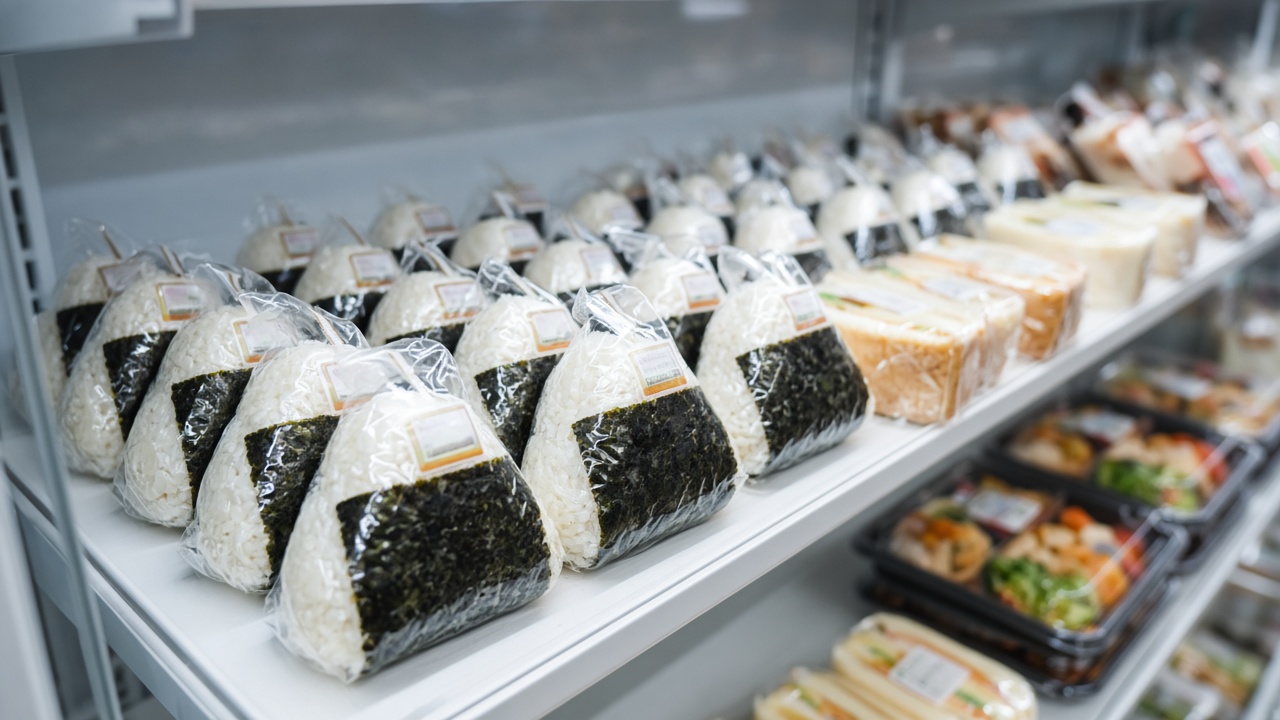
Onigiri, bento, sandwiches, noodles, salads, hot counter snacks and coffee. In August 2026, daily fresh food such as rice, bread, prepared dishes and dairy made up 35.3% of existing-store sales, the largest category.
-
Store a suitcase
Some 7-Eleven stores take bags, including suitcases too big for coin lockers, through the ecbo cloak booking app. You reserve and pay in advance.
-
Buy or collect tickets
7-Eleven’s multi-copy machines print tickets from Seven Ticket, Ticket Pia and e+. Lawson’s Loppi terminals handle Tokyo Disney Resort, highway-bus and leisure tickets, among others.
-
Print, scan, copy
At 7-Eleven, A4 printing from your phone costs ¥20 in black and white and ¥50 in colour. ID-photo prints cost ¥250 but are not suitable for passport applications.
-
Change leftover foreign cash
Some Lawson stores have automatic exchange machines that turn 12 to 14 major currencies into yen, one way only.
(Seven Bank August 2026 data; Seven Bank foreign cards; FamilyMart; ITmedia NEWS; Lawson Bank; JFA August 2026; 7-Eleven luggage storage; 7-Eleven tickets; Lawson Loppi; 7-Eleven printing; Lawson currency exchange)
For residents
This is where the konbini stops being a shop and becomes a public counter.
-
1
Pay utility bills and local taxes
Most payment slips with a barcode can be paid at the till: electricity, gas, water, phone, online-shopping invoices, and many municipalities’ resident, property and car taxes. Check the slip for its konbini deadline.
-
2
Pay National Pension premiums
The Japan Pension Service accepts premiums at 7-Eleven, FamilyMart, Lawson, Ministop, Seicomart, Daily Yamazaki, Poplar and others, with no fee. The FY2026 monthly premium is ¥17,920. A slip over ¥300,000 cannot be paid at a konbini.
-
3
Pay national taxes by QR code
Make a QR code on the National Tax Agency website and scan it at a Loppi terminal (Lawson, Natural Lawson, Ministop) or a FamilyMart multi-copy machine. It works up to ¥300,000, in cash only, and you get a payment receipt rather than an official tax receipt.
-
4
Print official certificates
With a My Number Card, or a smartphone with its certificate loaded, you can print a residence certificate (住民票) and other documents at the copier, if your municipality takes part. As of April 2025, 1,378 of 1,741 municipalities did, covering 97.8% of the population. Konbini printed 35.7 million certificates in FY2024.
-
5
Send and receive parcels
Yamato parcels go from 7-Eleven and FamilyMart, and Yu-Pack from Lawson. Yamato’s refrigerated (cool) parcels cannot be sent from a konbini. Many online shops let you pick up at a store.
(Japan Pension Service; National Tax Agency; J-LIS konbini certificates; Ministry of Internal Affairs and Communications, May 2025; Yamato Transport; Lawson Yu-Pack)
One habit matters more than any single service. Keep the stub the clerk hands back. It is your proof of payment, and it can take time for a konbini payment to reach the city’s or pension office’s records. For long-term residents, those stubs are more than housekeeping. Japan’s permanent residency rules now weigh on-time tax, pension and health-insurance payments heavily, and a shoebox of receipts can settle a question that a missing record cannot.
Konbini etiquette: the unwritten rules
Konbini staff are fast, polite and trained to a script. You will move through smoothly if you know the other half of that script.
-
1
Queue once, then step up
There is usually one line for all tills. Wait to be called with “Tsugi no kata, dōzo” (next, please).
-
2
Use the tray
Put cash in the small tray on the counter rather than handing it over. Change comes back the same way, often with the notes counted out in front of you.
-
3
Answer the three questions
Atatamemasu ka? (shall I heat it?), Ohashi / supūn wa? (chopsticks or a spoon?) and Fukuro wa? (do you need a bag?). A nod or “Daijōbu desu” (I’m fine) covers most answers.
-
4
Bags cost money
Plastic shopping bags have carried a charge across Japan since 1 July 2020. Each shop sets its own price. Bring your own if you can.
-
5
Say if you will eat in
Eating in the store’s eat-in area is taxed as dining out at 10%. Take-out food is taxed at 8%, so staff rely on you to say which. A Cabinet-approved outline would cut the tax on food to 1% from April 2027 to March 2029 if the Diet passes it. Dining out stays at 10%, so the gap would widen to nine points.
-
6
ID for alcohol and tobacco
The drinking and smoking age is still 20, even though adulthood moved to 18 in 2022. Expect to tap an age-confirmation screen, and to be asked for ID if you look young.
-
7
Bins are for what you bought
The bins by the door are for rubbish from the store’s own products, not for household waste.
-
8
Ask before using the toilet
Many stores let customers use the toilet. Ask first, and buy something as a courtesy.
(METI, plastic bag charge; National Tax Agency, reduced-rate Q&A on konbini eat-in (Q52); National Tax Agency, planned two-year cut to the tax on food; Government of Japan, age of majority)
A softer rule: many Japanese people avoid eating while walking along a busy street. Standing just outside the door with your coffee is normal. Wandering through a shrine with an open cup of noodles is not.
The konbini asks almost nothing of you: say whether you want it heated, whether you need a bag, and whether you will eat it here. Everything else is already done.
More than a shop: disasters and neighbourhood safety
On 1 July 2017 the Cabinet Office named Seven-Eleven Japan, Lawson and FamilyMart designated public institutions (指定公共機関) under the Disaster Countermeasures Basic Act. Seven & i Holdings, Ito-Yokado, AEON and UNY were named at the same time (Cabinet Office). That puts the chains in the same legal category as utilities and broadcasters. They must make disaster plans and help deliver relief supplies when the government asks. After a disaster, in other words, the chains are part of the official supply chain, not bystanders to it. Our earthquake guide covers what to do in the first minutes. The konbini is often where the next few days get organised.
On an ordinary night, stores work as Safety Stations under a JFA programme. In the 2025 survey, stores reported sheltering women more than 4,780 times and children more than 3,643 times. They helped older people, for example someone wandering or taken ill, more than 16,862 times. And they stopped special fraud more than 20,302 times, most often when a clerk questioned someone buying a suspiciously large amount of prepaid e-money (JFA Safety Station report, 2025 edition).
The network has stopped growing, and it is changing shape
The bright, always-open image hides an industry under strain. Four trends are worth knowing.
1. Fewer visits, bigger baskets. Customer visits peaked in 2019 at 17.46 billion. In 2025 they were 6.4% lower, and they fell year on year again in August 2026. Sales still hit a record because the average spend per visit climbed from ¥639 in 2019 to ¥738 in 2025, and ¥763 in August 2026 (JFA).
Fewer visits, bigger baskets
Annual customer visits and average spend per visit (tax excluded), all stores in the JFA survey, 2015–2025. Bars start at zero; 2019 and 2025 highlighted.
2015
2016
2017
2018
2019
2020
2021
2022
2023
2024
2025
−6.4%
visits, 2025 vs 2019
+15.4%
average spend
+8.0%
sales (¥11.16tn → ¥12.06tn)
Source: Japan Franchise Association (JFA), convenience store statistics time series 2005–2016 and 2017–2025, and August 2026 monthly report (published 2026-09-24). JFA member chains: seven today; more in earlier years. Percentage changes calculated by The Japanist.
2. The building boom is over. 7-Eleven opened 1,651 stores in FY2015 and 540 in FY2025, while closing 370 (Seven & i Holdings IR). Stores still open, close and relocate all the time. What has changed is the net growth.
3. The 24-hour model is no longer sacred. In February 2019, a 7-Eleven franchise owner in Higashi-Osaka cut his store’s night hours because he could not staff them. His standoff with head office became a national argument about whether every store must stay open all night (Nikkei). A METI survey of franchise owners published that March found about 61% said they were short of staff (Ryutsu News, summarising METI). Most stores still never close, though. 86.4% of Lawson’s domestic stores were open 24 hours in February 2026, and 89.7% of FamilyMart’s in May 2025 (Lawson; FamilyMart). So “open 24/7” is a very good bet, not a guarantee. Check the store page before a 3 a.m. errand in a small town.
4. Labour, machines and money. The industry has asked since 2018 for convenience-store work to be added to the Specified Skilled Worker visa (Mainichi; JFA material to the Regulatory Reform Council). It is still not one of the 19 fields confirmed in January 2026 (Immigration Services Agency). Chains are turning to self-checkout and staff-light formats instead. FamilyMart, for example, offers gated stores where customers pick items and pay at a screen without meeting a clerk (FamilyMart). Ownership is shifting too. Alimentation Couche-Tard dropped its roughly $46 billion bid for 7-Eleven’s parent, Seven & i, in July 2025 (Reuters). The Famima ATM deal now links FamilyMart to Seven Bank. Sankei reports that Seven Bank expects to pass Japan Post Bank as the country’s largest ATM operator once the rollout is complete (Sankei).
For a visitor, none of this changes tonight’s dinner. For a resident, it explains why a favourite store might shorten its hours, why so many clerks in the cities are international students (a reliance the industry itself describes in its visa lobbying), and why the ATM in the FamilyMart down the road may suddenly turn green.
Rural Japan: when the nearest konbini is a drive away
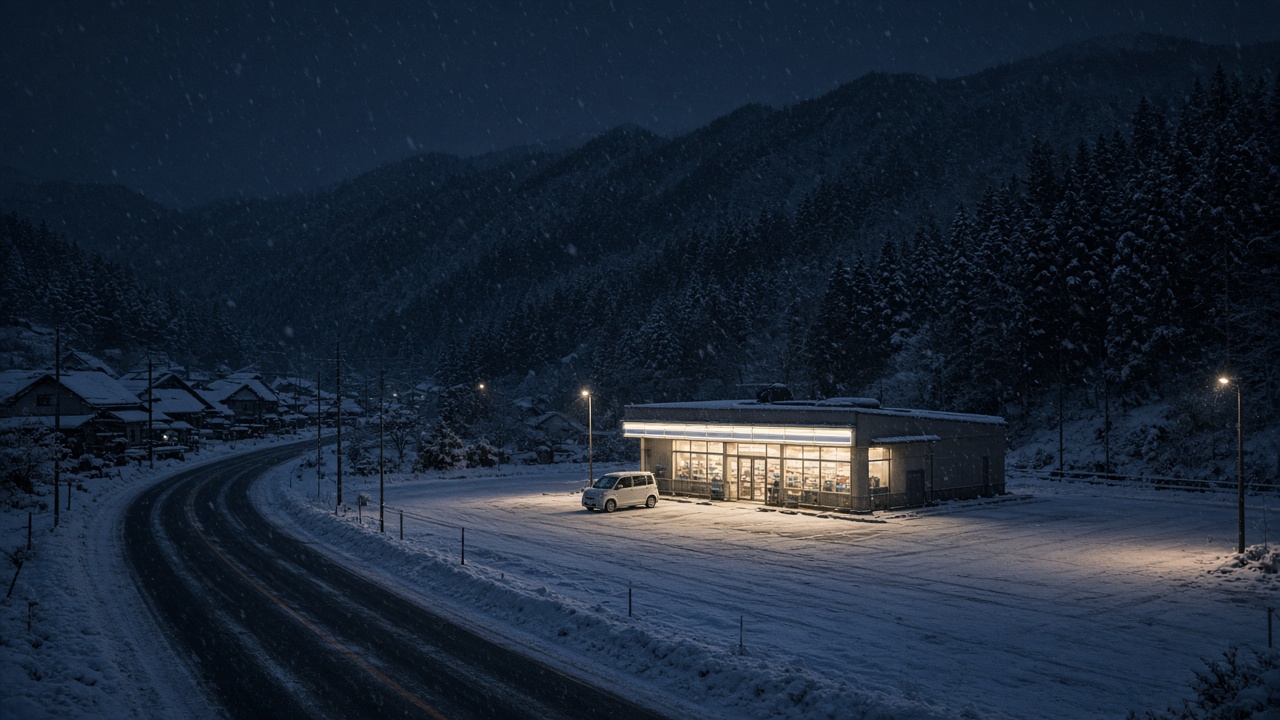
About one store for every 2,200 people is a national average, and averages hide geography. Stores cluster where people are. The Ministry of Land, Infrastructure, Transport and Tourism (MLIT) has estimated how large a municipality must be before it is more likely than not to have even one convenience store. Outside the three big metropolitan areas, that point is around 2,200 residents (MLIT data on regional living areas). In 2015, 7% of those municipalities were smaller than that. On population projections, MLIT expects 20% to be smaller by 2050 (MLIT White Paper 2021). That is a forecast about population, not about store closures, but the direction is clear.
Distance matters as much as population. The agriculture ministry’s research institute counts older people as having poor food access if they live 500 metres or more from a food shop (convenience stores included) and find it hard to use a car. It estimated 9.04 million people aged 65 and over were in that position in 2020, a quarter of that age group (MAFF Policy Research Institute). In those places the konbini is not a convenience. It is the nearest ATM, the nearest parcel desk and the nearest place to pay the water bill.
If you are thinking of living in rural Japan, that makes the nearest konbini a surprisingly useful test of a place. Our sister site Akiya X, which lists rural vacant homes, has published a practical guide: Japan’s Konbini and Your Akiya: Why the Nearest Convenience Store Matters. It covers how to check the real distance from a listing, which chain decides your ATM and parcel options, what owners who live abroad can and cannot do at the counter, and how to read a recent closure. It pairs well with our own look at Japan’s akiya opportunity.
A konbini checklist for your first week
-
1
Find your 7-Eleven
Note the nearest one to your hotel or flat for foreign-card cash. Treat FamilyMart’s new green Famima ATMs and some Lawson Bank machines as backups, and carry a second card.
-
2
Carry a bag and small coins
Plastic bags cost extra, and coins speed things up at the tray.
-
3
Use the kiosk for tickets
Concert, theme-park and bus tickets bought online can often be collected or paid for at the copier or Loppi.
-
4
Travel lighter
Book ecbo cloak storage at a participating 7-Eleven, or send a bag onward by takkyūbin from 7-Eleven or FamilyMart.
-
5
Residents: keep every stub
Tax, pension and utility receipts are your proof of payment. They matter more than ever for visa renewals and permanent residency.
-
6
Outside the cities, plan ahead
Do not assume the next town has a 24-hour store. Check hours, and top up cash where you can.
FAQ
How many convenience stores are there in Japan?
The Japan Franchise Association counted 56,189 at the end of August 2026 across the seven major chains in its survey, about one for every 2,200 people. At the end of February 2026, 7-Eleven had 21,927 domestic stores, FamilyMart 16,415 and Lawson 14,697.
Can I withdraw cash with a foreign card at a Japanese convenience store?
Usually, yes. Seven Bank ATMs, found in 7-Eleven stores (28,689 machines at the end of August 2026), accept many foreign-issued cards, though not every card works. Seven Bank machines branded Famima ATM have been going into FamilyMart stores since 1 June 2026, and some Lawson Bank ATMs accept overseas Visa, Mastercard, JCB and UnionPay cards.
Are Japanese convenience stores open 24 hours?
Most are, but not all. 86.4% of Lawson’s domestic stores (February 2026) and 89.7% of FamilyMart’s (May 2025) were open 24 hours. Check the chain’s store page before a late-night trip, especially outside the big cities.
Can you pay bills and taxes at a konbini?
Yes. Barcoded slips for utilities, many local taxes and National Pension premiums can be paid at the counter, generally up to ¥300,000 per slip. National taxes can be paid at Lawson, Ministop and FamilyMart with a QR code from the National Tax Agency, in cash only and up to ¥300,000.
Is it OK to eat inside a Japanese convenience store?
Only in the eat-in area, if the store has one. Tell the clerk you will eat in: eat-in food is taxed at 10% and take-out at 8%. Under a plan approved by the Cabinet in September 2026, take-out food would drop to 1% from April 2027 to March 2029 if the Diet passes it, while dining out would stay at 10%.
Are there convenience stores in rural Japan?
In most places, yes, but coverage thins with population. MLIT estimates that outside the big metropolitan areas a municipality needs roughly 2,200 residents before it is more likely than not to have a store. If you are considering a home in the countryside, Akiya X’s nearest-konbini guide explains how to check.
Can I send luggage or parcels from a konbini?
Yes. Yamato (Kuroneko) parcels can be sent from 7-Eleven and FamilyMart, and Japan Post Yu-Pack from Lawson. Yamato’s refrigerated (cool) parcels cannot be sent from a convenience store, and size limits apply.
Bottom line
Japan’s 56,189 convenience stores are the country’s most visited public counters, even though none of them is public. They feed people at 3 a.m., dispense yen to foreign cards, take more than a billion bill payments a year, print residence certificates and ship parcels. By law, the largest chains are part of the disaster response. For visitors, one well-chosen stop can solve the cash, ticket and bag problems of a whole trip. For residents, the counter is where much of the paperwork of life in Japan gets done.
The network is also at a turning point. The store count has flattened, visits are below their 2019 peak, the night shift is harder to staff, and the countryside is thinning out faster than any chain can follow. The konbini will stay. Whether it stays everywhere is the more interesting question.
Japan built a convenience store for every 2,200 people. The next decade decides whether that math still works in the towns that need one most.
Sources and further reading
- Japan Franchise Association (JFA) — Convenience store statistics, August 2026 monthly report (published 24 September 2026: 56,189 stores; 1.41 billion visits, −1.5%; average spend ¥762.6; daily fresh food 35.3% of existing-store sales); 2025 annual summary (¥12.058 trillion sales; 16.34 billion visits; ¥737.9 average spend; 56,054 stores at end-2025); time series 2005–2016 and 2017–2025 (December store counts; annual visits and average spend); statistics index
- Seven & i Holdings IR — Domestic convenience store data, FY2025 (store counts by chain at end-February 2026; 7-Eleven openings and closures, FY2015–FY2025; 527.06 million bill payments worth ¥6.27 trillion)
- Seven-Eleven Japan — 50th anniversary archive (first store May 1974, Toyosu; first 24-hour store 1975, Fukushima; onigiri and oden history); printing; tickets; luggage storage
- JFA and Japan Public Affairs Association — Konbini bill collection, Regulatory Reform Council material (9 October 2024: more than 1 billion payments a year; about 1.09 billion worth about ¥13 trillion in FY2022)
- Statistics Bureau of Japan — Population estimates (24 September 2026: 122.65 million, September 2026 provisional)
- Japan Tourism Agency — Inbound Consumption Survey, 2025 annual report (85.3% of visitors shopped at a convenience store)
- Seven Bank — August 2026 monthly data (28,689 ATMs); foreign-issued cards
- FamilyMart — Famima ATM launch, 1 June 2026 (about 16,000 ATMs over roughly four years); Q1 FY2025 operating overview (89.7% of stores open 24 hours, May 2025); store counts; ITmedia NEWS — Famima ATM features (foreign-card withdrawals); Sankei Shimbun — Famima ATM launch
- Lawson — Q4 FY2025 operating overview (12,693 of 14,697 domestic stores open 24 hours); Yu-Pack; Loppi services; currency exchange machines; Lawson Bank — overseas cards FAQ
- Yamato Transport — Sending parcels from convenience stores
- Japan Pension Service — Paying National Pension premiums by slip (konbini list; no fee; ¥300,000 limit; FY2026 monthly premium ¥17,920)
- National Tax Agency — Konbini payment by QR code; Reduced-rate Q&A, Q52 (konbini eat-in); Planned two-year cut to the tax on food (1% from 1 April 2027 to 31 March 2029, subject to legislation)
- J-LIS — Konbini certificate issuance; Ministry of Internal Affairs and Communications — Working group material, May 2025 (1,378 of 1,741 municipalities; 97.8% population coverage; 35.7 million certificates in FY2024)
- Cabinet Office (Disaster Management) — Additional designated public institutions (27 June 2017, effective 1 July 2017)
- JFA — Safety Station survey report, 2025 edition
- METI — Plastic shopping bag charge from 1 July 2020; Ryutsu News — METI franchise owner survey: 61% short of staff (26 March 2019); Nikkei — 7-Eleven 24-hour dispute (February 2019)
- Immigration Services Agency — Specified Skilled Worker field policies (19 fields, 23 January 2026); Mainichi Shimbun — Industry asks for konbini to be added (2018); JFA — Material to the Regulatory Reform Council
- Reuters — Couche-Tard withdraws Seven & i bid (July 2025)
- MLIT — Data on regional living areas (store-presence probability by municipal population); White Paper 2021 (7% in 2015 to 20% in 2050); MAFF Policy Research Institute — 2020 food-access estimate (9.04 million)
- Government of Japan — Age of majority and what stays at 20
- Akiya X — Japan’s Konbini and Your Akiya: Why the Nearest Convenience Store Matters (for readers considering a home in rural Japan)
- The Japanist — Earthquakes in Japan; Japan’s permanent residency overhaul; Navigating Japan’s akiya opportunity
Method note: Store, sales, visit and spend figures are JFA survey totals for its member chains (seven today; the membership was larger in earlier years, so read the long-run trend as indicative). Chain counts come from Seven & i Holdings’ compilation at the end of February 2026, which is a different month from the JFA’s August 2026 total. “About one store per 2,200 people” and “44.8 million visits a day” are our calculations. Services, fees and limits vary by chain, store and municipality, so check with the chain or your city hall before relying on one.
Continue Reading
Silver Week in Japan: What It Is, Why 2026 Is Five Days, and What People Actually Do
Japan’s third full five-day Silver Week since 2009 and 2015 runs 19–23 September 2026: Respect for the Aged Day, a Citizens’ Holiday sandwich, and the Autumnal Equinox—what it is, what families do, and how travellers should handle trains, Tokyo, and Nagoya.

Japan’s Autumn Foliage 2026: The Ultimate Guide to Chasing Kōyō Across Japan
The first 2026 kōyō call is in: late or on average, Tokyo maple 29 November, Kyoto city 11 December. How the colour travels, why a city date is not a temple date, Silver Week’s five-day collision, and how to plan a trip that follows the leaves.
Earthquakes in Japan: The Complete Guide for Visitors and Residents
What Japan's earthquakes actually mean for you—how the Shindo scale works, what the early warning can and cannot do, what to do in a hotel, mall, train or on the coast, and how building age decides whether a house survives. With official data and the lessons of Kobe, Tōhoku, Kumamoto and Noto.

If you're looking for nicely crafted Japan tours, check out: Arigato Travel’s experiences.