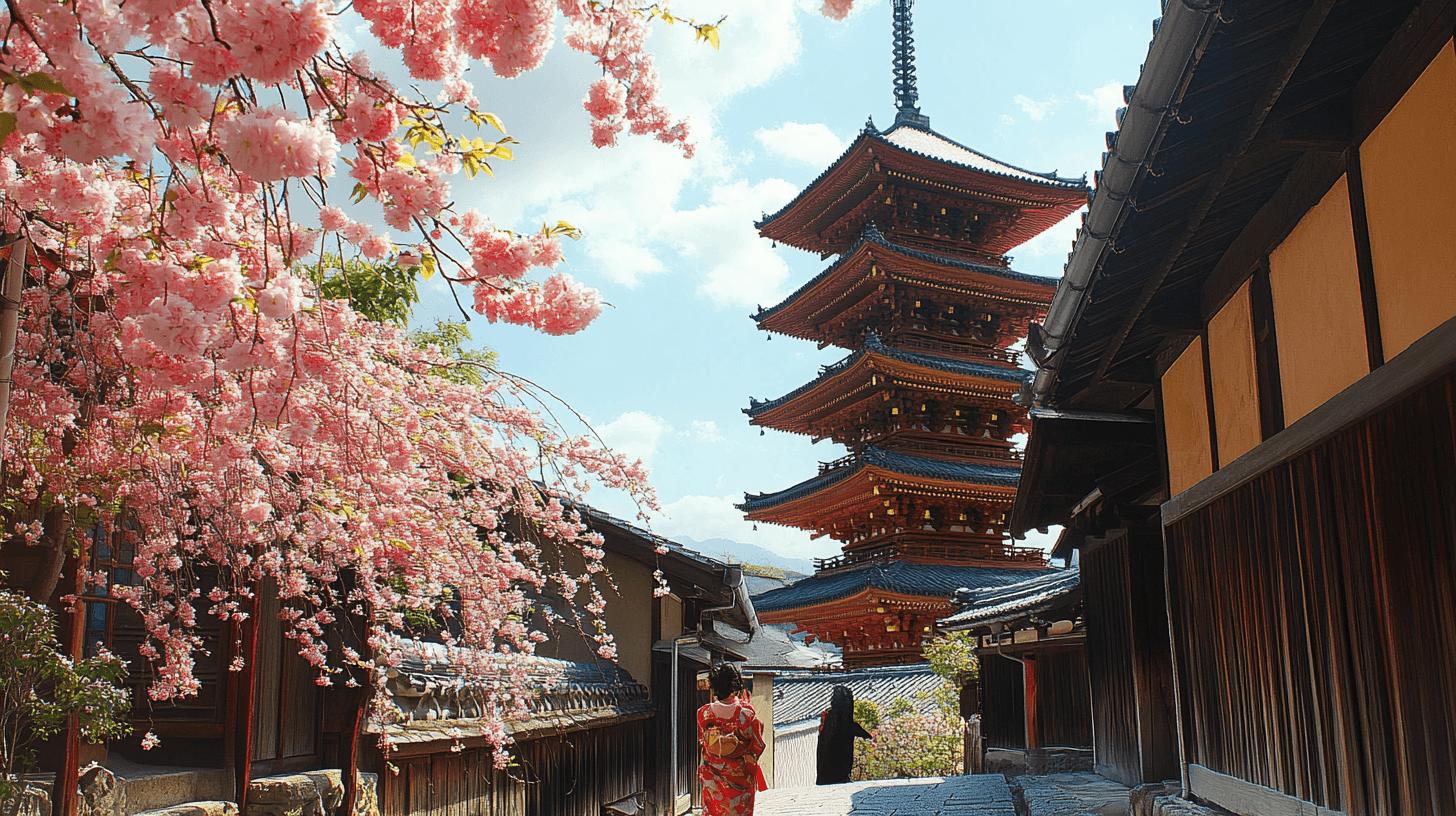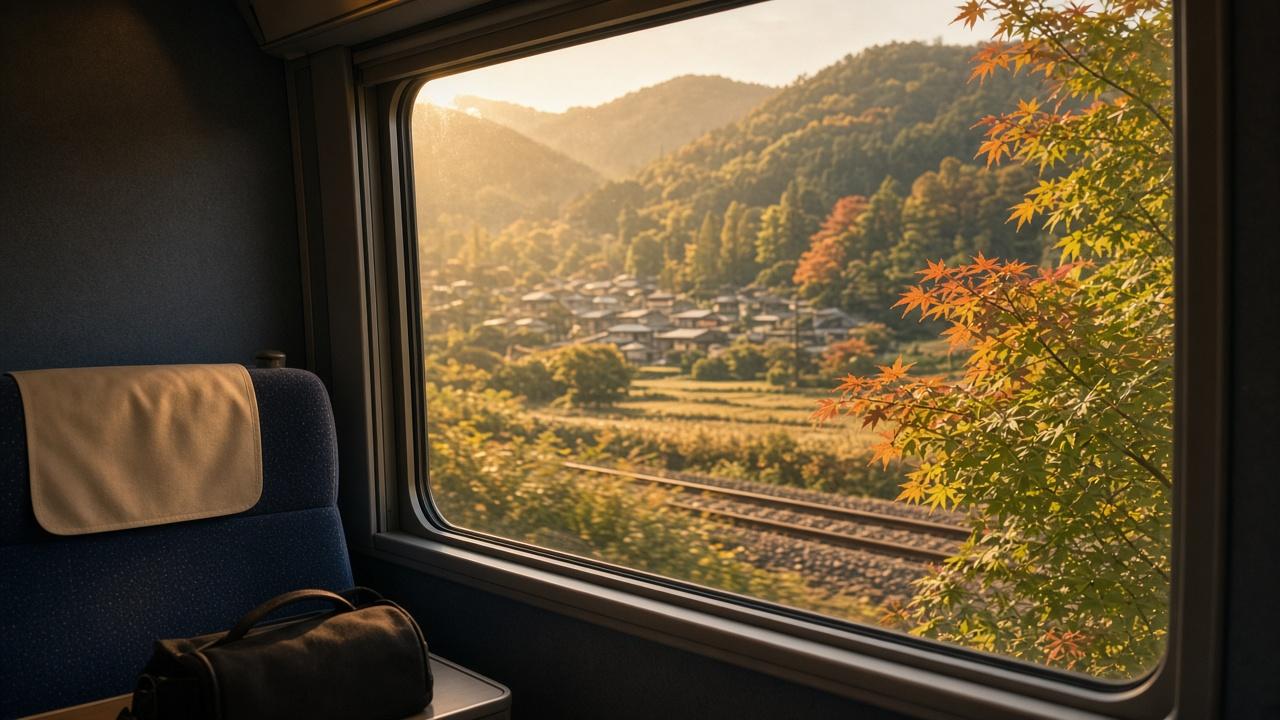
Silver Week in Japan: What It Is, Why 2026 Is Five Days, and What People Actually Do
If you are in Japan on Monday 21 September 2026, you are inside a rare autumn long break—Japan’s third full five-day Silver Week after 2009 and 2015. The name sounds like a second Golden Week. The calendar mechanics, the mood, and what Japanese people actually do with the days are quieter, more specific, and easier to misuse if you only know the nickname.
Japan’s travel year is shaped by a handful of domestic surges: New Year, Golden Week, Obon, and—when the September holidays align—Silver Week (シルバーウィーク). In most years the September cluster is a short Respect-for-the-Aged weekend. In 2026 it stretches from Saturday 19 September through Wednesday 23 September: five consecutive days off for much of the country.
That stretch is not a permanent fixture on the Cabinet Office calendar. It appears when Respect for the Aged Day (敬老の日, Keirō no Hi) and Autumnal Equinox Day (秋分の日, Shūbun no Hi) fall two days apart, and Japan’s Holiday Act turns the weekday between them into a holiday under Article 3, paragraph 3—commonly nicknamed a Citizens’ Holiday (国民の休日, kokumin no kyūjitsu). It is not a 振替休日 (furikae kyūjitsu, substitute holiday for a Sunday holiday). Nippon.com counts 17 national holidays for 2026 instead of the usual 16 (Cabinet Office still defines 16 named 国民の祝日 and lists 22 September as a separate 休日 under Art. 3(3)), and frames this as only the third full five-day Silver Week after 2009 and 2015.
This guide is culture plus travel utility: what the week is, how the sandwich day works, what families and communities do around Respect for the Aged Day and the equinox, what Japanese people tend to do with five free days, and what visitors should expect on trains, expressways, in Tokyo, and around Nagoya while the Asian Games are on—anchored in Cabinet Office / NAOJ dates and JR Central / NEXCO operating notices where those exist.
What Silver Week is—and what it is not
Silver Week is the informal autumn counterpart to Golden Week. Golden Week is the late-April / early-May cluster of fixed national holidays that almost every year produces a long break. Silver Week borrows the “Week” branding for a September cluster built around Respect for the Aged Day and the Autumnal Equinox.
The myth to retire first: Silver Week is not an annual five-day holiday.
- The name is used loosely for shorter September holiday clusters in ordinary years.
- The five-day version is rare. It needs Respect for the Aged Day (third Monday in September) and Autumnal Equinox Day to sit exactly two calendar days apart so a single weekday between them can become an Article 3(3) holiday.
- 2026 is that rare alignment. Nippon.com and the Cabinet Office sequence treat it as the third full five-day run after 2009 and 2015. Calendar projections under the current Holiday Act often cite the next five-day stretch as 2032 (Sat 18 – Wed 22 Sep); the next comparable 19–23 September twin of 2009/2015/2026 is often cited as ~2037. Equinox dates for far-future years remain NAOJ/official only when published the prior February—these figures are widely reported calendar arithmetic, not a Cabinet Office forecast.
A soft note on the name
“Silver Week” is wasei-eigo (和製英語)—Japanese-made English—usually traced to the film company Daiei in the 1950s, when executives who helped popularise “Golden Week” also tried an autumn “Silver Week” marketing label (originally around Culture Day, not September). The September sense of the phrase took off around the first modern five-day alignment in 2009. Treat the etymology as soft cultural history, not statute: the Cabinet Office list does not define a holiday called Silver Week.
In other words: you are not witnessing “Japan’s usual autumn Golden Week.” You are witnessing a calendar alignment that Japan’s holiday law knows how to amplify—and that residents treat as a genuine second long break when it arrives.
Silver Week is not an annual autumn Golden Week—it is a rare September alignment, not a yearly five-day fixture.
For the wider peak-calendar map—New Year, Golden Week, Obon, Silver Week—see our 2026 peak travel periods guide. For how this week collides with early alpine colour, see the 2026 kōyō guide.
How the Holiday Act creates the sandwich day
Japan’s national holidays are set by the Act on National Holidays (国民の祝日に関する法律). Two facts matter for September 2026, as published by the Cabinet Office and underpinned by the National Astronomical Observatory of Japan (NAOJ) 暦要項:
- Respect for the Aged Day falls on the third Monday in September—in 2026, Monday 21 September (敬老の日).
- Autumnal Equinox Day falls on the astronomical autumn equinox date for that year—in 2026, Wednesday 23 September (秋分の日).
Between them sits Tuesday 22 September. Under Article 3, paragraph 3 of the Holiday Act, a weekday that falls between two kokumin no shukujitsu (国民の祝日) becomes a holiday. The Cabinet Office 2026 table lists 22 September as 休日 with the note 祝日法第3条第3項による休日. In everyday Japanese this day is often nicknamed 国民の休日.
Do not confuse it with 振替休日. A furikae kyūjitsu is the substitute Monday (or other day) when a national holiday itself falls on a Sunday. 22 September 2026 is a sandwich / bridge day under Art. 3(3), not a Sunday-substitution holiday.
That sandwich turns two nearby holidays into three consecutive midweek days off—and, attached to the preceding weekend, into five. The same mechanism is why Nippon.com’s 2026 count rises from 16 to 17 (Cabinet: 16 named 祝日 + the Art. 3(3) sandwich 休日). The law is doing arithmetic; culture and travel behaviour do the rest.
2026 day-by-day: the practical five days
| Date | Day | Status | What it means in practice |
|---|---|---|---|
| 19 Sep | Sat | Weekend | Practical start of the five-day run; JR Central’s outbound booking peak |
| 20 Sep | Sun | Weekend | Mid-break day; still busy on popular routes |
| 21 Sep | Mon | Respect for the Aged Day (敬老の日) | National holiday; banks / government closed; family and community elder-honouring |
| 22 Sep | Tue | Art. 3(3) holiday (nicknamed 国民の休日) | Looks like a weekday; is a full holiday—JR Central’s return booking peak |
| 23 Sep | Wed | Autumnal Equinox Day (秋分の日) | National holiday; equinox / higan observances |
Practical window: Saturday 19 September – Wednesday 23 September 2026.
Nozomi all-reserved window (JR Central, official): Friday 18 September – Wednesday 23 September 2026—one day longer than the “five days off” branding, because Friday is already in the operating notice.
People who stack leave on Thursday 24 and Friday 25 can stretch the break toward nine or ten days ending on the following Sunday. When that happens, the return crush can spread beyond the statutory holidays alone.
Trap day: Tuesday 22 September. Trains run holiday timetables; banks and ward offices are closed; JR Central flags it as the shinkansen return peak—not “just a Tuesday between holidays.”
Respect for the Aged Day: what families and communities do
Respect for the Aged Day (Keirō no Hi, 敬老の日) is a national holiday whose statutory purpose, in the government’s own phrasing, is to honour elderly people who have contributed to society for many years and to celebrate longevity.
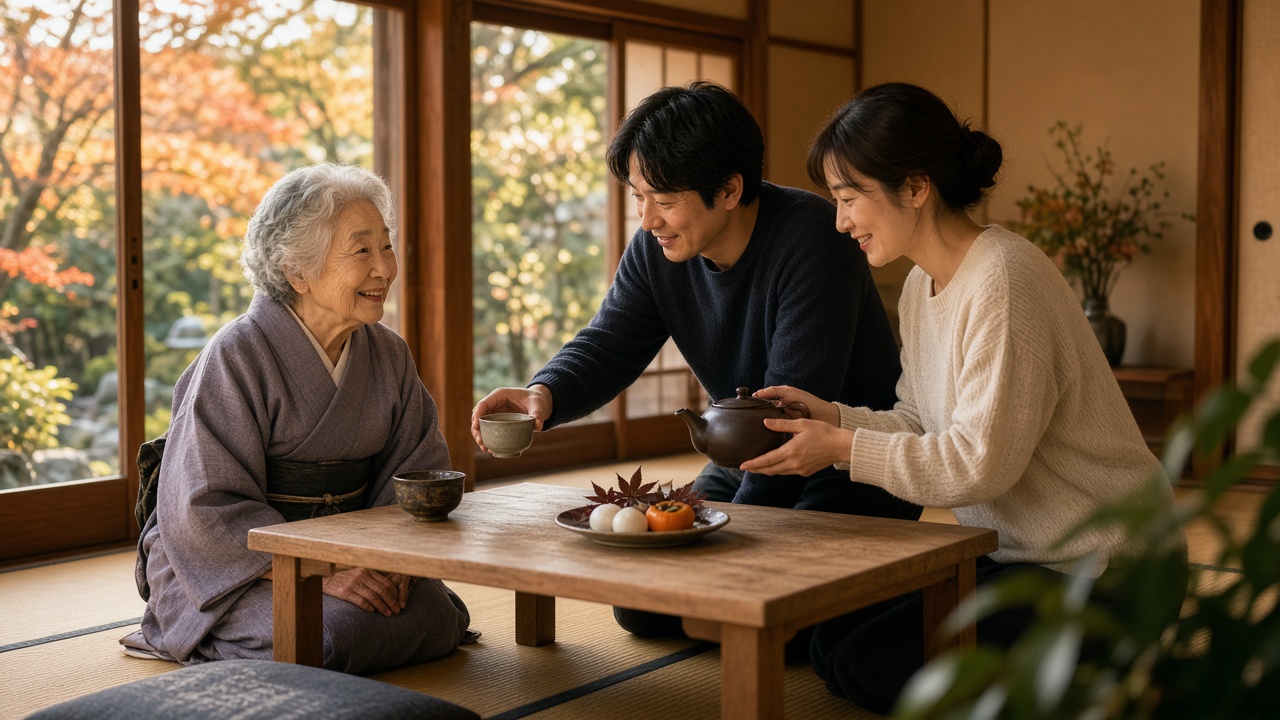
What that looks like on the ground varies by household and municipality, but the recurring patterns are steady:
- Family visits and calls. Adult children and grandchildren visit parents and grandparents, or at least telephone. Meals together—at home or at a restaurant—are common when travel allows.
- Gifts and small attentions. Practical presents, sweets, flowers, or simply time. The day is less about a single national ritual than about marking regard for elders inside the family calendar.
- Local ceremonies. Many cities and wards hold keirō events: congratulations for residents who have reached milestone ages, community lunches, performances, or certificates. These are civic and warm rather than tourist spectacles.
- Quiet public mood. It is not Obon’s lantern farewell and not Golden Week’s nationwide scramble for resort rooms—though the travel layer of Silver Week can still feel crowded. The holiday’s own emotional centre is respect and longevity, not fireworks.
For visitors, the useful takeaway is manners more than itinerary: this is a day when many Japanese people are thinking about older relatives. Crowding at departure hubs may look like “holiday chaos”; for a large share of travellers it is also the logistics of getting home to see parents.
Equinox, higan, and red spider lilies
Autumnal Equinox Day (Shūbun no Hi, 秋分の日) is both a national holiday and a hinge in the Buddhist–folk calendar. The Cabinet Office purpose language centres on honouring ancestors and remembering the deceased. NAOJ’s 暦要項 is what fixes the equinox date that the holiday follows.
Around the equinox falls higan (彼岸)—literally the “other shore”—a roughly week-long season (classically the equinox plus three days on either side) when many families visit graves, clean plots, offer flowers and incense, and hold memorial thoughts. Spring has its own higan; autumn’s lands inside Silver Week in 2026.
That overlap matters culturally:
- Silver Week is not only a vacation brand. In the middle of the five days sits a holiday explicitly about ancestors, inside a season already oriented toward graves and remembrance.
- The mood can therefore feel split: resort-bound shinkansen cars on one track; families carrying flowers toward cemeteries on another.
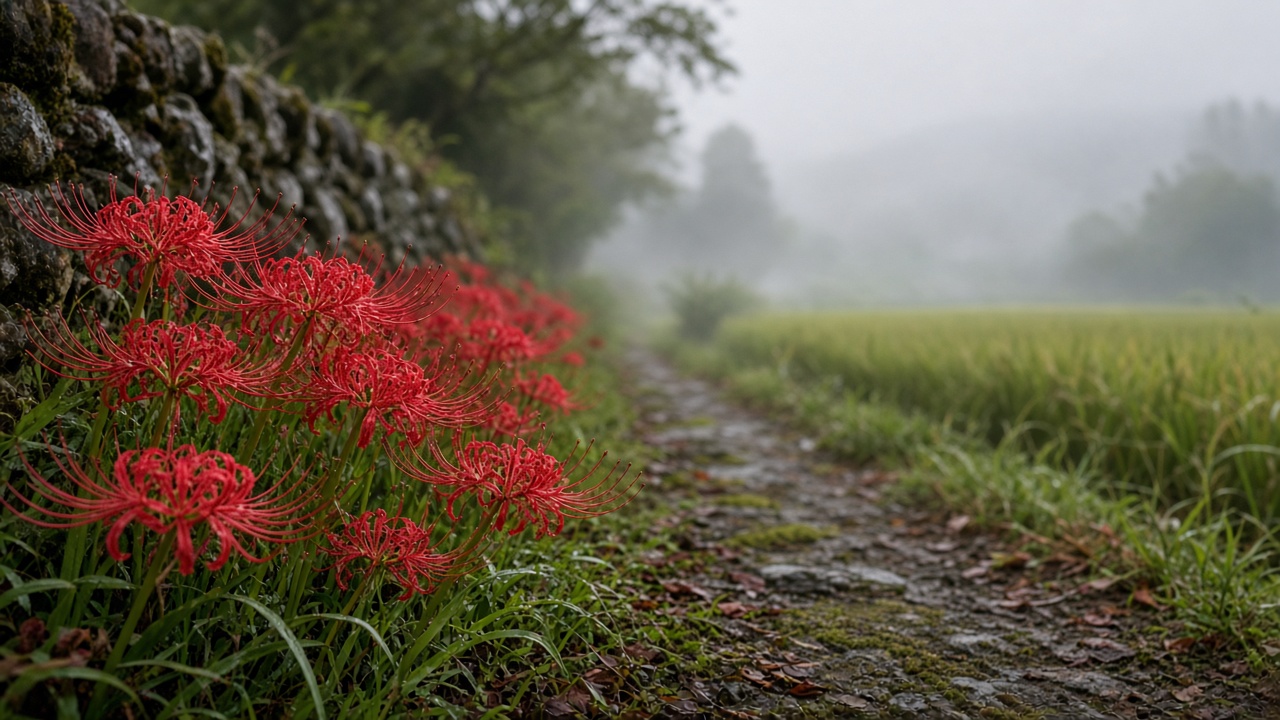
- Higanbana (彼岸花)—red spider lilies—bloom around this time and are culturally associated with higan. Fields and park plantings become seasonal markers as much as photo stops.
If Obon in August is the big midsummer homecoming for ancestors (our Obon guide), autumn higan is a quieter, equinox-timed counterpart. Silver Week 2026 stacks a rare long break on top of that quieter season—which is why the week can feel simultaneously festive and reflective.
What Japanese people actually do with the five days
There is no single national script. Behaviour clusters into a few overlapping patterns:
-
Hometown and family trips
Leave the big cities for parents’ homes, especially around Respect for the Aged Day and equinox grave visits—the Silver Week rhyme with Obon’s kisei (帰省). Shorter and less universal than Obon, but real enough that departure stations fill.
-
Autumn leisure trips
Onsen towns, early foliage in Hokkaidō and the high Alps, short escapes while the heat breaks, theme parks, and hotel stays booked months ahead. Our kōyō guide flags the Silver Week collision with early mountain peaks.
-
Leave-stacking
Office workers who take Thursday–Friday after the holidays stretch five days toward Golden Week length—extending hotel occupancy and softening (but lengthening) the return wave.
-
City life continues—with a caveat
Some neighbourhoods can feel calmer; treat “quieter Tokyo” as anecdotal, not measured emptying. What is documented: crowded departure hubs—Tokyo Station suitcase traffic on 19 September matching JR Central’s Saturday outbound peak.
-
Everyday commerce vs institutional closures
Convenience stores, restaurants, department stores, and major attractions generally stay open and often busier. Banks, post offices, and government offices close on 21–23 September. ATMs still work; museums often shift their closed day—Tuesday-looking 22 September still counts as a holiday.
Silver Week is therefore less “Japan shuts down” (New Year energy) and more “Japan redistributes”: paperwork pauses; retail keeps trading; the pressure shows up at stations, expressways, and booked lodging rather than as a shuttered capital.
What tourists should expect in 2026
Open vs closed
- Mostly open: shops, restaurants, convenience stores, big sightseeing spots, many museums (verify hours).
- Closed on 21–23 Sep: banks, post offices, ward/city offices, many other public counters.
- Do not assume Tuesday 22 is a normal weekday.
Shinkansen — JR Central (official)
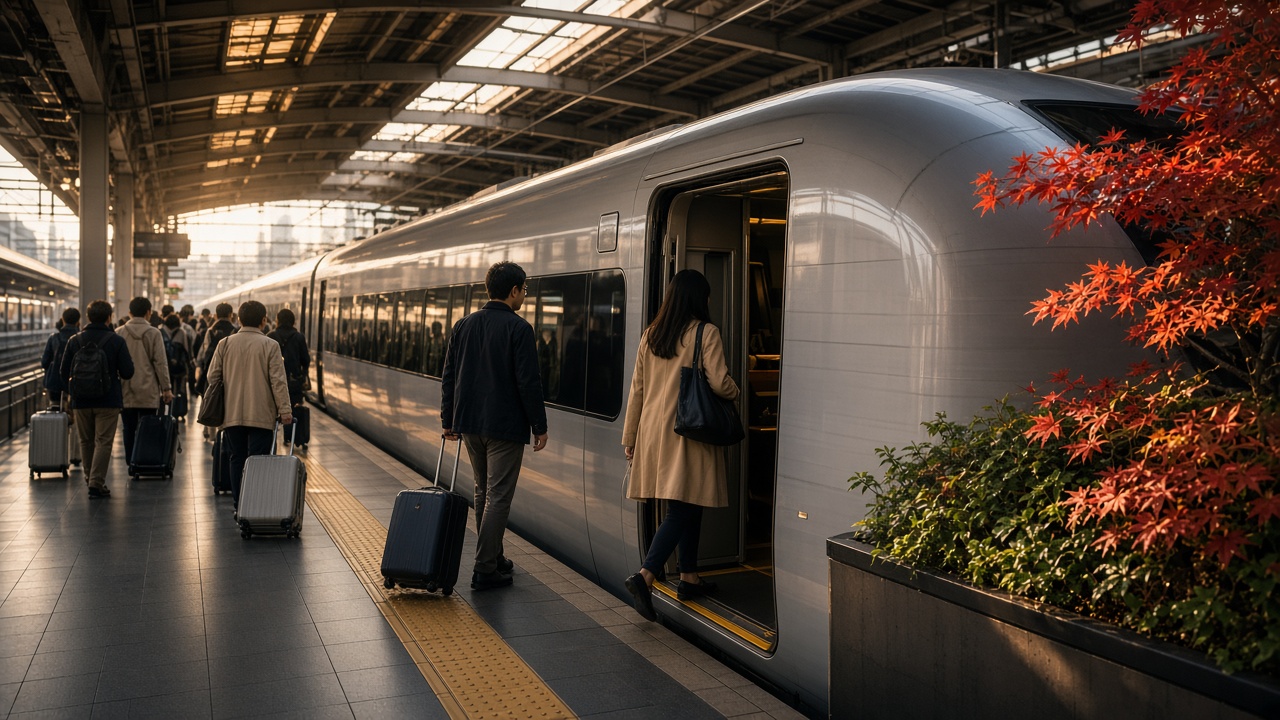
For Silver Week 2026, JR Central has published that Nozomi trains on the Tōkaidō/San’yō corridor run all-reserved (全席指定席, no non-reserved cars) from Friday 18 September through Wednesday 23 September. Hikari, Kodama, Mizuho, Sakura, and Tsubame keep non-reserved cars as usual—but those cars still compete hard on peak days.
JR Central’s 4 September 2026 reserved-seat bulletin (data as of end of business 2 September, compiled 3 September) reported roughly 1.07 million reserved seats already booked on the Tōkaidō Shinkansen for the 18–23 September window, against about 3.16 million shinkansen reserved seats made available (about 3.33 million including relevant conventional limited expresses). The same notice names the booking peaks:
- Outbound (下り): Saturday 19 September
- Return (上り): Tuesday 22 September
Morning Nozomi/Hikari departures from Tokyo on the 19th were already flagged as congested in that early-September snapshot; later media on the day itself described Tokyo Station as at peak outbound crush. Reserve a seat. All-reserved Nozomi means a non-reserved ticket does not get you a seat—only standing in the deck area under the stated conditions.
Expressways — NEXCO (official forecast)
NEXCO East / Central / West, JB Honshi-Bisan, and the Japan Road Traffic Information Center forecast 279 congestion events of 10 km or longer nationwide across 19–23 September (downhill/outbound concentrations early in the window; uphill/return later—especially around 21–22 September). Separately, the Holiday ETC discount does not apply during this busy window (the same exclusion pattern used for other major holiday peaks in recent years). If you are driving, read the NEXCO congestion guides and assume neither empty roads nor discounted tolls.
Nagoya and the Asian Games
The Asian Games (Aichi–Nagoya) run 19 September – 4 October 2026, with the opening on 19 September (Games Master Plan / organising calendar). Accommodation around Nagoya and trains through the area are tighter than Silver Week alone would explain. If your itinerary threads Nagoya, Kyoto, and Osaka in this window, build slack and book lodging early—or route around the Games region.
Costs
Holiday-surge pricing on hotels and some transport is normal. Prices often ease within a couple of days after the holiday ends—another reason the week after Silver Week is frequently recommended as a quieter alternative.
How to use Silver Week well (or skip moving)
If you are already in Japan during the five days:
-
1
Pick a base and stay
A Tokyo or Osaka staycation works well if you are not chasing a Saturday-morning seat out of town.
-
2
Skip new cross-country hops on the outbound peak
JR Central’s own peak day is Saturday 19 September outbound.
-
3
Bank and city-office errands early
Handle them before 19 September—or after 24 September.
-
4
Book Shinkansen before you need it
Especially Nozomi in the official all-reserved window (18–23 Sep).
-
5
Lean into the quieter culture
Higan atmosphere, early higanbana, Respect for the Aged Day’s family tone—observe without intruding on private grave visits.
-
6
Early foliage means shared windows
You compete with domestic travellers for the same alpine colour (kōyō guide).
-
7
Driving: trust the NEXCO forecast
Treat the 279-event outlook seriously; the Holiday ETC discount is off.
If your dates are still flexible:
- The week after Silver Week (from roughly 24 September) is often the sweet spot: heat breaking, holiday crowds back at work, rates easing, colour still early outside the highest peaks.
- Or position yourself before 19 September, stay put through the 23rd, and move again from the 24th—the same strategy we recommend for Obon.
If you must travel between regions during the five days:
- Prefer mid-break days over Saturday outbound and Tuesday return when you can.
- Give Nagoya extra caution during the Asian Games.
- Confirm the live JR / NEXCO notice the morning you move—forecasts are not weatherproof.
Silver Week at a glance
| Question | Answer |
|---|---|
| What is Silver Week? | Informal name for Japan’s September holiday cluster; full five-day version is rare |
| When in 2026? | Sat 19 Sep – Wed 23 Sep (practical five-day run) |
| Core holidays | 21 Sep 敬老の日; 22 Sep Art. 3(3) holiday (nicknamed 国民の休日, not 振替休日); 23 Sep 秋分の日 |
| Why five days? | Holiday Act sandwich day between two national holidays + preceding weekend |
| How rare? | Third full five-day Silver Week after 2009 and 2015 (Nippon.com) |
| Next comparable? | Next five-day often cited 2032 (18–22); next 19–23 twin ~2037 (projections, not Cabinet) |
| Holiday count 2026 | Nippon.com: 17; Cabinet: 16 named 祝日 + Art. 3(3) sandwich 休日 |
| Do shops close? | Mostly no; banks / gov offices close on holiday days |
| Nozomi | All-reserved Fri 18 – Wed 23 Sep (JR Central); peaks Sat 19 out / Tue 22 return |
| Expressways | NEXCO: 279 × ≥10 km congestion events forecast; Holiday ETC discount off |
| Tokyo? | Crowded departure hubs documented; “quieter city” is anecdotal |
| Nagoya? | Asian Games 19 Sep – 4 Oct tighten hotels and trains |
| Best visitor strategy | Stay put, or travel before/after; book reserved seats early |
FAQ
Is Silver Week the same as Golden Week?
No. Golden Week is the larger late-April / early-May holiday cluster and is a yearly travel surge. Silver Week is the autumn nickname for the September cluster around Respect for the Aged Day and the Autumnal Equinox. A full five-day Silver Week is uncommon.
Why is 22 September 2026 a holiday?
It is a holiday under Article 3, paragraph 3 of the Act on National Holidays: a weekday between two national holidays becomes a holiday. In everyday speech it is nicknamed 国民の休日. It is not a 振替休日. Confirm on the Cabinet Office holiday page; NAOJ’s 2026 暦要項 notes the same Art. 3(3) result for 22 September.
Does Silver Week happen every year?
The September holidays happen every year. The five-day branded stretch does not. Most years you get a shorter Respect-for-the-Aged weekend without the equinox sandwich.
Should tourists avoid Japan during Silver Week 2026?
Not necessarily. City staycations can be pleasant. Intercity travel, resort hotels, early foliage spots, expressway drives, and anything through Nagoya during the Asian Games need advance planning. If you can shift by a few days, the week after is often easier.
Will restaurants and convenience stores be open?
Yes in the vast majority of cases. Silver Week is a busy trading period for retail and dining, not a New Year-style shutdown. The closures that matter for visitors are banks and government offices on 21–23 September.
When is the next five-day Silver Week after 2026?
Nippon.com frames 2026 as the third full five-day Silver Week after 2009 and 2015. Under the current Holiday Act, calendar projections often cite the next five-day stretch as 2032 (Saturday 18 – Wednesday 22 September); the next 19–23 September twin of 2009/2015/2026 is often cited as 2037. Equinox dates for far-future years remain NAOJ/official only when published the prior February. These are widely reported projections, not an official Cabinet timetable—re-check the Cabinet Office list as those years approach.
Bottom line
Silver Week 2026 is Japan using a precise legal rule—Article 3(3) of the Holiday Act between two September shukujitsu—to turn an ordinary early-autumn weekend into a five-day national pause. It is the autumn rhyme to Golden Week in name only: rarer, tied to honouring elders and remembering ancestors, and experienced by residents as hometown visits, onsen bookings, leave-stacking, and heavy use of the Tōkaidō corridor.
For visitors, the week rewards the same discipline as Obon and Golden Week: respect the domestic calendar, reserve the seat, and do not invent long moves on peak days. JR Central has already told you which days those are. NEXCO has told drivers what the roads will look like. Stay in one place and the country can feel festive. Try to cross Honshū on instinct and you will meet the shinkansen at its most Japanese—sold out, punctual, and uninterested in your spontaneity.
Silver Week is not Japan’s second Golden Week on autopilot. It is a rare September alignment—Respect for the Aged Day, an Article 3(3) Citizens’ Holiday sandwich, and the equinox—when the country takes five days to honour longevity, visit the other shore, and fill the reserved-seat ledger on the Tōkaidō line.
Sources and further reading
- Cabinet Office of Japan — 国民の祝日について (official 2026 holiday list: 21 Sep 敬老の日; 22 Sep as 祝日法第3条第3項による休日; 23 Sep 秋分の日)
- National Astronomical Observatory of Japan (NAOJ) — 令和8(2026)年暦要項 (equinox date basis; notes 22 Sep holiday under Art. 3(3))
- JR Central — 2026年度 シルバーウィーク期間の指定席予約状況について (1.07M Tōkaidō reserved seats booked as of early Sep; peaks Sat 19 outbound / Tue 22 return; Nozomi all-reserved 18–23 Sep); Nozomi all-reserved periods; companion release 000045592.pdf
- NEXCO (East / Central / West) + JB Honshi-Bisan + JARTIC — シルバーウィーク期間の高速道路における渋滞予測について【全国版】 (279 × ≥10 km congestion events, 19–23 Sep); see also NEXCO East mirror. Holiday ETC discount exclusion for the busy window as reported in transport press summarizing MLIT/NEXCO practice.
- Nippon.com — Japan’s National Holidays in 2026 (17 holidays; third Silver Week after 2009 and 2015; Cabinet Office–based table)
- Wire / TV coverage of departure hubs — 日テレNEWS NNN, 19 Sep 2026 (Tokyo Station Tōkaidō platforms crowded; outbound peak; morning reserved seats nearly full). Confirms hub congestion, not that all of Tokyo emptied.
- The Japanist — 2026 peak travel periods; Autumn foliage / kōyō 2026; Obon guide
Name-origin note (soft): “Silver Week” as Daiei-era wasei-eigo and the September sense popularised around 2009 are standard dictionary/encyclopedia accounts, not Cabinet definitions. Asian Games (Aichi–Nagoya) dates 19 Sep – 4 Oct 2026 are cited for accommodation and transit planning from the Games calendar / Master Plan. Far-future next-five-day figures (often 2032 for 18–22; next 19–23 twin often ~2037) are calendar projections under the current Holiday Act, not official Cabinet forecasts; equinox dates stay provisional until NAOJ publishes them.
Continue Reading

Navigating Japan 2026: A Guide to Peak Travel Periods & Holidays
Planning Japan in 2026? Avoid the biggest crowd-and-price surges with this travel calendar guide to Golden Week, Obon, Silver Week, and other peak domestic travel windows.
Japan’s Autumn Foliage 2026: The Ultimate Guide to Chasing Kōyō Across Japan
The first 2026 kōyō call is in: late or on average, Tokyo maple 29 November, Kyoto city 11 December. How the colour travels, why a city date is not a temple date, Silver Week’s five-day collision, and how to plan a trip that follows the leaves.

Japan 2026: New Rules & Changes Every Tourist Must Know
Major changes are coming for Japan travelers in 2026. From tripled departure taxes to a completely new tax-free shopping system, here's everything you need to know before booking your trip.

If you're looking for nicely crafted Japan tours, check out: Arigato Travel’s experiences.