From late November, Japan's cities switch on their winter "illuminations": streets, parks and plazas lit with hundreds of thousands of LEDs. Most are free to walk through, and some run until February or March. Here are eight of the biggest for 2026–27, in Tokyo, Yokohama, Sapporo, Osaka, Mie and Kobe, with official dates, lighting hours and, where there is one, the price of entry.
Every date, time and price below comes from the organizer's own website or press release, or from the city that runs the event. Links, with dates, are at the end.
The short answer
-
When
Most of Japan's big illuminations run from November to Christmas Day. Several go on into February or March 2027.
-
What it costs
Street and plaza illuminations such as Marunouchi, Roppongi's Keyakizaka, Midosuji and Sapporo are on open streets and plazas, with no ticket. Nabana no Sato, the Yokohama Red Brick Christmas Market and part of Kobe Luminarie charge entry.
-
When to go
Lights usually come on between 4:00 and 5:00 p.m. and go off between 10:00 p.m. and 1:00 a.m. Weekdays are quieter than weekends.
-
Christmas markets
Roppongi Hills (from November 21), Yokohama Red Brick Warehouse and Sapporo's Munich Christmas Market (both from November 20) run until December 25.
-
Not in December
Kobe Luminarie is no longer a Christmas event. Its 2027 edition runs from January 29 to February 7.
Which illuminations are on, and when?
| Illumination | City | 2026–27 dates | Lighting hours | Entry |
|---|---|---|---|---|
| Marunouchi Illumination | Tokyo | Nov 12 – Feb 14 | 4:00–11:00 p.m. (to midnight in December) | Public street |
| Keyakizaka Illumination, Roppongi Hills | Tokyo | Nov 5 – Dec 25 | 5:00–10:00 p.m. | Public street |
| Yebisu Garden Place and Baccarat chandelier | Tokyo | Nov 14 – Feb 28 (chandelier to Jan 11) | 4:00–11:00 p.m. (chandelier 11:00 a.m.–11:00 p.m.) | Public plazas |
| Christmas Market in Yokohama Red Brick Warehouse | Yokohama | Nov 20 – Dec 25 | Light-up from 4:00 p.m. | From ¥500 |
| Sapporo White Illumination | Sapporo | Nov 20 – Mar 14 (varies by site) | 4:30–10:00 p.m. at most sites | Public streets and parks |
| Midosuji Illumination and Nakanoshima | Osaka | Nov 3 – Dec 31 | About 5:00 p.m. to 1:00 a.m. | Public street |
| Nabana no Sato | Kuwana, Mie | Oct 17 – May 31 | Varies; check the site | From ¥2,500 |
| Kobe Luminarie | Kobe | Jan 29 – Feb 7, 2027 | Check the site | Part of one venue paid |
Times are the organizers' published hours. Most say hours can change without notice, for example because of crowds or weather.
What is on in Tokyo?
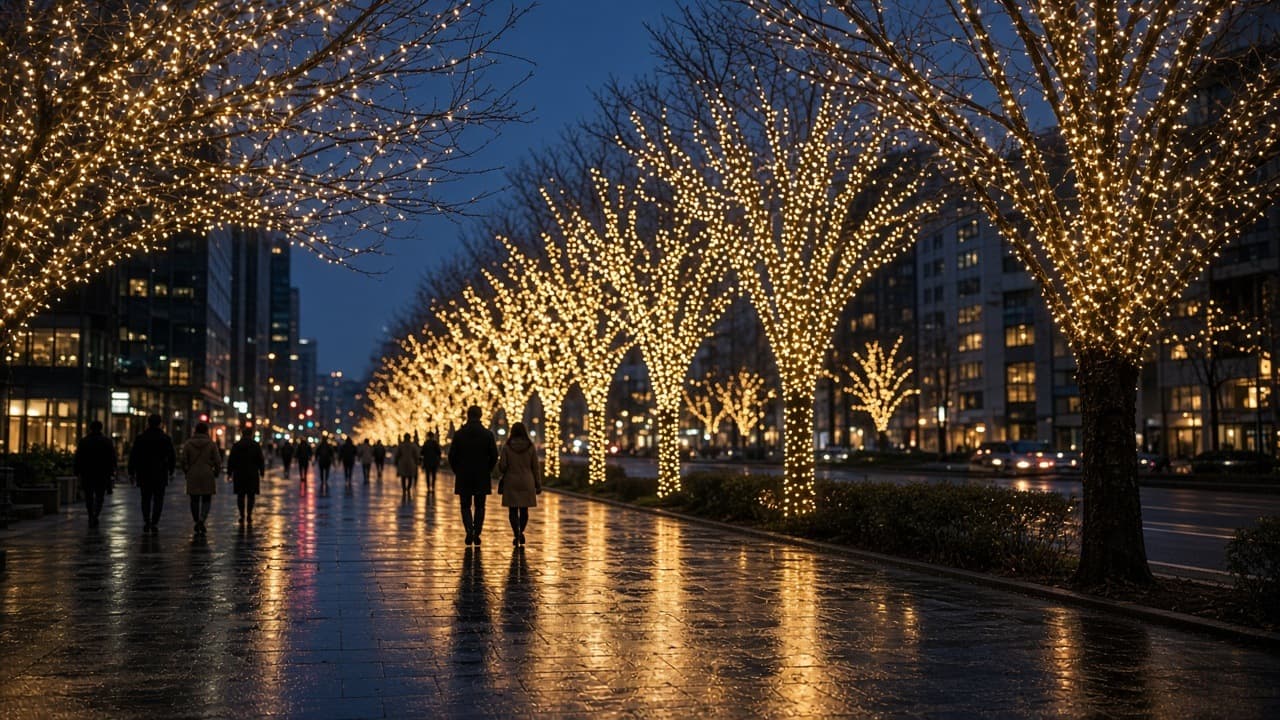
Marunouchi Illumination 2026. Now in its 25th year, this is Tokyo's long, golden street of lights. About 200 trees along Marunouchi Naka-dori, a street of about 1.2 km, are lit with some 572,000 champagne-gold LEDs. It runs from November 12, 2026 to February 14, 2027, 4:00 to 11:00 p.m., and until midnight from December 1 to 31. From November 27 to December 25, the trees of Gyoko-dori, the wide avenue between Tokyo Station and the Imperial Palace outer garden, are also lit, 4:00 p.m. to midnight.
Roppongi Hills, Keyakizaka Illumination "SNOW & BLUE". About 970,000 LEDs, themed "SNOW & BLUE", line roughly 400 m of Keyakizaka-dori, from November 5 to December 25, 5:00 to 10:00 p.m. Roppongi Hills asks visitors to come by public transport because the street gets very crowded, and not to step into the road to take photos. Mori Building lists two more light-ups on the site: 66 Plaza (November 13 to December 27, 5:00 p.m. to midnight; 11:00 p.m. on the last day) and the Mohri Garden (November 13 to December 25, 5:00 to 11:00 p.m.).
Roppongi Hills Christmas Market. Its 20th edition runs from November 21 to December 25, 11:00 a.m. to 9:00 p.m., at the O-yane Plaza. It is modeled on Stuttgart's Christmas market, with 10 stalls selling German Christmas goods, mulled wine, sausages and stollen.
Yebisu Garden Place. About 100,000 champagne-gold lights decorate the site from November 14, 2026 to February 28, 2027, 4:00 to 11:00 p.m. In the Center Plaza, the Baccarat Eternal Lights chandelier is on show from November 14 to January 11, 2027, lit 11:00 a.m. to 11:00 p.m. Baccarat says it is 5 m tall and 3 m wide, with 8,500 crystal parts and 250 lights.
What about Yokohama's Christmas Market?
The Christmas Market in Yokohama Red Brick Warehouse runs from November 20 to December 25. It is one of the few on this list with an entry fee:
| Detail | 2026 |
|---|---|
| Hours | November 21 – December 4: 11:00 a.m. to 9:00 p.m. (last orders 8:30 p.m.). December 5–25: 11:00 a.m. to 10:00 p.m. (last orders 9:30 p.m.). Opening day, November 20: 5:00 to 9:00 p.m. |
| Light-up | From 4:00 p.m. until closing; the Christmas tree is lit 4:00 to 11:00 p.m. |
| Standard entry | ¥500 on normal days; ¥1,000 on peak days: December 5–6, 12–13, 18–20 and 24–25 |
| Other tickets | Priority entry from ¥2,000, sold online in advance, by date and in limited numbers |
| How to pay | Cash at the main entrance, or online through the Asoview! ticket site |
Food, drink and shopping cost extra. Some areas are free to enter. The market goes ahead in rain but may close in a storm.
When is the Sapporo White Illumination?
Sapporo's official tourism site says Japan's tradition of seasonal lights began here: the first White Illumination, in 1981, was about 1,000 bulbs in Odori Park. The 46th edition opens on Friday, November 20, 2026, across several sites. Each closes on a different date:
| Site | Dates | Lighting hours |
|---|---|---|
| Odori Park | Nov 20 – Dec 25 | 4:30–10:00 p.m. |
| Sapporo Ekimae-dori | Nov 20 – Feb 11 | 4:30–10:00 p.m. (to midnight Dec 23–25) |
| Minami 1-jo-dori | Nov 20 – Mar 14 | 4:30–10:00 p.m. (to midnight Dec 20–25) |
| Kita 3-jo Plaza (Akapla) | Nov 20 – Mar 14 | 4:30–10:00 p.m. |
| Former Hokkaido Government Office (Akarenga), new for 2026 | Nov 20 – Feb 28 | 4:30–10:00 p.m. |
| JR Sapporo Station South Exit plaza | Nov 20 – Mar 14 | 4:30 p.m. to midnight |
| Nakajima Park, new for 2026 | Jan 9 – Jan 28, 2027 | 10:00 a.m. to 8:00 p.m. |
At several sites the start time moves with sunset. The new Nakajima Park venue, overseen by the Sapporo International Art Festival (SIAF2027), shows a new work called "SNOWFISH": large, glowing balloon creatures that change light and sound as people move, and that visitors can go inside.
Munich Christmas Market in Sapporo. This market recreates the feel of Munich's Christmas market. It began in 2002 as part of Sapporo's sister-city ties with Munich and is in its 25th year. It runs from November 20 to December 25, 11:00 a.m. to 9:00 p.m. (last orders 8:45 p.m.), in Odori Park blocks 1 and 2.
What is on in Osaka?
The Osaka Festival of Lights 2026 (Osaka Hikari-Kyoen), run by a committee that includes Osaka Prefecture and Osaka City, runs from November 3, 2026 to January 31, 2027. Its two core programs:
- Midosuji Illumination 2026: November 3 to December 31, from about 5:00 p.m. to 1:00 a.m. (the city writes it as "25:00"). The lights run about 4 km along Midosuji, from the Hanshin-mae crossing to the Namba-nishiguchi crossing. To mark 90 years of the boulevard in May 2027, the street is split into five areas, each lit to evoke an era from the 1940s to the present. The city lists the Osaka Metro stations from Umeda to Namba, and JR Osaka Station, as the nearest.
- OSAKA Hikari no Renaissance 2026, Nakanoshima: the Osaka City Hall facade and the Nakanoshima Illumination Street on the Miotsukushi Promenade are lit from November 3 to December 31, 5:00 p.m. to 1:00 a.m. From December 11 to 25, projection mapping plays on the east front of Osaka City Central Public Hall, 5:30 to 9:30 p.m., about 10 minutes every 12 minutes (last show 9:20 p.m.), and a "Hikari no Marché" light market runs near Naniwabashi Station, 4:00 to 10:00 p.m.
How much does Nabana no Sato cost?
Nabana no Sato, a garden park in Kuwana, Mie Prefecture, runs one of Japan's longest illumination seasons: October 17, 2026 to May 31, 2027, closed January 6–7. Its draws include a 200 m tunnel of light. Unlike the city shows, it charges entry, and the ticket includes a voucher you can spend in the park:
| Period | Convenience-store ticket | At the gate | Includes |
|---|---|---|---|
| Oct 17 – Nov 20 | ¥2,500 | ¥2,700 | ¥1,000 voucher and Begonia Garden entry |
| Nov 21 – Dec 22 | ¥3,000 | ¥3,200 | ¥1,000 voucher and Begonia Garden entry |
| Dec 23–25 (Christmas special opening) | ¥5,500, advance date-specific ticket | ¥5,500, only if any are left | ¥2,000 voucher and Begonia Garden entry |
Children below elementary-school age go free with an adult. On December 23–25 the park opens only from 3:00 p.m. (until 10:00 p.m. on the 23rd and 11:00 p.m. on the 24th and 25th) and limits ticket numbers. Lighting times change through the season, and prices for later periods are on the official fee page. The park advises buying tickets at a convenience store in advance, because buying at the gate can take 30 minutes or more.
When is Kobe Luminarie?
Kobe Luminarie began as a memorial to the victims of the 1995 Great Hanshin-Awaji Earthquake, and the City of Kobe still names remembering the victims and passing on the disaster's lessons among the event's aims. The 32nd edition runs for 10 days, from Friday, January 29 to Sunday, February 7, 2027, at Meriken Park, Higashi Yuenchi park and the former Foreign Settlement.
Most of it is free, but part of the Meriken Park venue charges entry:
| Ticket | Weekdays | Weekends |
|---|---|---|
| Advance | ¥500 | ¥750 |
| On the day | ¥1,000 | ¥1,500 |
How do I enjoy illuminations without the crowds?
A few practical points, drawn from the organizers' own advice:
- Take the train. Roppongi Hills and Osaka both point visitors to public transport; roads near the big shows get jammed.
- Go on a weekday if you can. Yokohama's higher-priced peak days are mostly weekends plus Christmas Eve and Christmas Day, a good guide to when crowds are biggest.
- Mind the road. Roppongi Hills asks photographers to obey traffic signals and not step into the street.
- Buy tickets ahead where you can. Nabana no Sato and Yokohama both sell in advance, and Nabana's Christmas nights need a date-specific ticket.
- Dress warmly. You will be outside after dark, often standing for a while, and Sapporo evenings in particular are cold.
FAQ
When do Japan's Christmas illuminations start in 2026?
Many are already on by late November. Midosuji in Osaka started on November 3, Roppongi Hills on November 5, Marunouchi on November 12 and Yebisu Garden Place on November 14. Sapporo and Yokohama's Christmas Market start on November 20.
Are Japan's illuminations free?
Most city-street ones are, because they are on public streets and plazas: Marunouchi, Keyakizaka, Yebisu Garden Place, Sapporo and Midosuji, for example. Nabana no Sato (from ¥2,500), the Yokohama Red Brick Christmas Market (from ¥500) and the paid area of Kobe Luminarie charge entry.
Which illuminations last past Christmas?
Marunouchi (to February 14), Yebisu Garden Place (to February 28), several Sapporo sites (to February 11, February 28 or March 14), Osaka's Midosuji (to December 31) and Nabana no Sato (to May 31, 2027).
Is Kobe Luminarie held in December?
No. The 2027 edition runs from January 29 to February 7, 2027.
What time are the lights on?
Usually from about 4:00 or 5:00 p.m. Closing ranges from 10:00 p.m. (Keyakizaka, Sapporo's Odori Park) to about 1:00 a.m. (Midosuji). Check each organizer's page on the day.
Where is the best Christmas market in Japan?
It depends on where you are. Tokyo has the Roppongi Hills Christmas Market (November 21 to December 25), Yokohama has the Red Brick Warehouse market (November 20 to December 25, from ¥500), and Sapporo has the Munich Christmas Market in Odori Park (November 20 to December 25).
Bottom line
Japan's winter lights are one of the country's great free shows. Pick one near where you are staying, go on a weekday evening, take the train, and save your money for the few that charge: Nabana no Sato and the Yokohama market. If you will be in Kobe in late January, Luminarie is the one to plan around.
Free to walk through, warm to remember: the best of Japan's winter is often after dark.
Sources and further reading
- Marunouchi Illumination Executive Committee / Mitsubishi Estate — Marunouchi and Gyoko-dori Illumination 2026 (Japanese, PDF) (dates, hours, number of trees and LEDs)
- Roppongi Hills — Keyakizaka Illumination 2026 (Japanese); Christmas Hills 2026 (Japanese) (Christmas Market dates and hours)
- Mori Building — Press release, September 30, 2026: Christmas Hills 2026 (Japanese, PDF) (66 Plaza and Mohri Garden light-ups)
- Yebisu Garden Place — Illumination 2026 (Japanese)
- Baccarat Japan — Baccarat Eternal Lights 2026 (Japanese)
- Yokohama Red Brick Warehouse — Christmas Market 2026 (Japanese) (dates, hours, entry prices, ticket sales)
- Sapporo White Illumination Executive Committee — Sapporo White Illumination official site (Japanese) (venue dates and hours; 2026 new venues); Munich Christmas Market in Sapporo 2026 (Japanese); Welcome to Sapporo: event page (English)
- City of Osaka — Press release, September 24, 2026: Osaka Festival of Lights 2026 core programs (Japanese) (Midosuji and Nakanoshima dates and hours)
- Nabana no Sato (Nagashima Resort) — Illumination hours and prices (Japanese); Illumination 2026–2027 (Japanese)
- City of Kobe — 32nd Kobe Luminarie dates announced (Japanese) (dates, venues, paid-area prices, purpose); Kobe Luminarie official site (Japanese)
- The Japanist — Christmas and New Year in Japan; Japan's winter 2026–27 forecast
Method note: Dates, hours and prices are those published by each organizer as of November 16, 2026. Organizers may change hours without notice, for example because of crowds or weather. Translations of Japanese sources are ours. Check each official site before you go.
Continue Reading
 Illustration, not a photo: this image was generated with AI.
Japan’s Winter 2026–27 Forecast: A Record El Niño, a Likely Warmer Winter and Less Snow on the Sea of Japan Coast
JMA says the 2026 El Niño is the strongest on record (+4.0°C in September) and will last through winter. Its December–February forecast gives a 60% chance of a warmer-than-normal winter in eastern and western Japan, 70% in Okinawa, and favours less snow on much of the Sea of Japan coast. What the odds mean for travellers.
Halloween 2026 in Shibuya: The Rules, Road Closures and Where to Celebrate in Tokyo Instead
Halloween falls on a Saturday in 2026. Shibuya bans drinking on the street from 18:00 to 05:00, fences off the Hachiko statue from October 30 to the morning of November 1, closes roads on both nights and fines litterers ¥2,000 on the spot. Shinjuku’s one-night rules, the Ikebukuro cosplay festival and official sources.
 Illustration, not a photo: this image was generated with AI.
Japan Proposes a New Arrival Card Question: “Do You Intend to Comply With Japanese Law?”
Japan’s Immigration Services Agency has opened public comment (until November 27, 2026) on adding a fourth question to the foreign-national arrival card. What is proposed, the planned December 2026 and January 2027 dates, what the agency has not said, and how to comment.