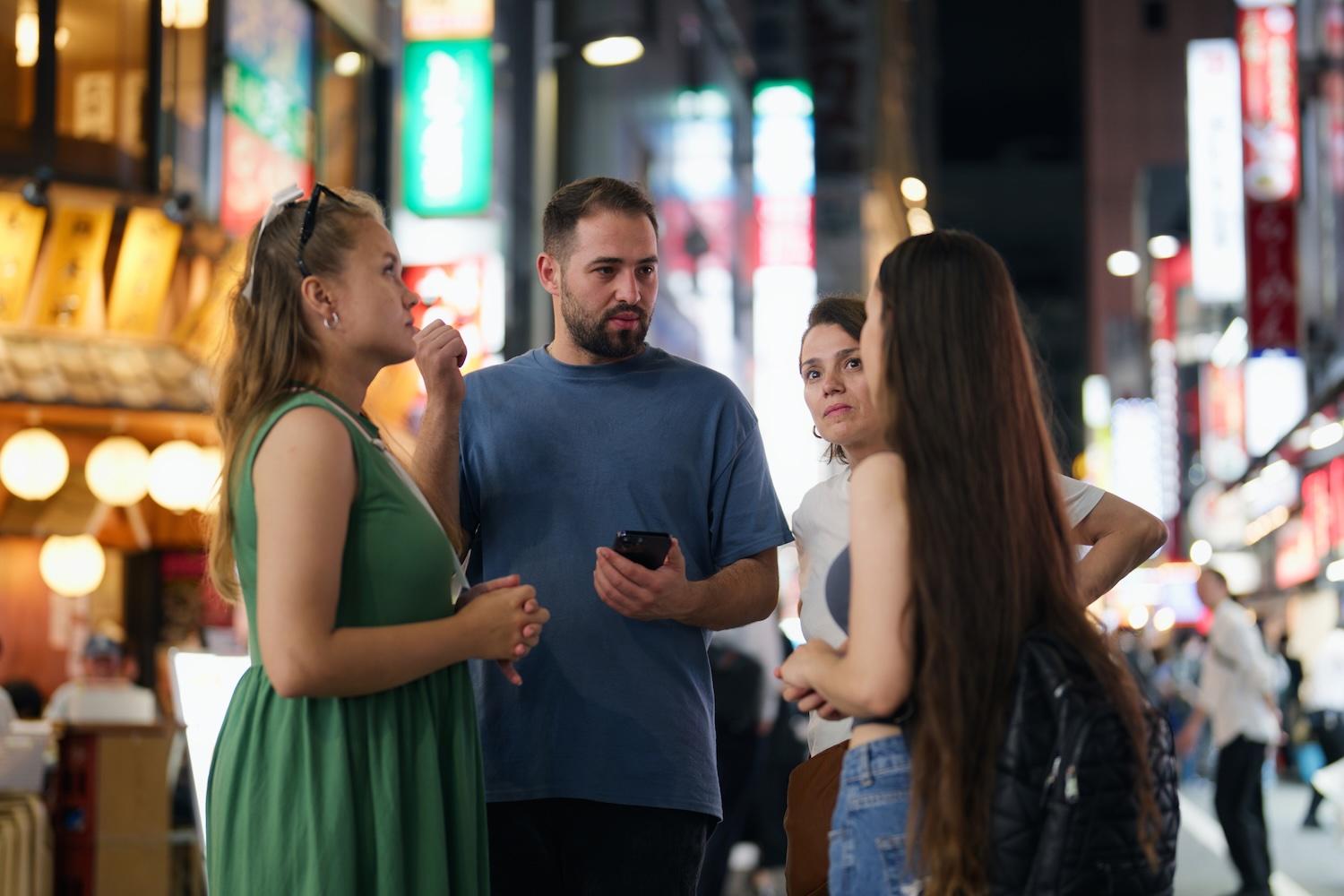
Why Group Travel to Japan is So Difficult (and Tips to Help)
Planning group travel to Japan? Learn why tiny restaurants and crowded trains make it difficult, plus expert tips to make your group trip a success.

Is there anything more fun than planning group travel to Japan? Sorry. Did I say fun? I meant horrible and stressful. The mix of personalities and viewpoints can lead you to experience things you’d otherwise never be interested in and visit places you’d never even considered. I still thank my friend group for exposing me to the joys of thrash metal bars on a particular wild trip, but organizing the rest of the trip was a lesson in frustration.
Unfortunately, large groups are pretty much the antithesis of everything Japan values. Harmony and most importantly order all seem to go out the window as soon as more than two people get together. In Japan, the ideal visitor lines up neatly, moves with purpose and avoids blocking shared spaces.
Japan never resists these groups in an overt “No Groups Allowed” way. Sure, there are the occasional trolls that love to sound off about how all these gaijin (foreigners) are ruining Japan or, at the very least, need to follow Japan’s unwritten rules better, but most of the time, the clashes are caused by an unspoken love of efficiency rather than them-vs-us rage.
1. The Best Restaurants Are Tiny
[

](http://cdn.gaijinpot.com/app/uploads/sites/4/2026/07/iStock-bernersteven-izakaya-group-travel-to-japan.jpeg)Roads can also be tight.
My mental image of dining out involves a big table, shared plates and lively conversation. On holidays in Germany and Austria, I gravitated to rowdy beer halls. Compare that to Japan. Most restaurants feature quiet chat and tables for couples. Four people is often a stretch.
One of my favorite breakfast spots has 10 seats and queues that extend across the road. Yep, that’s a thing in Japan: queuing to get in a queue. Walk in with six people and expect a polite but clear “no.” This happens even with empty seats. While it is easy to take this personally, it’s usually about geometry and meeting customer expectations.
The Fix:
-
Look for an izakaya (casual Japanese pub): These spots offer fantastic shared plates and a lively vibe. Popular chains like Torikizoku or Chiba Chan are absolute lifesavers for large groups. (Chiba Chan is famous for serving a literal boat of Japanese fried chicken and fries!)
-
Book a nomihoudai (all-you-can-drink): Use nomihoudai at casual spots so you don’t have to itemize a massive bar tab at the end of the night.
-
Expect an omakase (chef’s choice). If you do book a nicer restaurant, you will likely need to order a set course so the small kitchen can manage your table’s timing.
-
Learn the betsu-betsu (paying separately): Many restaurants refuse to split the bill, so be prepared to pay together and settle up later if they say no.
2. Hotel Rooms Are Small
[

](http://cdn.gaijinpot.com/app/uploads/sites/4/2026/07/iStock-AzmanL-ryokan-Group-Travel-to-Japan.jpeg)Try a family room at a traditional Japanese inn.
Japanese hotel rooms are compact even at the best of times. Plan to stay in a big city? Get used to limited space. Fitting two adults and their luggage into a standard room is tough for most standard rooms. It feels more like playing high-level Tetris than enjoying a vacation.
However, this actually has advantages. The lack of hotel hangout space encourages me to explore. Nothing convinces you to see a city more than a bedroom that barely accommodates watching TV.
The Fix:
-
Book a ryokan (Japanese-style inn): For larger groups and families, these offer a great balance. Futons are put down at night and rolled into the closet during the day, giving your group much more floor space.
-
Look into apartment-style hotels: If traditional inns aren’t your style, look for specific apart-hotel chains (like Mimaru) that cater to inbound groups with bunk beds, kitchenettes and communal tables.
-
Watch the paper doors: If you do stay in a traditional room, take care not to lose your deposit by putting your hand through a fragile paper screen (like a certain member of my friend group I could mention).
3. Public Transport Punishes Groups
[

](http://cdn.gaijinpot.com/app/uploads/sites/4/2026/07/iStock-O2O-Creative-japan-train-luggage.jpeg)Good luck getting your luggage on during rush hour.
Japan’s transport system is world-class, but by design, it is ruthlessly optimized. When you insert a group, you can quickly see why “I saw this ridiculous thing on the ride home” is a popular topic of complaint on 5channel (the Japanese equivalent of Reddit).
This can be especially grating when people travel with luggage. When you have barely enough room to move, as on many central Tokyo lines, expecting commuters to make room for multiple people with bags is not going to happen.
The Fix:
-
Use takuhaibin (luggage-forwarding services): Like the Yamato Black Cat logo, these services can send your heavy bags directly from the airport to your hotel or between cities.
-
Reserve oversized baggage seats: If you absolutely must take luggage on the bullet train, you are now required to reserve specific oversized baggage seats at the back of the car or risk paying an oversized luggage fee or being refused boarding.
-
Go digital at the gates: To avoid ticket-gate bottlenecks, have everyone load a digital Suica or Pasmo card onto their smartphone in advance so the whole group can tap in and out of stations seamlessly.
4. Attractions Are Not Group-friendly
Many of Japan’s most famous spots are beautiful, historic and clearly designed for calm solo contemplation rather than large clusters of humans moving as one. Take Kyoto as an example. When you think of Japan’s ancient capital, you probably think of amazing sights like the Silver Pavilion—a favorite of mine, too—but this amazing sight is found near narrow shrine paths.
You’ll notice this at Tokyo Disneyland and DisneySea, too. Lines for “single riders” can be demonstrably shorter. Sometimes it’s better to just split up and get in the single-rider lines if you really want to experience everything.
Even navigating these streets with my parents was challenging. Fun fact: some historical areas, like the winding streets of Kanazawa, were actually designed to be difficult to navigate in groups as a defense against invading samurai armies.
The Fix:
-
Divide and conquer: Break up the group into twos or threes. You will see more, move faster and annoy fewer people.
-
Set anchor points: Most tourist sites are near excellent restaurants or cafes, so simply arranging a nearby rendezvous point is usually the easiest way to manage a large party.
-
Visit at off-peak hours: If you want to experience a site together, get there right at sunrise before the crowds arrive or go later in the evening when the large tour buses have left.
5. Booking Systems Feel Like a Puzzle
Japan’s booking ecosystem has its own logic. Even after years in this country, I still balk at making seat reservations by phone or navigating Japanese-only websites, only to find out they have group-size limits.
It can feel like the system is quietly hoping you give up. In many respects, they are, as many places are simply not designed for groups. Also, many online booking systems require a local Japanese phone number.
The Fix:
-
Book via apps or Google Maps: Platforms like TableCheck or Gurunavi make group booking much easier. Surprisingly, many restaurants now also allow you to book online directly via reservation links on their Google Maps profiles.
-
Don’t fear the phone: If you do have to call, simply saying “I’d like to make a reservation” in English is often enough to get by. Most Japanese staff can understand dates, times and numbers in English if you speak clearly and slowly.
-
Leverage your concierge: Utilize your hotel’s concierge service to make reservations. With a little flexibility, a concierge can completely bypass the local phone-number hurdles for you.
-
Head to a depachika (department store basements): If dinner reservations fail, Japanese food halls let everyone in the group buy exactly what they want from different gourmet vendors and eat together at a shared seating area or nearby park.
6. Everyone Underestimates the Walking
[

](http://cdn.gaijinpot.com/app/uploads/sites/4/2026/07/iStock-FilippoBacci-geisha-japan-.jpeg)These geta (footwear) were made for walking.
One of the first things that comes to mind when thinking about Japan is its bullet trains and perfectly functioning subway system. However, the futuristic high-speed rail network obscures the reality that many stations are located far from attractions and that many of the best areas are inaccessible by public transportation.
While cities like Kyoto and Sapporo were built on a grid and are relatively easy to negotiate, Tokyo is a sprawling labyrinth that evolved organically around Edo Castle. Walking blindly in one direction will not guarantee that you hit a station.
The Fix:
-
Check the topography: Look at the route on Google Maps, both on the way there and on the way back. If you see a big difference in estimated time, there are likely steep hills involved.
-
Wear easily removable shoes: You will be taking your shoes off constantly at temples, shrines and traditional restaurants. Fumbling with laces while five people wait behind you creates a massive bottleneck.
-
Pad your schedule: Build in buffer time everywhere and consciously schedule time for breaks, especially in the sweltering summer heat.
Groups can work in Japan
[

](http://cdn.gaijinpot.com/app/uploads/sites/4/2025/09/iStock-JohnnyGreig-Japan-Isnt-a-Personality-izakaya.jpeg)It all works out in the end.
Japan is not difficult for groups because it is unfriendly. It is difficult because it is finely tuned for efficiency and small-scale experiences. And there isn’t that much space to begin with. Once you stop fighting that and start adapting to it, the trip becomes much smoother. After all, people have different energy levels, interests and food preferences, so forcing everyone to be on the same page the whole day will inevitably create friction.
Instead of militantly sticking to your plan to travel as a group, it is worth being a little more flexible: split up more, plan, but also improvise and include anchor points where everyone meets up but with flexibility in the middle.
Paradoxically, spending less time together often makes the shared time better and the best moments often happen when your group accidentally stops behaving like a group. Ultimately, group travel to Japan doesn’t have to be a headache. By embracing the culture’s love for order utilization and a few clever logistics, you can ensure everyone has an unforgettable time.
What are your best tips or worst experiences from traveling with a group here? Let us know in the comments below!
Note: This article content is being automatically formatted. For the original source formatting, visit the link below.
Original source:GaijinPot Blog ↗
More Japan News

How a British Man Became Japan’s Cheese Guy in Okinawa
Looking for the best cheese in Japan? Discover the story of John Davis, the cheese guy in Okinawa, and his artisan shop.

Ricchaadotv on Comedy, Music and Expat Life in Japan
Viral creator @Ricchaadotv sits down with GaijinPot to talk about his alter-egos, couch surfing in Tokyo and making it in Japan.
What Talking to Taxi Drivers Taught Me About Life in Japan
Ordinary taxi conversations revealed a more personal side of daily life, curiosity and human connection.