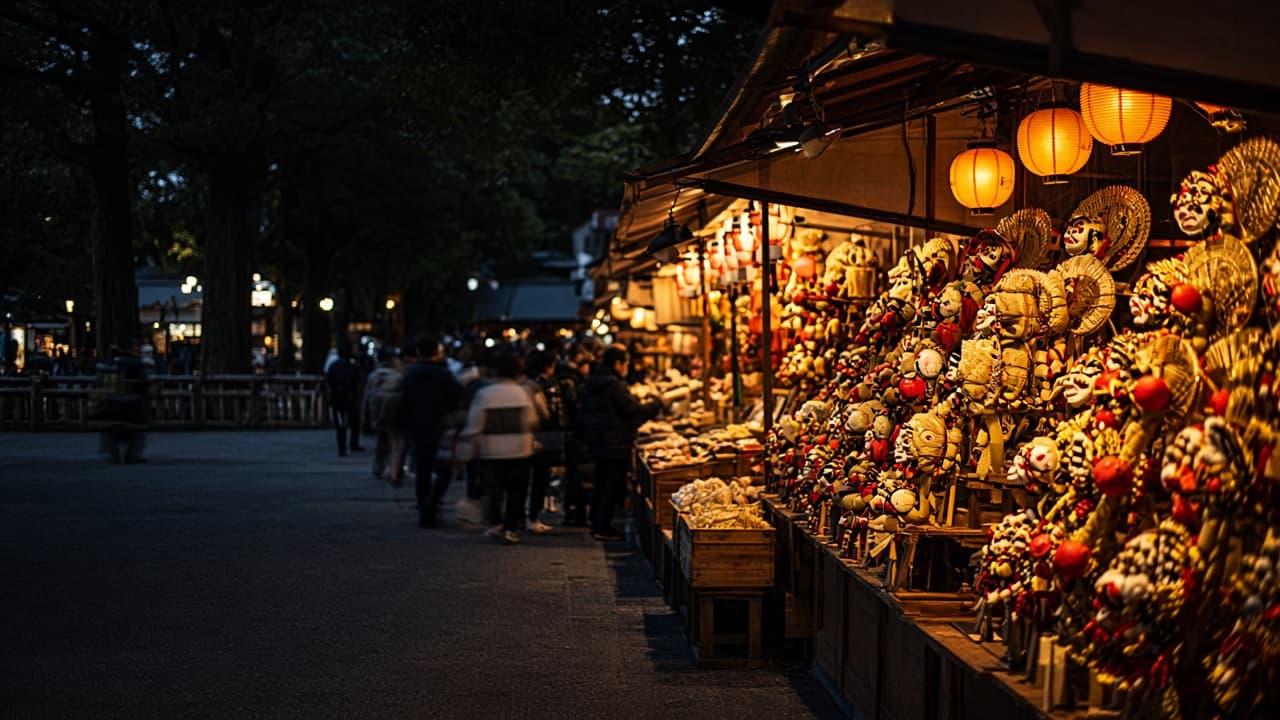
Every November, a small shrine in Asakusa stays open for 24 hours straight while crowds squeeze past stalls stacked with decorated "rakes" piled high with lucky charms. This is Tori no Ichi, the rooster-day fair, where Tokyo shops and households buy a decorative rake, a kumade, to "rake in" good fortune for the year ahead. In 2026 there are two fair days, Saturday, November 7 and Thursday, November 19. Here is what happens, how to buy a kumade without embarrassing yourself, and how to get there.
Dates, times and customs below come from the Asakusa Otori Shrine, Taito City, the Tokyo Convention & Visitors Bureau (GO TOKYO) and the Shinjuku Tourism Promotion Association. Links are at the end.
The short answer
-
Two fair days in 2026
The first rooster day (ichi no tori) is Saturday, November 7. The second (ni no tori) is Thursday, November 19. There is no third rooster day this year.
-
Open around the clock
At the Asakusa Otori Shrine each fair day runs from midnight to midnight, starting with a drum at 00:00.
-
Where to go
The best-known fair is at Otori Shrine and the neighbouring Chokokuji temple in Senzoku, Taito City, about 9 minutes' walk from Iriya Station on the Hibiya Line.
-
What people buy
Decorative kumade rakes, from about ¥1,000 for a small one to hundreds of thousands of yen. The shrine says ¥20,000–50,000 are the most popular sizes.
-
Expect crowds
The shrine counts about 150 kumade stalls, about 750 street stalls and 700,000 to 800,000 visitors a year.
-
Prayers from ¥5,000
Prayers inside the shrine hall are held throughout the fair. The offering starts at ¥5,000, for up to five people per family or group.
What is Tori no Ichi?
Tori no Ichi means "rooster market". It is a festival held at Otori (eagle) shrines and some temples on the days of the rooster in November. Japan's traditional calendar labels each day with one of the twelve zodiac animals in a repeating cycle, so a rooster day comes round every 12 days. That is why 2026's two fair days, November 7 and November 19, are exactly 12 days apart.
The Asakusa Otori Shrine (鷲神社, affectionately called otori-sama) enshrines two deities: Ame-no-Hiwashi-no-Mikoto, a god of opening up new land, good fortune and thriving business, and the legendary prince Yamato Takeru. According to the shrine, Yamato Takeru stopped here to pray for victory on a military campaign. On his way home he hung a rake on the pine tree in front of the shrine to celebrate, and the day he came back to give thanks was a rooster day in November. The shrine made that its festival day, and the fair grew around it.
The shrine says the festival's proper name was tori no machi (酉の祭, "rooster festival"), and that by the 1750s and 1760s it already drew big crowds. Takarai Kikaku, one of the haiku poet Bashō's best-known students, summed up its place in the year in a verse the shrine still quotes: haru wo matsu / koto no hajime ya / tori no ichi, roughly "the first step in waiting for spring: the rooster fair".
The shrine also says the festival has never once been skipped, not even in the year of the 1923 Great Kanto Earthquake or during the war.
So Tori no Ichi is really a festival about the coming year. People give thanks for the year that is ending and ask for good luck, good business and a safe household in the next one.
Why do people buy kumade rakes?
A rake gathers things in, so a kumade is a symbol of raking in good fortune and customers. The decorative kumade sold at the fair are piled with colourful lucky ornaments, and no two stalls make them quite the same way.
There are two kinds to know about:
| Kumade omamori | A small rake-shaped charm from the shrine itself, popularly called kakkome or hakkome | Shrine charm counters, only during Tori no Ichi |
|---|---|---|
| Engi kumade | The large decorated rakes that fill the stalls | The roughly 150 kumade stalls around the shrine |
The shrine's own suggestion is to pray first, receive the kakkome charm, and then choose a decorative kumade if you want one. Kumade were once mainly for merchants, but the shrine notes that people now buy them for all kinds of wishes: a safe and happy home, good health, success, even love.
The tradition is to start with a small kumade and move up to bigger ones over the years as your business or household grows.
How do you buy a kumade?
Buying a kumade is part of the fun, and the Otori Shrine explains the old etiquette in some detail:
- Walk the whole fair first. Every stall has its own style, and two rakes of the same size can cost very different amounts depending on the decorations.
- Haggle. Bargaining with the stallholder is expected and part of the show.
- Leave the discount as a tip. The stylish Edo way, the shrine says, was to leave whatever you had knocked off the price as goshugi, a gift for the stall. You end up paying the asking price, but you feel generous and the stallholder feels well paid.
- Seal it with a hand-clap. Once the deal is done, it is sealed with a rhythmic tejime hand-clap, a wish for your home or business to prosper. Clap along.
Prices start at about ¥1,000 for a small kumade. Big ones can run to hundreds of thousands of yen, and the shrine says the best-selling range is about ¥20,000 to ¥50,000. Bring cash, and if you're buying a large one, think about how you'll carry it home on a crowded train.
When is Tori no Ichi 2026, and what happens when?
At the Asakusa Otori Shrine, the fair begins with the ichiban daiko, the first drum, at midnight, and runs for a full 24 hours (Otori Shrine, 2026 schedule).
| Fair | Sat, November 7, 00:00–24:00 | Thu, November 19, 00:00–24:00 |
|---|---|---|
| Eve ceremony (宵宮開運福寿祭) | Fri, November 6, from 23:15 | Wed, November 18, from 23:15 |
| Special ceremony (鷲祭特別祭儀) | November 7, from 13:00 | November 19, from 13:00 |
You can attend the two formal ceremonies, but you must book in advance and check in at least 15 minutes before they start. Ordinary prayers inside the shrine hall are held throughout the fair, in order of arrival. The offering starts at ¥5,000, and each family or group is limited to five people.
The shrine adds that at the stroke of midnight, the very first person to receive the shrine's rake charm gets a special "number one" ticket that can be exchanged for a small gold koban (old coin) charm. The shrine keeps secret which charm counter it will come from.
Which day is best? The shrine says the blessings are the same whichever rooster day you visit, so go on the day that suits you. November 7 is a Saturday and November 19 is a weekday.
What else is there to eat and buy?
Two old lucky foods survive at the Asakusa fair:
- Yatsugashira (八頭, "eight heads"), a large taro root. It is said to help you rise to the head of others in life, and because one root sprouts many shoots, it is also a charm for being blessed with children. The shrine says only one stall inside the grounds still sells it.
- Kirizansho (切山椒), a sweet rice-flour cake flavoured with Japanese sansho pepper and cut into strips. It is a New Year sweet that signals the end of the year.
How do I get to the Asakusa Otori Shrine?
The fair takes place at Otori Shrine (鷲神社), 3-18-7 Senzoku, Taito City, and the next-door Chokokuji temple (長國寺), 3-19-6 Senzoku, where the fair is also held (GO TOKYO; Taito City). Despite the "Asakusa" in its name, it is about 23 minutes on foot from Asakusa Station on the Ginza Line, so it is not next door to Sensoji.
Walking times given by Taito City:
| Station | Line | On foot |
|---|---|---|
| Iriya | Tokyo Metro Hibiya Line | about 9 min |
| Minowa | Tokyo Metro Hibiya Line | about 10 min |
| Asakusa | Tsukuba Express | about 11 min |
| Minowabashi | Toden Arakawa (Tokyo Sakura Tram) | about 17 min |
| Uguisudani | JR | about 20 min |
| Asakusa | Tokyo Metro Ginza Line, Toei Asakusa Line, Tobu | about 23 min |
Public transport is the sensible choice: the streets around the shrine are packed on fair days.
Are there other Tori no Ichi fairs in Tokyo?
Yes. The Otori Shrine says more than ten fairs are now held in Tokyo. Historically, Edo had three: Otori Shrine in Hanahata (today's Adachi Ward), Shosenji temple in Senju, and Asakusa. The Senju fair closed in the Meiji era, leaving Hanahata and Asakusa as the two that have run continuously since the Edo period.
The best-known alternative in central Tokyo is in Shinjuku. The Shinjuku Tourism Promotion Association lists the 2026 Shinjuku Tori no Ichi on the same days, November 7 and 19, at Hanazono Shrine (5-17-3 Shinjuku, about 3 minutes from Shinjuku-sanchome Station and 7 minutes from the east exit of Shinjuku Station). Hanazono also holds an eve festival the day before each fair, on November 6 and 18. Two smaller shrines in Nishi-Shinjuku, Juniso Kumano Shrine and Naruko Tenjin Shrine, hand out kumade only (Shinjuku Tourism Promotion Association).
Visiting in November for the autumn colours as well? See our autumn leaves (koyo) guide.
What do I do with a kumade when I get home?
The Otori Shrine gives simple guidance (Otori Shrine, how to display charms):
-
1
When to put it up
New charms and kumade traditionally go up on December 28. If you are replacing an old kumade, you can put the new one up straight away.
-
2
Where to put it
Somewhere high, ideally facing south or east. If that isn't possible, just avoid having it face north.
-
3
What to do with the old one
Take last year's kumade and charms back to the shrine or temple where you bought them, with a small fee for ritual burning (otakiage).
Tips for visiting Tori no Ichi
-
1
Pick your hour
The fair runs all day and all night, so you can go whenever suits you.
-
2
Bring cash
Stalls set their own prices, and haggling is part of the custom.
-
3
Go with the flow
Paths between the stalls are narrow. Keep moving and don't stop in the middle to take photos.
-
4
Ask before photographing
Stalls are working shops. A smile and a nod go a long way.
-
5
Try the old snacks
Look for kirizansho cakes, and for yatsugashira taro at the one stall in the grounds that still sells it.
-
6
Use the train
Iriya Station on the Hibiya Line is the closest stop.
FAQ
When is Tori no Ichi in 2026?
Tori no Ichi 2026 falls on the two rooster days in November: Saturday, November 7 (ichi no tori) and Thursday, November 19 (ni no tori). At the Asakusa Otori Shrine, each fair day runs from midnight to midnight.
What is a kumade?
A kumade is a rake. At Tori no Ichi, people buy decorated kumade covered with lucky charms to "rake in" good fortune and business for the coming year. The shrine also gives a small rake-shaped charm, popularly called kakkome, only during the fair.
How much does a kumade cost?
According to the Asakusa Otori Shrine, small kumade start at about ¥1,000 and large ones can cost hundreds of thousands of yen. The most popular range is about ¥20,000 to ¥50,000.
Do you have to haggle for a kumade?
You don't have to, but bargaining is part of the custom. The traditional, stylish way is to leave the discount with the stall as a tip, then join the tejime hand-clap that seals the sale.
Is there a third rooster day in 2026?
No. November 2026 has only two rooster days, so the fair ends with ni no tori on November 19. Folklore says years with a third rooster day have more fires, a belief the Otori Shrine says nobody can fully explain.
Where is the biggest Tori no Ichi in Tokyo?
The fair at Otori Shrine and Chokokuji temple in Senzoku, Taito City, is the best known. The shrine counts about 150 kumade stalls, 750 street stalls and 700,000 to 800,000 visitors a year. Hanazono Shrine in Shinjuku holds another large fair on the same days.
What is the nearest station to the Asakusa Otori Shrine?
Iriya Station on the Tokyo Metro Hibiya Line, about 9 minutes on foot. Minowa (Hibiya Line) is about 10 minutes, and Asakusa on the Tsukuba Express is about 11 minutes.
Bottom line
Tori no Ichi is one of the most Tokyo things you can do in November: a centuries-old fair where business owners, families and curious visitors crowd into a small shrine at all hours to buy a little luck for the year ahead. Go on November 7 or 19, walk the stalls, try haggling for a small kumade, and clap along when the deal is sealed.
Start small, buy a little bigger each year, and let the rake do the work.
Sources and further reading
- Asakusa Otori Shrine (鷲神社) — Tori no Ichi 2026 (Japanese) (dates, 24-hour opening, ceremonies, prayer offering from ¥5,000); Tori no Ichi notes (Japanese) (three historic Edo fairs, stall and visitor numbers, kumade prices and etiquette, lucky foods, third-rooster-day folklore); Shrine history (Japanese) (deities, origin story, tori no machi, Kikaku's haiku); How to display kumade and charms (Japanese); English page
- Taito City — Tori no Ichi (Japanese) (updated September 24, 2026: November 7 and 19, 2026; venues; walking times from stations)
- GO TOKYO (Tokyo Convention & Visitors Bureau) — Tori-no-ichi Fair (updated October 1, 2026: venues and addresses)
- Shinjuku Tourism Promotion Association — Shinjuku Tori no Ichi (Japanese) (Hanazono Shrine, Juniso Kumano Shrine, Naruko Tenjin Shrine; November 7 and 19, 2026)
- The Japanist — Japan's autumn leaves (koyo) guide
Method note: Dates, times, prices and visitor figures are those published by the shrine and local authorities as of November 2, 2026. Kumade prices are set by each stall. Ceremony times and arrangements can change, so check the shrine's site before you go.
Continue Reading
 Illustration, not a photo: this image was generated with AI.
Japan’s “Ghost Holiday”: What Obon Really Means—and Why It Matters to Tourists
Obon is Japan’s ancestor homecoming—not Halloween. 2026 dates (Aug 13–16, July Obon, Okinawa Kyūbon), a regional date map, peak travel days, Bon Odori etiquette, and why trains sell out.
 Illustration, not a photo: this image was generated with AI.
Japan's 2026 Summer Fireworks (Hanabi) Guide: Dates, Tickets, and Best Viewpoints
Summer in Japan is defined by Hanabi Taikai—massive fireworks festivals that paint the night sky. From Tokyo's historic Sumidagawa to the grand displays of Nagaoka, here is your complete guide to 2026 schedules, ticketing, and viewing locations.
 Illustration, not a photo: this image was generated with AI.
Japan Launches MMX to Mars’s Moon Phobos: What the Mission Will Do, and When the Samples Come Home
JAXA launched MMX on an H3 rocket from Tanegashima at 04:41 JST on October 20, 2026. It will orbit Phobos, drop the Idefix rover, land to collect about 10 grams of soil and return it to Australia in 2031: the first sample ever brought back from the Mars system. Timeline, key facts and official sources.