Japan’s “Ghost Holiday”: What Obon Really Means—and Why It Matters to Tourists
Every August, Japan begins to move.
Tokyo residents head for the shinkansen. Osaka empties onto highways. Airports fill. Family homes in rural towns suddenly come alive. Cemeteries are cleaned. Lanterns glow outside houses and temples. People gather in yukata beneath the summer night sky, forming circles around wooden towers and dancing to repetitive folk songs.
And then, almost as quickly as it began, it ends.
For a visitor, Obon can look like a giant summer festival.
It is much more than that.
Obon—お盆—is one of Japan’s most important annual traditions for remembering the dead. It is a period when many Japanese families return to their ancestral hometowns, visit graves, participate in Buddhist ceremonies, and gather with relatives. According to traditional belief, the spirits of deceased ancestors return to the world of the living during this period before departing again.
That is where the nickname “ghost holiday” comes from.
But “ghost holiday” is only a journalistic shorthand—not the Japanese name, and not a literal description of the season.
Obon sits at the intersection of Buddhism, older Japanese traditions surrounding ancestors, family life, regional customs and the modern Japanese summer vacation. It is simultaneously solemn and joyful: a time to remember people who have died, but also a time for families to reunite, communities to celebrate, and generations to come together.
For tourists, Obon is also one of the most important periods of the Japanese travel calendar.
The Japan National Tourism Organization (JNTO) identifies the Bon / Obon period as one of the country’s busiest domestic travel windows—on a practical par with Golden Week and the New Year holidays. Transportation and accommodation can become extremely busy, while some businesses operate reduced hours or close temporarily.
If you are visiting Japan in August, understanding Obon can make the difference between wondering why everything suddenly became crowded—and understanding that you are witnessing one of the country’s most meaningful traditions.
2026 Obon dates
Book trains and hotels against this window
Not a national holiday
-
Most of Japan
Thu 13 – Sun 16 Aug 2026
Core Hachigatsu Bon; mukae (welcome) through okuri (send-off).
-
Tokyo / Yokohama (parts)
Mon 13 – Thu 16 Jul 2026
Shichigatsu Bon in communities that kept the solar 7th-month date.
-
Okinawa (Kyūbon)
Tue 25 – Thu 27 Aug 2026
Lunar 7/13–15: Unkee → Nakabi → Ūkui. Some areas extend a fourth day.
-
Mountain Day (national holiday)
Tue 11 Aug 2026
Statutory holiday that often extends company leave into the Obon week.
Cabinet Office 2026 national holidays include Mountain Day (11 Aug) but not Obon itself. Companies still schedule summer leave around mid-August—so trains and hotels behave as if it were a national holiday.
August/July windows: JNTO & Japan Guide. Okinawa Kyūbon 2026: lunar 7/13–15 → 25–27 Aug. Holidays: Cabinet Office of Japan.
What exactly is Obon?
Obon is a traditional Japanese period for honoring and remembering deceased ancestors.
It is commonly associated with Buddhism, although its modern form reflects a mixture of Buddhist ideas and longstanding Japanese traditions concerning ancestors and the relationship between the living and the dead.
The central idea is simple:
The dead are remembered as still belonging to the family.
During Obon, families may return to their ancestral hometowns, clean family graves, visit Buddhist temples, participate in memorial services and gather together.
The precise customs differ considerably from one region and family to another. There is no single Obon ceremony performed identically throughout Japan.
That is important for visitors to understand.
Obon is not simply “Japan’s Halloween.”
It is not primarily a celebration of ghosts in the Western pop-culture sense. The spirits of ancestors are treated with respect, affection, and remembrance.
JNTO describes the traditional belief as one in which the spirits of deceased family members return to the realm of the living and revisit their loved ones.
The atmosphere therefore varies.
One evening you might see families quietly visiting a cemetery.
A few hours later, you might encounter hundreds of people dancing in a public square.
Both can be part of Obon.
Why is Obon called a “ghost holiday”?
The phrase is useful for getting a visitor’s attention, but it can be misleading.
Obon is better understood as a homecoming for the ancestors.
According to the traditional belief, deceased family members return during Obon to visit their living relatives. Families prepare for their arrival and later perform rituals associated with sending them back.
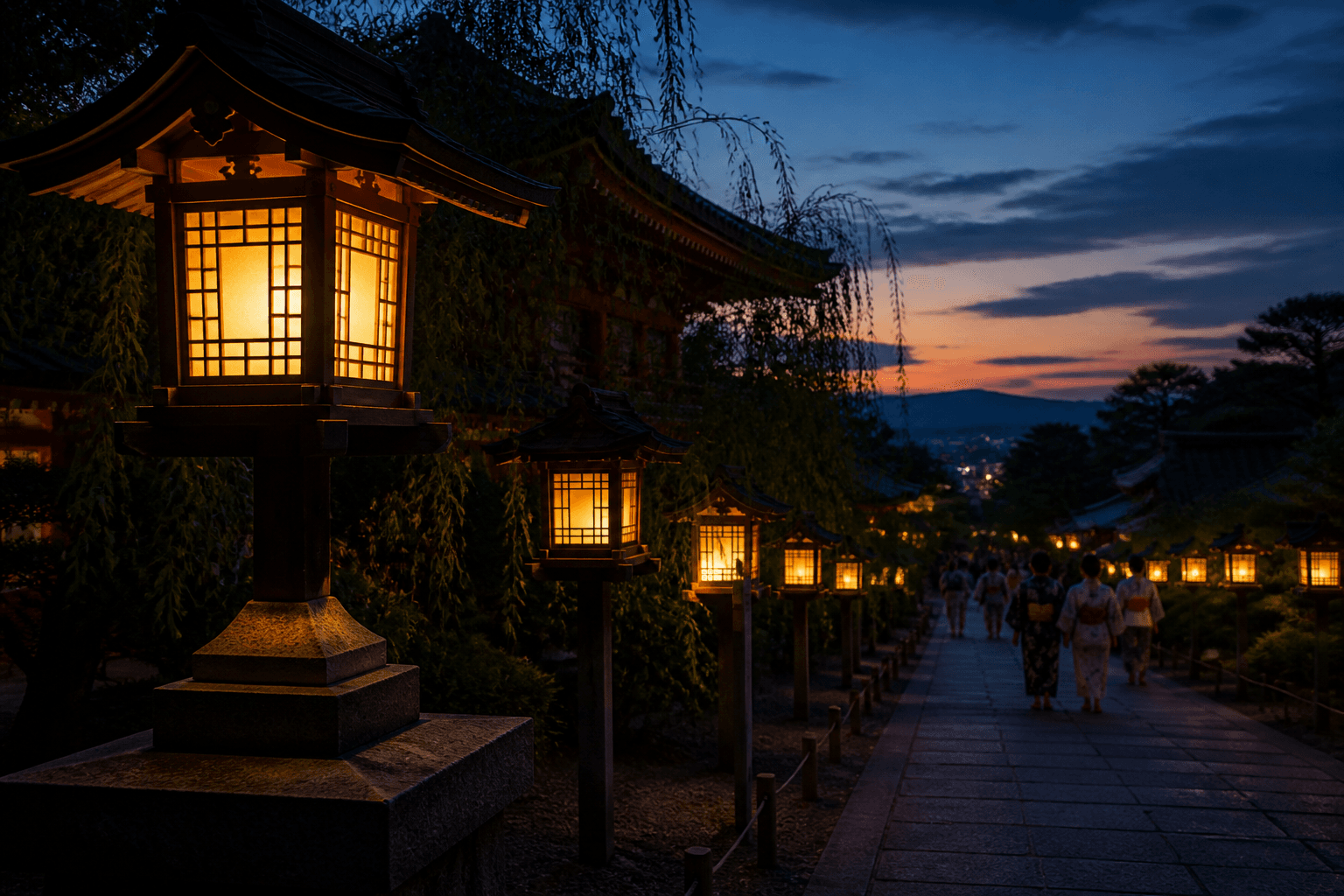
This is why lanterns and fires are so important in many Obon traditions.
Light serves as a guide.
The beginning of Obon may involve mukaebi (迎え火)—welcoming fires intended to guide ancestral spirits home.
The end may involve okuribi (送り火), or sending-off fires, which symbolically guide them back.
Not every region follows exactly the same customs, however.
In Kyoto, for example, the end of Obon is marked by the spectacular Gozan Okuribi (五山送り火), when five large fires are lit on mountains surrounding the city on August 16. The fires include enormous characters and symbolic shapes, and the event is traditionally understood as helping guide the visiting spirits back.
For a traveler in Kyoto, it is one of the most dramatic manifestations of the season.
But the meaning is quieter than the spectacle suggests.
The fire is not simply entertainment.
It is a farewell.
When is Obon?
This is where things become surprisingly complicated.
There is no single nationwide Obon date.
The most commonly observed form of Obon in Japan takes place around August 13–16. JNTO describes the summer Bon holiday as typically running from August 13 to 16.
But some communities observe Obon in July, while Okinawa and some other areas retain customs based on the traditional lunar calendar, meaning their Obon dates can fall at a different time each year.
The reason dates vary is connected to Japan’s adoption of the Gregorian calendar during the Meiji period.
Before the calendar change, Obon was associated with the seventh month of the lunar calendar. After Japan adopted the modern solar calendar, communities adapted in different ways.
As a result, three broad patterns developed:
Where Obon falls on the map
Three broad date patterns after Japan adopted the Gregorian calendar in the Meiji period.
Most of Japan
August Obon
八月盆 · Hachigatsu Bon
13–16 Aug 2026
Dominant nationwide pattern—Kyoto, Osaka, most of Honshu, Shikoku, Kyushu, and Hokkaido. The window tourists should plan around.
Regional pocket
July Obon
七月盆 · Shichigatsu Bon
13–16 Jul 2026
Still observed in parts of Tokyo, Yokohama, and some northern communities. Not all of Greater Tokyo follows this calendar.
Shifts yearly
Lunar Obon
旧盆 · Kyūbon
25–27 Aug 2026
Okinawa and parts of Amami keep the 7th lunar month. Gregorian dates move every year; Eisa dancing is a signature tradition.
Tap a colored zone or marker for local context. Filters on the map isolate August, July, or lunar patterns. Circles are illustrative hubs—not hard prefecture borders.
Patterns summarized from Japan Guide and JNTO regional guidance; local temple and municipal calendars still decide exact practice.
- July Obon (Shichigatsu Bon) — still observed in parts of Tokyo, Yokohama, and some northern communities, typically around July 13–16
- August Obon (Hachigatsu Bon) — the dominant pattern across much of Japan, typically August 13–16
- Lunar-calendar Obon (Kyūbon) — particularly important in Okinawa and parts of the Amami islands; Gregorian dates shift each year
For most international tourists, mid-August is the date that matters most.
In 2026, the commonly observed August Obon period falls on Thursday 13 August through Sunday 16 August. Okinawa’s Kyūbon falls later, on 25–27 August 2026 (lunar 7th month, days 13–15).
And there is another important distinction:
Obon is not a national holiday
Japan’s Cabinet Office lists the country’s statutory national holidays, and Obon does not appear among them. In 2026, the nearby statutory holiday is Mountain Day (山の日) on Tuesday 11 August, which often helps companies extend summer leave into Obon week.
So why does so much of the country seem to take time off?
Because many companies, schools, organizations and businesses arrange summer vacation around Obon.
In practical terms, that makes it function like a major holiday period even though it is not legally a national holiday.
When trains and highways hurt most
A practical day-by-day read for tourists, not a railway timetable.
Tourist calendar — busiest travel days, Obon 2026
Peak domestic travel window anticipated 8–16 August. Outbound surges: 8 & 11–13 Aug. Return surges: 15–16 Aug.
-
8 Aug
Sat
Peak outboundPeak outboundWeekend + early leave from cities. Avoid long-haul Shinkansen if you can.
-
9–10 Aug
Sun–Mon
BusyBusyTravel still elevated; book reserved seats even for mid-day trains.
-
11 Aug
Tue
Mountain Day + outboundMountain Day + outboundNational holiday feeding into Obon. High highway and rail demand.
-
12 Aug
Wed
Busy / Awa Odori opensBusy / Awa Odori opensTokushima Awa Odori begins. Intercity seats remain scarce.
-
13 Aug
Thu
Obon starts + outbound peakObon starts + outbound peakMukae day for most regions. Worst day to relocate between cities.
-
14 Aug
Fri
Core ObonCore ObonStay put. Local Bon Odori nights; some family shops closed.
-
15 Aug
Sat
Return rush beginsReturn rush beginsHometown → city traffic builds. Festival crowds still high.
-
16 Aug
Sun
Peak return + Gozan OkuribiPeak return + Gozan OkuribiReturn peak. Kyoto mountains lit from 20:00; viewing spots pack early.
-
17 Aug+
Mon+
EasingEasingDemand falls after the weekend return. Better for intercity hops.
Strategy: move between cities before 13 Aug or after 16 Aug; spend the core days in one base (Tokyo/Osaka can feel quieter as residents leave). Reserve Nozomi / limited express seats early—JR operators have run all-reserved Nozomi services in recent Obon peaks.
Peak window and outbound/return days: Japan Guide Obon 2026 traffic note. Festival anchors: JNTO (Awa Odori 12–15 Aug; Gozan Okuribi 16 Aug). Mountain Day: Cabinet Office. Always re-check JR Central / JR West and SmartEX for the year’s operating notice.
What happens during Obon?
There is no universal checklist, but a traditional August Obon period often follows a rough sequence.
August 13: Welcoming the ancestors
The first day is often associated with welcoming the spirits home.
Families may clean their homes and graves and prepare offerings.
In some places, mukaebi, or welcoming fires, are lit to guide the ancestors.
The symbolism is straightforward:
“Come home.”
The rituals surrounding this day vary greatly by region.
August 14–15: The ancestors are remembered
The middle of Obon is often the period when families spend time together and perform memorial practices.
People may visit family graves, attend Buddhist services, make offerings and spend time with relatives.
For many Japanese people, this is one of the few periods of the year when geographically dispersed families can reliably reunite.
That is one reason Obon has such enormous implications for domestic travel.
August 16: Sending the ancestors home
The final day is traditionally associated with saying goodbye.
In places where the custom is practiced, okuribi—sending-off fires—are used symbolically to guide the spirits back.
Kyoto’s Gozan Okuribi is Japan’s most famous example.
Five large fires are lit on mountains around Kyoto beginning at 8 p.m. on August 16, with the remaining formations following at five-minute intervals. Each burns for roughly half an hour (Kyoto tourism materials cite about 30 minutes; JNTO describes about 40). The five formations are Daimonji (大), Myō-Hō (妙法), Funagata (船形), Hidari Daimonji (左大文字), and Toriigata (鳥居形).
For visitors, it can look like an enormous public spectacle.
Culturally, it is a farewell.
Bon Odori: Why is everyone dancing?
If you encounter Obon in Japan, there is a good chance you will eventually encounter Bon Odori (盆踊り).
Bon Odori literally means “Bon dance.”
It is one of the most visible and accessible aspects of Obon.
People gather in a circle around a raised platform called a yagura (櫓), while traditional music plays. Dancers move in repeating patterns, often following simple choreographed movements.
The dances vary dramatically from region to region.
There isn’t one “Obon dance.”
There are hundreds of local variations, each connected to regional music, traditions and history.
And unlike some formal religious ceremonies, Bon Odori can be remarkably welcoming to outsiders.
JNTO specifically notes that Bon Odori dancing is often open to everyone, and that basic dances are generally easy to learn by following the people around you.
For a foreign visitor, this may be one of the easiest ways to participate respectfully in Japanese culture.
You don’t need to be Japanese.
You don’t need to dance perfectly.
Watch first.
Follow the people around you.
And understand that you are participating in a living community tradition rather than watching a performance created solely for tourists.
Is Bon Odori a religious ritual?
It can have religious roots, but the modern reality is more complicated.
Bon Odori developed within the broader cultural world of Obon, which has strong Buddhist associations. But contemporary Bon Odori events can also function as neighborhood festivals and community gatherings.
Some are deeply connected to local religious traditions.
Others feel much more like community summer festivals.
Food stalls appear.
Children play games.
People wear yukata.
Music plays.
Neighbors meet.
Visitors join the dancing.
This is one of the defining characteristics of Japanese festivals: the boundary between religious tradition, community celebration and seasonal entertainment is not always as clear-cut as a Western visitor might expect.
Why do Japanese people travel so much during Obon?
This is perhaps the most important thing tourists need to understand.
Obon is a homecoming holiday.
Japan is highly urbanized, and millions of people live far from the towns where their families originated.
Obon provides one of the major opportunities each year for people to return to those hometowns.
Someone who lives in Tokyo may travel to Niigata.
Someone working in Osaka may return to Kyushu.
Someone living in Nagoya may drive back to their family’s home in the countryside.
The result is a huge annual migration.
JNTO’s August guidance describes the Bon period as one of Japan’s busiest and most expensive travel periods, noting that seats on planes, trains and highway buses can sell out in advance—and recommending that visitors either plan ahead or consider staying in large cities, which can enjoy fewer crowds than usual as residents leave.
This is why Obon matters enormously to tourists. For the wider 2026 peak-travel picture (Golden Week, Silver Week, New Year), see our Japan 2026 peak travel periods guide.
What should tourists expect on trains?
If you are traveling between major Japanese cities during Obon, book ahead.
The most famous example is the Tokaido–Sanyo Shinkansen corridor connecting Tokyo, Nagoya, Kyoto, Osaka and western Japan.
During major holiday periods, demand becomes extraordinary.
JR Central and JR West have, in recent peak seasons including Obon 2024 and Obon 2025, operated Nozomi trains with all reserved seats (no non-reserved cars), increasing the number of reserved ordinary seats per train by approximately 30 percent. The exact Obon window is announced each year—check JR Central, JR West, or SmartEX before you travel.
The important lesson is broader:
Don’t treat Obon travel like an ordinary Tuesday
Normally, Japan’s railway system can give travelers an extraordinary amount of flexibility.
During Obon, that flexibility can disappear.
If you know you need to travel from Tokyo to Kyoto on a particular day, reserve your seat rather than assuming you can simply show up.
This is particularly important if you are:
- traveling with several people
- carrying substantial luggage
- trying to sit together
- traveling with children
- catching a flight immediately afterward
- making a connection to another reserved service
JNTO also recommends advance planning during major holiday periods because transportation and accommodations can become crowded and expensive.
What about highways?
The same phenomenon happens on roads.
Millions of people travel by car and highway bus during Obon.
That means major expressways can experience significant congestion.
For tourists renting a car, the implications are straightforward:
A journey that normally takes two hours may take considerably longer during peak Obon travel periods.
Do not build a tightly timed itinerary around normal driving times.
If you have an important flight, hotel check-in or attraction reservation, allow considerably more margin than you would during a normal weekday.
Will everything be closed?
No.
This is one of the most common misconceptions about Obon.
Japan does not shut down.
Tokyo, Osaka, Kyoto and other major cities remain very much alive.
Restaurants, convenience stores, department stores, attractions and hotels can continue operating normally.
However, some independent businesses and family-run establishments may close for several days because their owners and employees are taking their own Obon vacation.
JNTO notes that during Japan’s major holiday periods, many businesses may close or operate reduced hours, and advises travelers to check individual operators in advance.
So don’t assume:
“Everything will be closed.”
Instead think:
“Some things I want to visit may have unusual hours.”
Check before you go.
Is Tokyo empty during Obon?
This is one of the more interesting effects of the holiday.
Tokyo can actually feel less crowded in certain places because so many residents leave the city to visit family or travel.
That doesn’t mean Tokyo becomes empty.
It is still one of the world’s largest metropolitan areas, and international tourism continues.
But compared with ordinary periods, some central neighborhoods can feel surprisingly relaxed.
JNTO specifically recommends considering major cities such as Tokyo and Osaka during the peak Obon period because they can experience fewer crowds than usual as residents leave for their hometowns.
This creates a useful strategy for tourists:
If everyone is leaving Tokyo, you don’t necessarily have to
Instead of following the domestic migration, you can stay in a major city and explore.
Should tourists avoid Japan during Obon?
Not necessarily.
If your priority is the absolute lowest crowds and cheapest domestic transportation, Obon is not ideal.
But if your goal is cultural immersion, Obon can be extraordinary.
You may encounter:
- Bon Odori
- summer festivals
- traditional dances
- family ceremonies
- cemetery visits
- lantern traditions
- regional food
- neighborhood celebrations
- spectacular evening events
The key is planning.
Obon is not a reason to cancel a trip.
It is a reason to understand the calendar.
The best strategy: travel before or after the peak
If your itinerary is flexible, consider traveling between major destinations before August 13 or after August 16 rather than directly through the core period.
Even better, spend the busiest days in one location rather than trying to cross the country.
For example:
Less stressful:
Tokyo → Kyoto before Obon → stay in Kyoto during Obon → Osaka afterward
More stressful:
Tokyo → Kyoto on August 13 → Osaka August 14 → Hiroshima August 15 → Tokyo August 16
The second itinerary places you directly inside one of Japan’s biggest annual transportation movements.
The first lets you settle somewhere and experience the holiday locally.
Obon is different in every region
One of the biggest mistakes tourists make is assuming that “Obon” means the same thing everywhere.
Japan’s regional diversity is enormous.
Obon traditions have developed differently across communities, producing distinctive dances, rituals, foods and festivals.
Some of the country’s most famous summer festivals overlap with the Obon season.
Kyoto: Gozan Okuribi
Kyoto’s Gozan Okuribi is perhaps the most visually famous Obon-related event.
On August 16, enormous fires are lit on mountains surrounding the city.
The best-known formation is Daimonji, the large character meaning “great.”
Four additional fires create other symbolic shapes (Myō-Hō, Funagata, Hidari Daimonji, Toriigata).
The fires begin at 8 p.m., with the remaining formations following at five-minute intervals.
For visitors, it is one of Kyoto’s great summer spectacles—and viewing spots along the Kamo River fill early.
But remember what you are watching:
a farewell to the ancestors.
Entering the mountain sites on the night is restricted; watch from designated city viewpoints.
Tokushima: Awa Odori
In Tokushima, the Obon season becomes one of Japan’s largest dance spectacles.
The Awa Odori takes place annually from August 12–15 and has roots stretching back more than 400 years.
JNTO reports that the festival attracts well over one million people, including dancers and spectators.
The streets transform into enormous dance stages.
Groups of dancers known as ren (連) perform distinctive choreography while musicians provide the soundtrack.
Visitors who are not registered with a troupe can often join the Niwaka Ren for open participation—an excellent example of how Japanese festival culture can invite outsiders into the celebration rather than merely asking them to watch.
Gifu: Gujo Odori
Another extraordinary example is Gujo Odori in Gifu Prefecture.
The festival has a history of roughly 400 years and features ten recognized dances. (It was inscribed on UNESCO’s Intangible Cultural Heritage list in late 2022.)
Its peak occurs during the Obon period, when the town fills with dancers. In 2026, the four Obon nights are scheduled for August 13–16, with all-night dancing on those peak evenings.
JNTO describes Gujo Odori as one of Japan’s three most important Bon festivals and notes that it is particularly welcoming to visitors.
It is a powerful reminder that Obon isn’t one festival.
It is an entire family of regional traditions.
Okinawa: A different Obon experience
Okinawa deserves special attention.
Okinawan Obon traditions differ significantly from those found in mainland Japan, and dates also differ because many communities retain lunar-calendar practices (Kyūbon). In 2026, that window is 25–27 August (with some areas extending a fourth day).
One of the most recognizable Okinawan Obon traditions is Eisa (エイサー), a powerful style of group dancing involving drums and movement.
Visitors should therefore avoid assuming that mainland Japanese customs automatically apply to Okinawa.
Okinawa has its own historical and cultural traditions, and Obon is an excellent example.
What happens at Japanese cemeteries during Obon?
For many families, visiting the family grave is one of the most important parts of Obon.
Graves may be cleaned.
Flowers and offerings may be placed.
Incense may be burned.
Families may pray or perform memorial rites.
This is not a tourist attraction.
That distinction matters.
You may encounter people performing these rituals at a cemetery or temple. If you do, behave as you would when encountering any private family ceremony.
Don’t crowd people.
Don’t interrupt.
Don’t photograph intimate moments without permission.
And don’t treat the presence of graves as an invitation to turn someone’s remembrance of a family member into a photo opportunity.
Can tourists visit temples during Obon?
Yes—but with awareness.
Japan’s Buddhist temples are deeply connected to Obon, and some hold public ceremonies or events.
Visitors may also encounter memorial tablets, offerings, lanterns and other objects associated with the season.
Observe the distinction between:
a public festival
and
a private religious ceremony.
A Bon Odori held in a public square is generally designed as a community event.
A family’s memorial service at a temple is different.
When in doubt, watch quietly and follow posted instructions.
What are the lanterns for?
Lanterns are among the most recognizable visual symbols of Obon.
They can have several meanings depending on the region and context, but broadly they are associated with guiding or welcoming ancestral spirits.
Some families display lanterns at home.
Others participate in lantern-related ceremonies.
One of the most beautiful traditions is tōrō nagashi (灯籠流し), in which lanterns are floated on water.
These ceremonies can be especially poignant because they combine light, water and remembrance.
But again, the precise practice varies by location.
Why are vegetables sometimes shaped like animals?
Visitors may encounter a particularly charming Obon tradition involving vegetables.
In some households, cucumbers and eggplants are fashioned into small animal-like forms using toothpicks or chopsticks.
The cucumber becomes a horse (精霊馬 / shōryō-uma).
The eggplant becomes an ox.
The symbolism varies by tradition, but the basic idea is that the horse allows the ancestors to arrive quickly, while the slower ox carries them home again.
Not every family does this, and it should not be presented as a universal Japanese custom.
It is one of the many household traditions that reveal how intimate Obon can be.
What is Shōjin Ryōri?
Some Buddhist traditions associated with Obon involve shōjin ryōri (精進料理), vegetarian Buddhist cuisine.
Historically, Buddhist dietary practices have influenced Japanese food culture in profound ways.
During memorial occasions, vegetarian dishes may be prepared and offered.
Again, however, this should not be presented as a nationwide rule that every Japanese family follows during Obon.
Modern Japanese Obon meals vary enormously according to family, region and personal practice.
What should tourists wear to Bon Odori?
You do not need a traditional Japanese outfit to attend.
Locals may wear yukata, a lightweight summer kimono, particularly at festivals.
Visitors are welcome to do the same if they wish, but ordinary summer clothing is perfectly acceptable at many public events.
The more important thing is behavior.
Wear something comfortable.
Stay respectful.
Don’t push into the dance circle.
Watch the movements.
Join when appropriate.
And remember that the event belongs to the community.
You are a guest participating in it.
Can foreigners participate in Bon Odori?
Often, yes.
In fact, Bon Odori can be one of the best cultural experiences available to a visitor.
JNTO explicitly encourages visitors to participate in local festivals and notes that Bon Odori dancing is generally open to everyone.
You don’t need perfect Japanese.
You don’t need perfect dancing.
Stand toward the outside of the circle and follow along.
Most Bon Odori movements are repetitive, which makes them surprisingly easy to learn.
And if you make a mistake?
You will probably not be the first person to do so.
What should tourists NOT do?
A few rules will take you a long way.
-
1
Don’t treat Obon as Halloween.
The deceased are being remembered, not turned into entertainment.
-
2
Don’t photograph private mourning without permission.
A family visiting a grave is not a tourist attraction.
-
3
Don’t enter restricted religious areas.
Follow signs and barriers. On Gozan Okuribi night, mountain sites are closed.
-
4
Don’t touch religious objects because they look interesting.
Observe first; ask if unsure.
-
5
Don’t block paths during ceremonies.
Especially important in crowded festivals and riverside viewing spots.
-
6
Don’t assume every Obon event is a tourist attraction.
Some are community or family religious events.
-
7
Don’t expect every region to follow the same traditions.
Japan has enormous regional variation.
-
8
Don’t assume August 13–16 is the only Obon period.
July Obon and lunar Kyūbon calendars also exist.
Obon is also a lesson in Japanese family life
Perhaps the most important thing for a foreign visitor to understand is that Obon isn’t fundamentally about festivals.
It is about relationships across generations.
Japan has undergone enormous demographic, economic and social changes.
People have moved from rural areas to cities.
Families have become geographically dispersed.
Yet Obon continues to provide an annual moment when many people return to the places from which their families came.
The modern journey may involve a high-speed shinkansen instead of a horse-drawn cart.
The destination might be a small house in a rural village.
The reason is remarkably old:
go home.
Visit the people who came before you.
Remember them.
Spend time with the people who are still here.
Then return to everyday life.
Why Obon can feel both joyful and melancholy
This duality is what makes Obon so fascinating.
It is not simply a celebration.
And it is not simply mourning.
It contains both.
There is dancing.
There is laughter.
There are food stalls and children.
There are fireworks and summer nights.
But there are also graves, incense, memorial services and remembrance.
That mixture is not contradictory.
It reflects a very human understanding of death:
the dead remain part of the living family through memory.
Obon gives that idea a calendar date, a ritual language and a physical presence.
Is Obon Japan’s version of Day of the Dead?
The comparison is tempting.
Both involve remembrance of deceased loved ones.
Both can include food, family gatherings and distinctive public traditions.
But they are not the same tradition.
Mexico’s Día de los Muertos developed through its own combination of Indigenous traditions and Catholic influences.
Obon developed through Japanese Buddhist traditions and indigenous Japanese approaches to ancestors and the dead.
Comparisons can help outsiders understand the emotional role of a festival, but they should not erase the differences between cultures.
The Buddhist roots of Obon
The word Obon is generally connected with the Buddhist tradition of Urabon (盂蘭盆), itself associated with the Sanskrit term ullambana.
The traditional Buddhist story commonly associated with Obon tells of Maudgalyayana (Mokuren / 目連 in Japanese), one of the Buddha’s disciples, who discovers that his deceased mother is suffering and seeks the Buddha’s guidance.
Through offerings and acts of merit dedicated to Buddhist monks, he is able to help her.
The story became associated with the practice of honoring and making offerings for deceased ancestors.
Over centuries, Buddhist practices interacted with Japanese traditions surrounding ancestors, creating the Obon customs familiar today.
The result is not a purely Buddhist festival in the narrow institutional sense.
It is a deeply Japanese cultural tradition shaped by multiple layers of history.
Obon and Japan’s complicated relationship with death
One reason Obon can seem unfamiliar to Western visitors is that modern societies often separate everyday life from death.
Death happens in hospitals.
Funerals happen in designated places.
Cemeteries are often physically removed from daily life.
Obon brings remembrance back into the center of family life.
The ancestors are not simply absent.
They are symbolically invited home.
They are given offerings.
Their graves are cleaned.
Their memory becomes part of the household.
And then they are sent away again.
That annual rhythm helps explain why Obon can feel simultaneously intimate and public.
Why August is such a big month for Japan
Obon isn’t the only reason August is important.
Japan’s summer calendar is filled with festivals and fireworks.
Some major events happen immediately before or during Obon.
For example, Aomori’s Nebuta Festival (typically early August), Akita’s Kanto Festival and Sendai’s Tanabata Festival occur in early August.
Tokushima’s Awa Odori follows during the Obon period.
Kyoto’s Gozan Okuribi comes at the end.
The result is one of the richest cultural periods of the Japanese calendar.
For travelers who understand the timing, August can therefore be much more than simply “hot season.”
It is festival season.
But August in Japan is hot
There is another practical consideration tourists sometimes underestimate.
August is extremely hot and humid across much of Japan.
JNTO describes summer across much of Honshu and Kyushu as hot and humid and recommends lightweight, breathable clothing.
That matters during Obon because many of the most interesting events take place outdoors.
Bon Odori often occurs at night, which helps.
But you may still spend hours standing in heat and humidity before the temperature falls.
Bring water.
Take breaks.
Seek shade or air conditioning.
And don’t confuse cultural enthusiasm with a requirement to stay outside for hours.
The tourist’s Obon survival guide
If you’re visiting Japan during Obon, keep these rules in mind.
-
1
Book long-distance transportation early
Especially if you know the exact day and route. Check yearly Nozomi all-reserved notices.
-
2
Reserve hotels early
JNTO identifies Obon as one of Japan’s major peak travel periods.
-
3
Avoid unnecessary intercity hops on peak days
Choose one base and explore locally through 13–16 Aug.
-
4
Check business hours
Independent restaurants and family shops may close for Obon leave.
-
5
Check festival dates separately
“Obon” does not mean every region celebrates on the same dates.
-
6
Expect crowds at major festivals
Awa Odori and similar events can draw a million people.
-
7
Participate respectfully
Public Bon Odori is often welcoming; private memorial rites are not.
-
8
Give yourself extra transport time
Highways and buses slow dramatically on outbound and return peaks.
-
9
Consider Tokyo or Osaka on peak days
Cities can feel quieter as residents leave for hometowns.
-
10
Don’t confuse “busy” with “bad”
Obon crowds are part of the cultural experience.
The best way to experience Obon as a foreigner
There is a temptation when visiting Japan to search for “authentic” experiences.
Obon offers something better.
It allows you to witness an ordinary part of Japanese life that isn’t necessarily designed for foreigners.
Go to a local Bon Odori.
Watch the dancers.
Eat something from a festival stall.
Observe how families and neighbors interact.
If people invite you to participate, join in.
If a ceremony is clearly private, step back.
The objective isn’t to “consume” Japanese culture.
It is to encounter it respectfully.
Three things every tourist should remember
If you remember nothing else, remember these:
-
Obon is about ancestors.
Dancing, lanterns and festivals express a deeper tradition of remembering the dead.
-
Obon is one of Japan’s biggest travel periods.
Expect crowded trains, busy roads and scarce accommodation—plan accordingly.
-
Obon isn’t one identical festival.
July Obon, August Obon and lunar Kyūbon all exist; regional difference is the point.
So, should you visit Japan during Obon?
If you have no choice, don’t worry.
Japan remains open.
If you have flexibility, however, understand what you are choosing.
Traveling during Obon means entering one of Japan’s busiest domestic travel periods.
But it also means encountering Japan at one of its most culturally expressive times.
You might watch thousands of people dance beneath a summer sky.
You might stumble upon a neighborhood festival.
You might see lanterns floating down a river.
You might stand in Kyoto and watch enormous fires appear on the mountains.
Or you might simply notice something quieter:
a family returning to an old hometown.
A grave being carefully cleaned.
Flowers being placed.
Incense rising into the summer air.
That may be the most important part of Obon.
The festival is spectacular.
The meaning is intimate.
And for a visitor willing to look beyond the crowds and colorful yukata, Obon offers a glimpse into something much deeper than Japanese summer entertainment.
It offers a glimpse into how Japan remembers.
And, perhaps most importantly, how it continues to make room for the people who are no longer here.
Obon at a glance
| Question | Answer |
|---|---|
| What is Obon? | A Japanese tradition centered on remembering and honoring deceased ancestors |
| When is it in 2026? | Most of Japan: 13–16 Aug; parts of Tokyo/Yokohama: ~13–16 Jul; Okinawa Kyūbon: 25–27 Aug |
| Is it a national holiday? | No (Mountain Day on 11 Aug 2026 is the nearby statutory holiday) |
| Why is August so busy? | Hometown returns + company summer leave; peak domestic travel ~8–16 Aug |
| What is Bon Odori? | Traditional community dancing associated with Obon |
| Can tourists participate? | Often yes, particularly at public Bon Odori events |
| Should you reserve trains? | Yes—especially long-distance travel; check yearly Nozomi all-reserved notices |
| Will Japan shut down? | No, although some businesses may close or reduce hours |
| Are all Obon traditions the same? | No; regional differences are substantial |
| What is Gozan Okuribi? | Kyoto’s 16 Aug mountain-fire ceremony sending off the ancestors (from 20:00) |
| What should tourists be most careful about? | Respecting private memorial rituals and planning around peak domestic travel |
FAQ
When is Obon in Japan in 2026?
Most of Japan observes Obon from Thursday 13 August through Sunday 16 August 2026. Parts of Tokyo, Yokohama, and some northern communities keep July Obon around 13–16 July. Okinawa’s lunar-calendar Kyūbon falls on 25–27 August 2026. Obon itself is not a statutory national holiday; Mountain Day on 11 August 2026 is the nearby Cabinet Office holiday.
Is Obon a national holiday in Japan?
No. The Cabinet Office list of 国民の祝日 does not include Obon. Many companies still grant summer leave around mid-August, so trains, highways, and hotels behave as if it were a major national holiday period.
Should tourists avoid Japan during Obon?
Not necessarily. Intercity transport and some accommodations are expensive and crowded, especially around 8–16 August 2026. Cultural experiences such as Bon Odori, Awa Odori, and Kyoto’s Gozan Okuribi can be exceptional. Reserve seats early, avoid unnecessary city-to-city hops on peak days, or base yourself in Tokyo or Osaka while residents leave for hometowns.
Can foreigners join Bon Odori dancing?
Often yes. JNTO notes that Bon Odori is generally open to everyone and that basic steps are easy to learn by following the circle. Public neighborhood dances are welcoming; private family memorial rites at graves or temples are not spectator events and should not be photographed without permission.
Will shops and restaurants close during Obon?
Japan does not shut down. Convenience stores, major attractions, hotels, and many restaurants in large cities stay open. Some independent and family-run businesses close or reduce hours while owners take Obon leave—check hours for specific places you care about.
What are the busiest Obon travel days in 2026?
Japan Guide anticipates the peak domestic travel window between 8 and 16 August 2026, with outbound surges on 8 and 11–13 August and return surges on 15–16 August. Mountain Day on 11 August often intensifies the outbound rush. Reserve Shinkansen seats early and confirm whether Nozomi trains are all-reserved for that year’s Obon notice.
Sources and further reading
- Japan National Tourism Organization — Japan in August (Bon period travel advice; big-city strategy); Awa Odori; Gujo Odori; Kyoto Gozan Okuribi; summer budget tip on Obon
- Cabinet Office of Japan — 国民の祝日 (2026 statutory holidays; Obon not listed; Mountain Day 11 Aug 2026)
- Kyoto City / Kyoto Travel — Gozan Okuribi (lighting sequence from 20:00; ~30-minute burn)
- Japan Guide — Obon (regional date patterns; 2026 peak travel 8–16 Aug, outbound/return days)
- JR Central — Obon / peak-period Nozomi all-reserved-seat notices (year-specific; ~30% more reserved ordinary seats when applied)
- Gujo Hachiman Tourism — 2026 Gujo Odori schedule (Obon nights 13–16 Aug)
- Okinawa cultural calendars — Kyūbon 2026 as lunar 7/13–15 → 25–27 August 2026 (confirm local Unkee / Nakabi / Ūkui practice)
A final note on the title
“Japan’s ‘Ghost Holiday’” is deliberately provocative, but the phrase is a journalistic shorthand, not the Japanese name or a literal description of Obon.
The heart of Obon is not fear of ghosts.
It is remembrance.
And that distinction is exactly what makes the tradition worth understanding.
Continue Reading

Japan's 2026 Summer Fireworks (Hanabi) Guide: Dates, Tickets, and Best Viewpoints
Summer in Japan is defined by Hanabi Taikai—massive fireworks festivals that paint the night sky. From Tokyo's historic Sumidagawa to the grand displays of Nagaoka, here is your complete guide to 2026 schedules, ticketing, and viewing locations.
Japan’s Centenarians Top 100,000 for the First Time—What the Numbers Actually Say
MHLW’s Reiwa 8 release (15 September 2026): 107,677 people aged 100+, first time over 100,000 since 1963—+7,914 from 99,763, 87.6% women, Shimane’s rate lead, and why 老人の日 is not Silver Week’s 敬老の日.
Silver Week in Japan: What It Is, Why 2026 Is Five Days, and What People Actually Do
Japan’s third full five-day Silver Week since 2009 and 2015 runs 19–23 September 2026: Respect for the Aged Day, a Citizens’ Holiday sandwich, and the Autumnal Equinox—what it is, what families do, and how travellers should handle trains, Tokyo, and Nagoya.

If you're looking for nicely crafted Japan tours, check out: Arigato Travel's experiences.Partner link