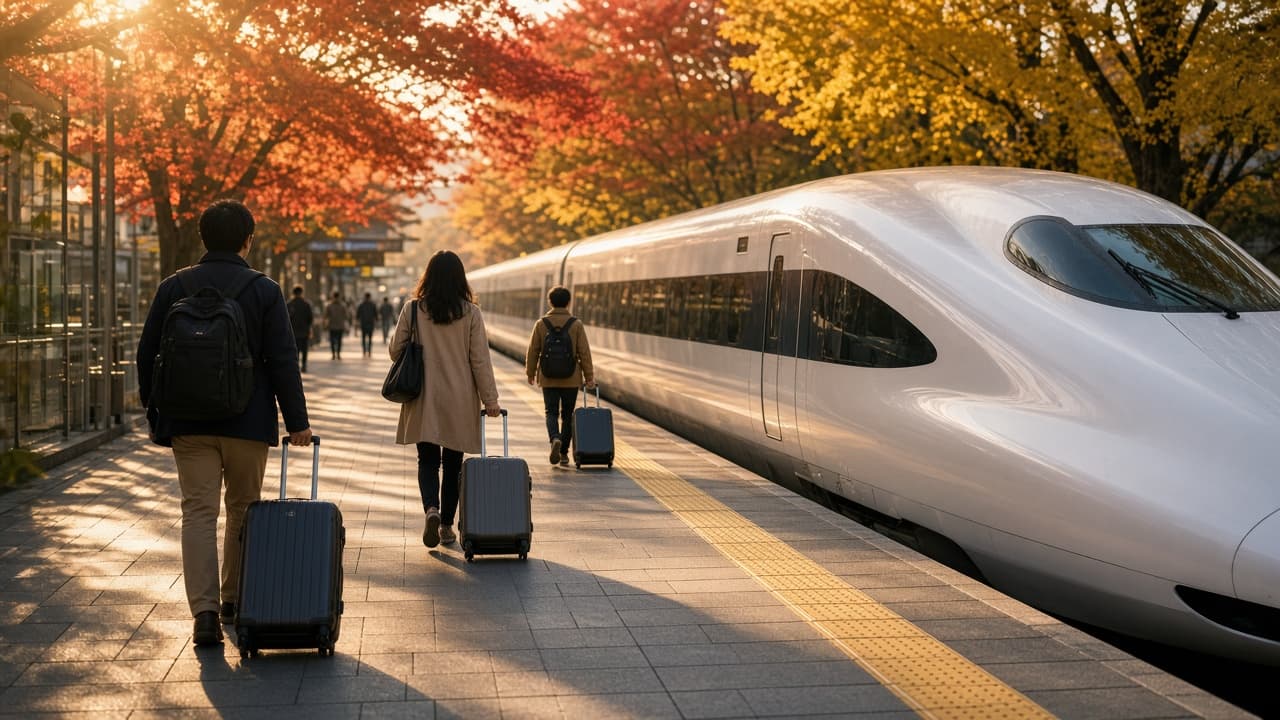
On Monday, November 23, 2026, Japan marks Labor Thanksgiving Day (勤労感謝の日, Kinrō Kansha no Hi). Together with the weekend it makes a three-day break, November 21–23, and the bullet trains between Tokyo and Hakata run with a special rule that surprises many travelers: every Nozomi is reserved-seat only. Here is what the holiday is, what is different that weekend, and what to book if you are travelling.
The holiday's date and purpose come from Japan's Cabinet Office. Train rules come from JR Central and JR West. The ceremony at the Imperial Palace is described by the Imperial Household Agency. Links, with dates, are at the end.
The short answer
-
The date
Monday, November 23, 2026. It is a national holiday every year on November 23, and it does not move.
-
The long weekend
Saturday, November 21 to Monday, November 23: three days off for most people in Japan.
-
What the day is for
The law says it is a day "to honor labor, to celebrate production, and for the people to thank one another". Its older roots are in a harvest ritual, Niinamesai.
-
The big travel catch
From November 21 to 23, every Nozomi on the Tokaido and Sanyo Shinkansen (Tokyo–Hakata) is all-reserved. A non-reserved ticket does not get you a seat on a Nozomi.
-
If you have no seat
Book a reserved seat, or use a Hikari or Kodama, which keep non-reserved cars as usual (they may be crowded).
What is Labor Thanksgiving Day?
Labor Thanksgiving Day is one of the 16 national holidays set by Japan's Act on National Holidays (1948). The Cabinet Office's summary of the law gives each holiday a purpose. For November 23 it is, in our plain-English translation: to honor labor, celebrate production, and for people to thank one another.
Note the last part. It is not only "thank the workers"; it is "thank one another". That is why it is a good day for small gestures: a card for a colleague, a meal with family, a thank-you to the person who runs your neighborhood shop.
The date is fixed. The Cabinet Office table of holidays for 2026 and 2027 lists it on November 23 both years: a Monday in 2026 and a Tuesday in 2027.
Why is it a long weekend in 2026?
November 23 falls on a Monday this year, so the holiday sits right after a Saturday and a Sunday.
| Date | Day | Status |
|---|---|---|
| November 21 | Saturday | Weekend |
| November 22 | Sunday | Weekend |
| November 23 | Monday | Labor Thanksgiving Day, national holiday |
If a holiday lands on a Sunday, the law makes the next non-holiday day a day off instead. That rule does not apply in 2026, because the holiday is on a Monday already.
JR Central and JR West also treat this weekend as one of the year's busy travel periods, which is why the train rules below apply.
What changes on the Shinkansen from November 21 to 23?
JR Central and JR West announced on May 21, 2026 that, for the second half of fiscal 2026, the three-day weekends would also get "all-reserved" Nozomi service. They previously did this for Golden Week, Obon, Silver Week and the year-end holidays. For this weekend, the announced period is November 21 (Sat) to November 23 (Mon, holiday).
Here is what that means in practice, based on JR Central's English guidance:
| Question | Answer |
|---|---|
| Which trains? | Every Nozomi on the Tokaido and Sanyo Shinkansen between Tokyo and Hakata |
| What is different? | The non-reserved cars (normally cars 1 and 2) become reserved. There are no non-reserved seats on any Nozomi. |
| Can I sit with a non-reserved ticket? | No. With a non-reserved limited express ticket you may board a Nozomi only by standing in the passageway (not in the Green Car, cars 8 to 10) |
| Do other trains change? | No. Hikari, Kodama, Mizuho, Sakura and Tsubame keep non-reserved seats as usual. JR notes Hikari and Kodama non-reserved cars may be very crowded. |
| When do reserved seats go on sale? | 10:00 JST, one month before the travel date. Shinkansen Online Reservation (Smart EX or Express Reservation) also releases some seats up to a year ahead. For November 21–23 the one-month sale has already opened. |
| I already have a non-reserved ticket. | JR says you can change it once without a change fee at a major-station counter or some ticket machines, paying the price difference |
| Can a Japan Rail Pass holder use the Nozomi? | Not on the pass alone. JR Central says that in these periods pass holders can buy a separate Nozomi/Mizuho ticket. If it is for a non-reserved seat, you stand. Or reserve a seat on a Hikari or Kodama. |
If the train you want is full, JR's advice is to try a different time or day, since the busiest hours are concentrated.
What is Niinamesai, the older holiday behind November 23?
Before 1948, November 23 was not "Labor Thanksgiving Day". It was a day for an ancient rite, Niinamesai (新嘗祭), which gives the date a second meaning.
The Imperial Household Agency lists Niinamesai under November 23 among the main court rites and calls it the most important of the regular ceremonies held at the palace. It describes the Emperor offering the year's new grain to the gods at the Shinkaden hall, giving thanks, and then eating the grain himself. The agency adds that grain grown by the Emperor himself is among the offerings.
The ceremony is held inside the palace at night, and the Yomiuri Shimbun describes it as closed to the public. Ise Jingu's own announcement for 2026 says it offers ceremonial food and an imperial offering on November 23, and that Niinamesai continues at all of its shrines through November 29. If you want to see a harvest-thanks festival, check the announcement of the shrine you plan to visit for times and public access.
For visitors, the takeaway is simple: November 23 is a harvest-thanks day wearing a modern name. New-crop rice is a fitting thing to eat that day.
What is open and closed on a Japanese national holiday?
The law makes every national holiday a day off. In practice, schools and many offices close, while restaurants, shops, museums, attractions and transport usually run, often to a holiday schedule. Hours vary, so check each place's own site before you go, especially for small museums, public facilities and anything you must book.
Two points for travelers:
- Trains and highways are busier. The Shinkansen rule above is the clearest sign. Buses and local lines may also run holiday timetables, so check them on the day.
- Reserve what you can. Popular restaurants, hotels and day trips are more likely to be full over a three-day weekend, so book ahead.
Who else is travelling that weekend?
Mid-to-late November is also the autumn-leaf season in many parts of Japan, and, as the Meiji Jingu guidance in our Shichi-Go-San guide notes, families often visit shrines on convenient weekends and holidays around November 15, which can include this weekend. If you plan to see the leaves, our autumn foliage guide explains how to time and plan a visit. Our overview of the year's peak travel periods lists the other big holiday windows.
FAQ
When is Labor Thanksgiving Day in 2026?
Monday, November 23, 2026. It is a fixed-date national holiday, so every year it is on November 23. In 2027 it falls on a Tuesday.
Is November 21–23, 2026 a long weekend in Japan?
Yes. Saturday, November 21 and Sunday, November 22 are the weekend, and Monday, November 23 is the holiday.
What does Labor Thanksgiving Day celebrate?
According to the Act on National Holidays, summarized by the Cabinet Office, it is a day to honor labor, celebrate production and for people to thank one another. Its older roots are in Niinamesai, the harvest rite of offering new grain to the gods.
Are all Nozomi trains reserved from November 21 to 23, 2026?
Yes. JR Central and JR West have announced that every Nozomi on the Tokaido and Sanyo Shinkansen between Tokyo and Hakata is all-reserved for this period. Hikari, Kodama and the other trains keep non-reserved cars.
Can I stand on a Nozomi with a non-reserved ticket?
JR says you may board a Nozomi with a non-reserved limited express ticket by standing in the passageway of an ordinary car, but not in the Green Car. JR also warns that crowding may prevent you from boarding the train you want. Staff may direct you to another train.
Can I use a Japan Rail Pass on the Nozomi that weekend?
Not on the pass by itself. JR Central says pass holders can buy a separate Nozomi/Mizuho ticket for these periods; for a non-reserved seat you stand. You can also book a reserved seat on a Hikari or Kodama.
Are shops and attractions open on Labor Thanksgiving Day?
Many are, but it varies. Public holidays are days off for schools and many offices, while businesses decide their own hours. Check each site, and book popular places early.
What is Niinamesai?
An imperial harvest-thanks ceremony held at the palace on November 23, in which the Emperor offers the year's new grain to the gods and then eats it himself. The Imperial Household Agency calls it the most important of its regular ceremonies. It is held privately inside the palace.
Bottom line
November 23 is both a modern "thank one another" holiday and an ancient harvest-thanks day. For travelers, the practical point is the train: if you are riding the Tokaido or Sanyo Shinkansen on November 21–23, reserve a seat, ideally the return trip first, and have a backup in a Hikari or Kodama.
A day to honor work, celebrate the harvest, and say thank you to each other.
Sources and further reading
- Cabinet Office of Japan — National holidays (Japanese) (2026 and 2027 holiday tables; the purpose of Labor Thanksgiving Day under the Act on National Holidays; substitute-holiday rules)
- JR Central and JR West — Press release, May 21, 2026: all-reserved Nozomi periods added for FY2026 (Japanese, PDF) (November 21–23 period; ticket rules); JR Central Global: peak-period all-reserved Nozomi guide (English) (boarding rules, sale timing, Japan Rail Pass note)
- Imperial Household Agency — Major ceremonies (Japanese) (Niinamesai on November 23)
- Yomiuri Shimbun — Niinamesai and Labor Thanksgiving Day (Japanese), November 11, 2024 (the ceremony is held at night and is not open to the public)
- Ise Jingu — Niinamesai announcement (Japanese) (November 23 ceremonies and the period through November 29)
- The Japanist — Shichi-Go-San 2026 guide; Japan's autumn leaves (koyo) guide; Japan's 2026 peak travel periods
Method note: Train rules, dates and sale times are those published by JR Central and JR West as of November 9, 2026, and JR can change them, for example after a major disruption. Translations of Japanese sources are ours. Check operators' own sites before you travel.
Continue Reading
 Illustration, not a photo: this image was generated with AI.
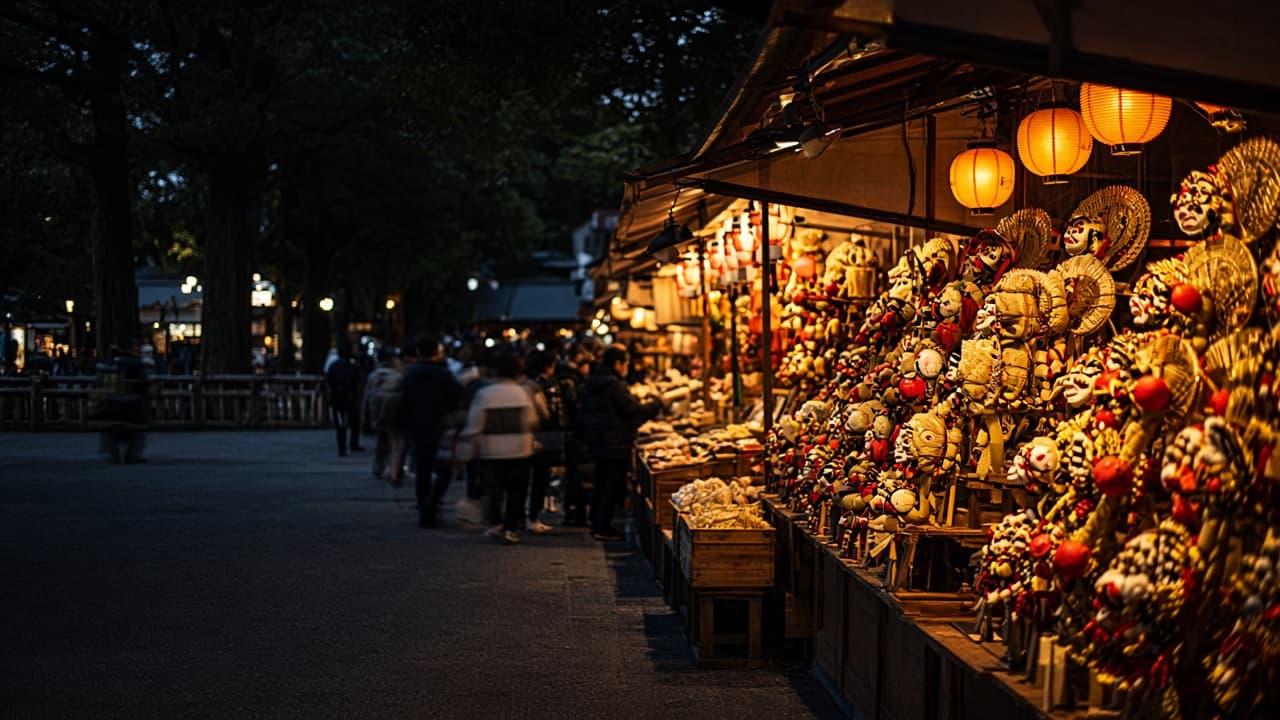
Tori no Ichi 2026: Tokyo’s Rooster-Day Fair, Lucky Kumade Rakes and How to Visit
Tokyo’s rooster-day fair falls on Saturday, November 7 and Thursday, November 19 in 2026. At the Asakusa Otori Shrine each fair day runs from midnight to midnight, with about 150 kumade stalls and 700,000–800,000 visitors. What kumade are, how to haggle and clap the deal, ceremony times, stations and Shinjuku’s Hanazono fair.
 Illustration, not a photo: this image was generated with AI.
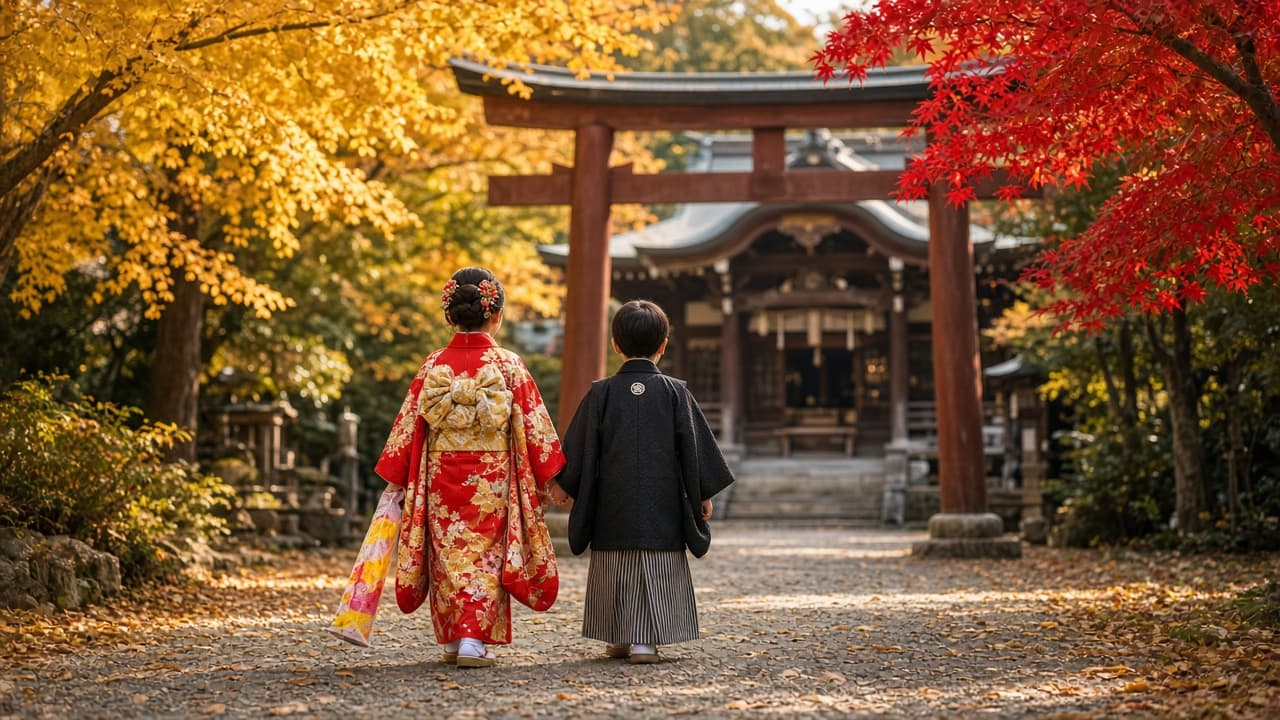
Shichi-Go-San 2026: Japan’s Day for Children Aged 3, 5 and 7, Explained
Shichi-Go-San’s traditional date, November 15, falls on a Sunday in 2026 and is not a public holiday. Which ages celebrate, what children wear, why chitose-ame candy matters, and how a family prayer works at Meiji Jingu: no booking, offerings from ¥5,000, gates closing at 16:10 in November.
 Illustration, not a photo: this image was generated with AI.
Japan’s “Ghost Holiday”: What Obon Really Means—and Why It Matters to Tourists
Obon is Japan’s ancestor homecoming—not Halloween. 2026 dates (Aug 13–16, July Obon, Okinawa Kyūbon), a regional date map, peak travel days, Bon Odori etiquette, and why trains sell out.