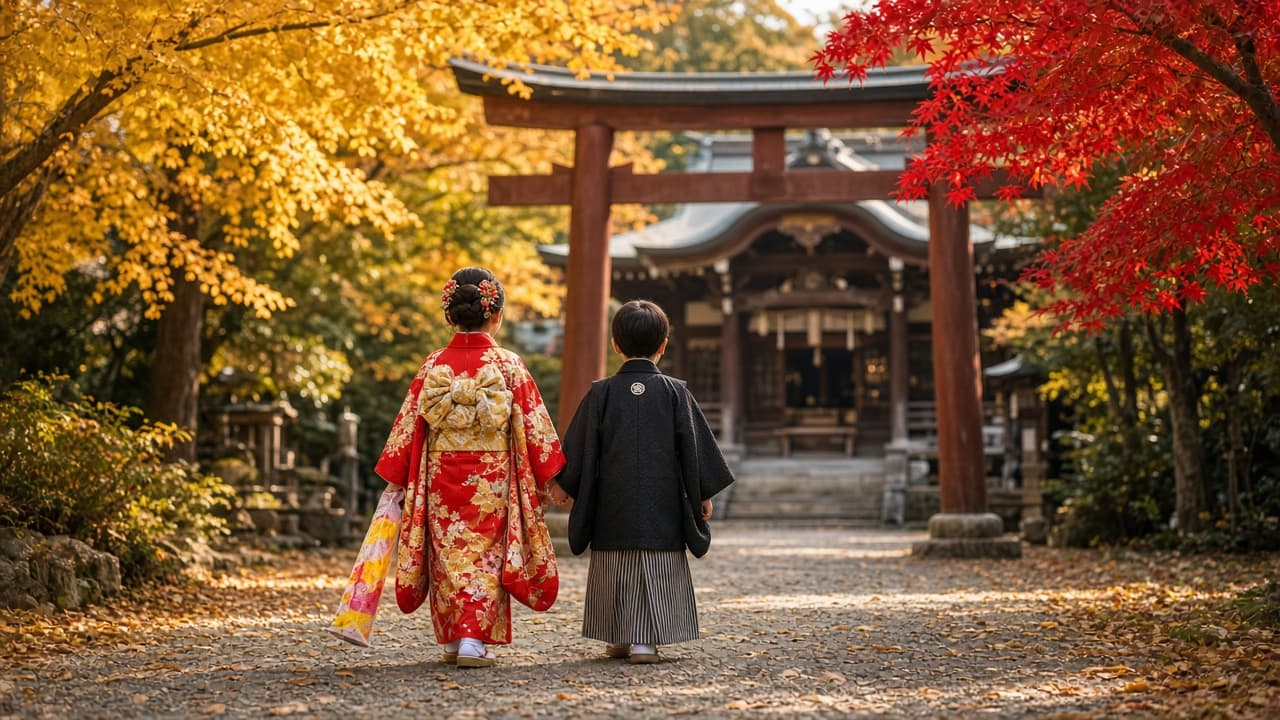
In November, Japan's shrines fill with tiny kimono. Three-year-olds in bright red vests, five-year-old boys in their first hakama and seven-year-old girls in long-sleeved kimono walk up to the shrine with their parents and grandparents, often clutching a long bag of candy. This is Shichi-Go-San, "seven-five-three", the day families give thanks that a child has grown up safely so far. The traditional date, November 15, falls on a Sunday in 2026. Here is what the celebration means, who takes part, and what to expect if you visit a shrine, with Tokyo's Meiji Jingu as a worked example.
Facts about the custom, ages, clothing and Meiji Jingu's prayers come from the shrine's official pages. Holiday dates come from Japan's Cabinet Office. Links are at the end.
The short answer
-
The date
The traditional day is November 15, which is a Sunday in 2026. It is not a public holiday, and many families visit on a convenient weekend or holiday around it.
-
Who celebrates
By today's usual practice, girls at 3 and 7 and boys at 5 (in some regions boys at 3 too), counting actual age.
-
What happens
Families visit a shrine to thank the gods for the child's healthy growth and pray for future happiness and a long life.
-
What children wear
Three-year-old girls often wear a red sleeveless hifu vest, five-year-old boys their first hakama, and seven-year-old girls a kimono tied with a proper obi.
-
The candy
Long red-and-white sticks of chitose-ame, "thousand-year candy", a treat Japan's farm ministry lists as Shichi-Go-San's festive food.
-
At Meiji Jingu
No booking is needed for a family prayer. Register on the day; offerings start at ¥5,000, and the gates close at 16:10 in November.
What is Shichi-Go-San?
Shichi-Go-San (七五三) simply means "seven, five, three". It is a rite of passage for young children. Families take a child to a shrine at ages 3, 5 or 7 to give thanks that they have grown up safely and to pray for a happy future and a long life.
Meiji Jingu explains that it began as a ceremony of the imperial court and the nobility and spread to ordinary people later. In an age when many babies and small children died, children under seven were thought of as "children of the gods". Only at seven were they seen as full members of the community, which is why getting a child safely to these ages was worth celebrating.
The modern Shichi-Go-San brings together three older ceremonies. According to Meiji Jingu, the present form settled in the Meiji era (1868–1912):
| Age | Old ceremony | What it marked |
|---|---|---|
| 3, boys and girls | Kamioki (髪置き) | Starting to let the hair grow |
| 5, boys | Hakamagi (袴着) | Wearing a hakama for the first time |
| 7, girls | Obitoki (帯解き), also called himotoki | Wearing a proper obi for the first time, instead of ties |
Which ages celebrate Shichi-Go-San?
Today the usual pattern, as Meiji Jingu describes it, is:
- Girls: at 3 and again at 7
- Boys: at 5, and in some regions also at 3
In the past, ages were counted in kazoedoshi, the traditional system in which a baby is one at birth and everyone gains a year at New Year. Under that system boys celebrated at 3 and 5 and girls at 3 and 7. Now most families use the child's actual age.
Meiji Jingu is relaxed about it. It says families don't need to be strict about age, and that it is fine to celebrate siblings together in a single visit.
Why November 15?
Nobody knows for certain. Meiji Jingu says there are several theories. One is that November 15 was kijukunichi (鬼宿日), considered the luckiest day in the old almanac. Another links it to the harvest festivals of the eleventh month, shimotsuki in the old calendar.
What matters more in practice is that families no longer stick to the exact date. Meiji Jingu says most now go on a convenient holiday or weekend around November 15. In 2026 that means:
| Date | Day | Why it's popular |
|---|---|---|
| November 3 | Tuesday | Culture Day, a national holiday |
| November 14–15 | Saturday–Sunday | The weekend of the traditional date |
| November 21–23 | Saturday–Monday | Long weekend; November 23 is Labour Thanksgiving Day |
Because families pick their own dates, you may spot them at shrines on many November weekends.
What do children wear for Shichi-Go-San?
Children wear their best clothes, and for most families that means kimono. Meiji Jingu describes the traditional outfits for each age:
- Age 3 girls: a festive kimono without a full obi, with a sleeveless, collared vest called a hifu (被布), traditionally vermilion, plus ribbons or flower hairpins. Many families remake the kimono from the baby's first shrine visit.
- Age 3 boys: a crested kimono with a soft sash and a sleeveless haori jacket, often adapted from the first shrine-visit kimono as well.
- Age 5 boys: a crested kimono and matching haori jacket over a hakama, the pleated trousers that give the hakamagi ceremony its name. Boys also carry a white folding fan and a small ceremonial "guardian sword".
- Age 7 girls: a full-length kimono, tucked and taken in to fit, tied with a proper obi for the first time, with tall pokkuri sandals or cloth zori.
Some children wear Western-style formal clothes instead. Rental kimono are widely available, including packages sold through shrine-linked venues (see the Meiji Jingu example below).
What is chitose-ame?
Chitose-ame (千歳飴) means "thousand-year candy". It is a long, thin stick of red and white candy, usually sold in a decorated paper bag, and it is the classic treat of Shichi-Go-San. Japan's Ministry of Agriculture, Forestry and Fisheries calls it essential to the celebration and lists it among Japan's gyoji-shoku, the special foods for festivals and family occasions that carry wishes for a family's happiness and health.
The name says it all: it is a wish for the child to live a long life. Red and white is Japan's colour combination for celebrations.
What happens at the shrine?
A family can simply visit, wash their hands at the purification basin and pray at the main hall like any other visitor. Many book a formal prayer ceremony, called kigan (祈願), inside a hall, where a priest prays for the child by name.
Here is how it works at Meiji Jingu in Shibuya, one of Tokyo's best-known shrines for Shichi-Go-San. Prayers take place in the Kaguraden hall, to the right (east) of the main shrine:
| Booking | Not needed for individuals and families; register on the day |
|---|---|
| Reception | 9:00–16:20 (the English page suggests arriving between 9:00 and 16:00) |
| Ceremonies | About every 30 minutes, from around 9:30 to 16:30. Register at least 10 minutes before your slot |
| Format | Shared with other families |
| Offering | From ¥5,000, cash in yen only. From ¥10,000 the child's name is written on the ofuda talisman, and the talisman is larger |
| Length | The ceremony takes about 25 minutes; allow 40–60 minutes with waiting |
| Language | Spoken guidance is in Japanese only; English registration information is available at the desk |
| Gate hours in November | 6:10 to 16:10 |
During the ceremony a large drum is struck, a priest performs a purification and reads a prayer, and shrine maidens holding seasonal flowers perform the Yamato-mai, a dance Meiji Jingu created for people receiving prayers in the Kaguraden. Everyone sits on tatami with shoes off, and photography is not allowed during the ceremony. Meiji Jingu's English page says people who are not of the Shinto faith may also attend, as long as they are appropriately dressed.
Note the closing time: in November the shrine's gates close at 16:10, earlier than the prayer reception's listed end time. Meiji Jingu itself warns visitors to watch the gate times in November and December, and it takes at least ten minutes to walk from the entrance to the main shrine buildings. Arrive early. Meiji Jingu also notes that reception may move to a different spot during the Shichi-Go-San season.
For families who want everything arranged, Meiji Kinenkan, the shrine's affiliated wedding and banquet venue, sells reserved Shichi-Go-San plans that include the child's rental kimono, dressing and the prayer offering. They are listed at ¥35,000 to ¥135,000 including tax, depending on the outfit. Families who only want the prayer don't need a plan.
Smaller local shrines usually work the same way, with a prayer fee paid in an envelope or at the counter. Fees and booking rules differ, so check each shrine's website first.
Can visitors watch or take part?
Anyone can visit a shrine during the Shichi-Go-San season, and seeing families in their kimono is one of the loveliest sights of a Japanese autumn. A few courtesies help:
-
1
Ask before photographing
These are private family moments. Don't photograph children without asking their parents first.
-
2
Give families space
Steps and gates are favourite photo spots. Wait your turn and keep paths clear.
-
3
Time it right
Weekends around November 15 are the busiest. Weekday mornings are calmer.
-
4
Use normal shrine etiquette
Bow at the torii gate, wash your hands at the basin and pray quietly at the main hall.
If your own child is 3, 5 or 7 and you live in Japan, you can celebrate too. At Meiji Jingu, for example, people who are not of the Shinto faith may attend a prayer ceremony. Other shrines set their own rules and fees, so check before you go.
FAQ
When is Shichi-Go-San in 2026?
The traditional day is Sunday, November 15, 2026. It is not a public holiday, and many families choose a convenient weekend or holiday around it, such as November 3 (Culture Day) or the November 21–23 long weekend.
Which ages celebrate Shichi-Go-San?
Usually girls at ages 3 and 7, and boys at age 5 (in some regions also at 3), counting the child's actual age. In the past, ages were counted in the traditional kazoedoshi system.
Why is Shichi-Go-San on November 15?
There are several theories. According to Meiji Jingu, one says November 15 was kijukunichi, the luckiest day in the old almanac. Another links it to the old eleventh-month harvest festivals.
What is chitose-ame?
Chitose-ame means "thousand-year candy". It is a long red-and-white candy stick given to children at Shichi-Go-San as a wish for a long, healthy life.
Do you need to book a Shichi-Go-San prayer at Meiji Jingu?
No. Meiji Jingu says individuals and families don't need a reservation. Register on the day at the Kaguraden; reception is listed as 9:00–16:20, but the gates close at 16:10 in November, so come early. Offerings start at ¥5,000, in cash.
What do children wear for Shichi-Go-San?
Traditionally kimono: a red hifu vest for 3-year-old girls, a hakama and haori for 5-year-old boys, and a kimono with a proper obi for 7-year-old girls. Western formal clothes are common too.
Can foreigners celebrate Shichi-Go-San?
Yes. Meiji Jingu, for example, says people who are not of the Shinto faith may attend its prayer ceremonies, though spoken guidance is in Japanese only. Other shrines set their own rules, so check first. If you're only watching, ask before photographing children.
Bottom line
Shichi-Go-San is a simple, joyful custom with a serious root: gratitude that a child has made it safely to 3, 5 or 7. In 2026 the traditional day is Sunday, November 15, but you'll see families in kimono at shrines all through November. If you're in Tokyo that month, you might pair a shrine visit with the city's other great autumn tradition, the Tori no Ichi rooster fair.
Three, five, seven: a day to give thanks for every year a child has grown.
Sources and further reading
- Meiji Jingu — Q&A: Shichi-Go-San (Japanese) (origins, ages, kazoedoshi, November 15 theories, traditional clothing); Rites of life (Shichi-Go-San "on or around November 15"); Prayers for individuals (Japanese) (Kaguraden reception 9:00–16:20, no booking for individuals, ceremonies about every 30 minutes, offerings from ¥5,000, Yamato-mai dance); Kigansai (private rite) (open to people not of the Shinto faith, cash only, about 25 minutes, Japanese-only guidance, no photography); How to visit (November gate hours 6:10–16:10); Access (at least ten minutes' walk from the entrances to the main buildings)
- Meiji Kinenkan — Meiji Jingu Shichi-Go-San plans (Japanese) (rental plans ¥35,000–¥135,000 including tax)
- Ministry of Agriculture, Forestry and Fisheries — Festive foods (Japanese) (chitose-ame as Shichi-Go-San's festive food); aff magazine, candy feature (Japanese) (November 2016: the long red-and-white candy essential to Shichi-Go-San)
- Cabinet Office — National holidays (Japanese) (Culture Day, November 3; Labour Thanksgiving Day, November 23)
- The Japanist — Tori no Ichi 2026: Tokyo's rooster-day fair; Japan's autumn leaves (koyo) guide
Method note: Shrine hours, fees and procedures are those published by Meiji Jingu and Meiji Kinenkan as of November 2, 2026, and can change, especially at busy times. Other shrines set their own fees and booking rules.
Continue Reading
 Illustration, not a photo: this image was generated with AI.
Tori no Ichi 2026: Tokyo’s Rooster-Day Fair, Lucky Kumade Rakes and How to Visit
Tokyo’s rooster-day fair falls on Saturday, November 7 and Thursday, November 19 in 2026. At the Asakusa Otori Shrine each fair day runs from midnight to midnight, with about 150 kumade stalls and 700,000–800,000 visitors. What kumade are, how to haggle and clap the deal, ceremony times, stations and Shinjuku’s Hanazono fair.
 Illustration, not a photo: this image was generated with AI.
Japan Launches MMX to Mars’s Moon Phobos: What the Mission Will Do, and When the Samples Come Home
JAXA launched MMX on an H3 rocket from Tanegashima at 04:41 JST on October 20, 2026. It will orbit Phobos, drop the Idefix rover, land to collect about 10 grams of soil and return it to Australia in 2031: the first sample ever brought back from the Mars system. Timeline, key facts and official sources.
 Illustration, not a photo: this image was generated with AI.
Japan’s Centenarians Top 100,000 for the First Time—What the Numbers Actually Say
MHLW’s Reiwa 8 release (15 September 2026): 107,677 people aged 100+, first time over 100,000 since 1963—+7,914 from 99,763, 87.6% women, Shimane’s rate lead, and why 老人の日 is not Silver Week’s 敬老の日.