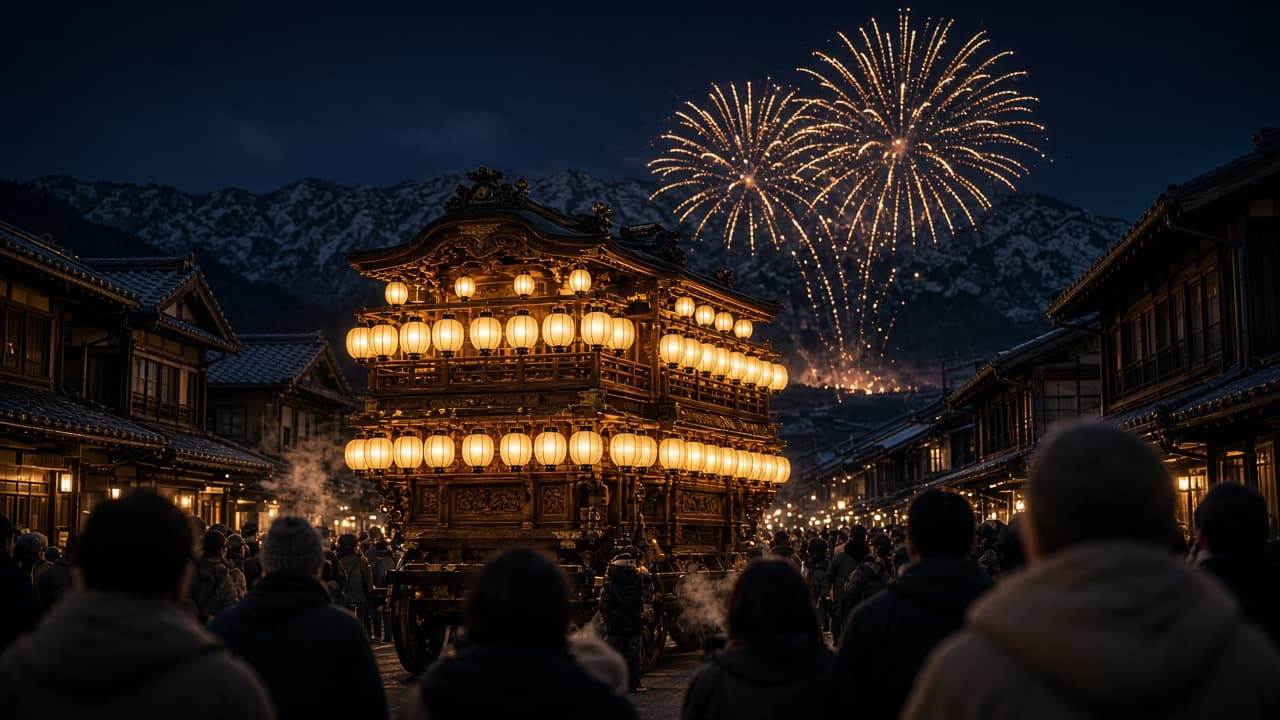
Every December, the small mountain city of Chichibu, about 80 minutes from central Tokyo by limited express, hosts one of Japan's great float festivals. The Chichibu Yomatsuri, or Night Festival, is the annual grand festival of Chichibu Shrine. In 2026 it falls on Wednesday, December 2 and Thursday, December 3. On the main night, six giant wooden floats weighing up to about 20 tonnes are hauled through the streets to drums and flutes while fireworks burst overhead in the cold winter sky. Here is what happens, when, where you can and cannot watch, and how to get there and back.
Dates, times and rules below come from Chichibu City, the Chichibu Tourism Association and Chichibu Shrine. Train details come from Seibu Railway and Chichibu Railway. Links, with dates, are at the end.
The short answer
-
The dates
Wednesday, December 2 (the eve, yoimiya) and Thursday, December 3, 2026 (the main festival). The festival is held on these dates every year, whatever day of the week they fall on.
-
What it is
The annual grand festival of Chichibu Shrine. It is counted among Japan's three great float festivals, with Kyoto's Gion Matsuri and Hida's Takayama Matsuri, and, according to Japan's Agency for Cultural Affairs, is one of the festivals in UNESCO's "Yama, Hoko, Yatai, float festivals in Japan" listing.
-
The fireworks
On December 3 from 7:30 p.m., with the finale at 9:50 p.m., launched from Hitsujiyama Park. There is also a separate show on December 2, 7:00 to 8:00 p.m.
-
The catch
The climax at the Otabisho and Dangozaka slope is closed to spectators from about 5:30 p.m. to 10:30 p.m. Watch the floats on the route earlier in the evening instead.
-
How to go
Take the train. Seibu Railway and Chichibu Railway run extra trains, and the city centre is closed to cars for most of December 3.
What is the Chichibu Night Festival?
The Chichibu Yomatsuri (秩父夜祭) is the annual grand festival, or reitaisai, of Chichibu Shrine, the principal shrine of the Chichibu region in western Saitama Prefecture. Chichibu City describes it as one of Japan's three great float festivals, alongside the Gion Matsuri in Kyoto and the Takayama Matsuri in Hida, with a history of more than 300 years.
Its heart is a night procession that carries the shrine's deity out of the shrine. The famous floats, the kabuki performed on them and the fireworks are, in the shrine's own words, tsuke-matsuri: festivities added around that sacred procession, which grew popular from the late Edo period through the Meiji and Taisho eras.
The shrine also tells a local legend. The goddess of Chichibu Shrine, Myōken, and the male god of Mount Bukō, the mountain that rises over the city, are said to be in love, and the festival night is the one night a year they can meet. Mount Bukō's own wife is said to be the god of a nearby Suwa shrine, so when the floats pass close to it, the drummers fall silent.
The festival is protected at every level:
| Recognition | What it covers | Year |
|---|---|---|
| Important Tangible Folk Cultural Property (Japan) | The six floats, Chichibu Matsuri Yatai | 1962 |
| Important Intangible Folk Cultural Property (Japan) | The float events, their music, float kabuki and dances, and the Chichibu Shrine kagura | 1979 |
| UNESCO Intangible Cultural Heritage | One of the 33 festivals in "Yama, Hoko, Yatai, float festivals in Japan", per the Agency for Cultural Affairs | 2016 |
According to Japan's Agency for Cultural Affairs, Chichibu's festival, under its formal name the float events and kagura of the Chichibu Festival (秩父祭の屋台行事と神楽), is one of the 33 festivals that made up "Yama, Hoko, Yatai, float festivals in Japan" when UNESCO inscribed it in 2016. In December 2025, UNESCO extended the listing to add four more festivals.
What are the floats?
There are six floats: two kasaboko, which can carry a tall decorated parasol on top, and four yatai, which carry a roofed stage. Chichibu City's 2026 festival leaflet describes them as covered in vividly painted carvings and gold-thread embroidery.
The largest, the Shimogō kasaboko, is about 7 metres tall and weighs about 20 tonnes with its parasol fitted. The leaflet notes that it and the Nakachika kasaboko are usually hauled with the parasols removed. The four yatai are each about 6.5 to 6.7 metres tall and 12 to 14 tonnes.
Two things to watch for:
- Giri-mawashi (turning the float). To change direction, the haulers lever the whole float up and spin it around an axle, while a drum piece called tama-ire plays.
- Float kabuki and dances. Musicians and dancers perform hiki-odori dances on the yatai at stops around town. Float kabuki, with stages built out from the sides of a float, rotates among the four yatai, one each year; in 2026 it is the turn of Miyaji.
What happens on each day?
The Chichibu Tourism Association describes the two days like this:
| Day | What happens |
|---|---|
| Wed, Dec 2 (eve) | Four yatai parade until 8 p.m. It is calmer, and you can get close to the floats. During the day you may sometimes be able to help pull a float's ropes. Float kabuki on the Miyaji yatai, 12:00–2:00 p.m. Fireworks, 7:00–8:00 p.m. |
| Thu, Dec 3 (main festival) | All six floats parade from early morning until the next morning. Float kabuki, 12:30–2:30 p.m. and 4:30–6:30 p.m. The shrine's procession leaves Chichibu Shrine at about 6 p.m. Fireworks from 7:30 p.m. |
The association recommends seeing the floats both by day and by night, because they feel very different.
City and tourism association timetables for the main day include:
| Time (Dec 3) | Event | Where |
|---|---|---|
| 9:30 a.m.–3:30 p.m. | Chichibu Shrine kagura (sacred dance), an Important Intangible Folk Cultural Property | Kagura hall, Chichibu Shrine |
| 12:30–2:30 p.m. | Float kabuki | Chichibu Shrine |
| About 6:00 p.m. | Floats leave Chichibu Shrine for the Otabisho | City centre |
| 7:30 p.m. | Fireworks, Part 1: 100 large shells in a row, star mines, "golden waterfall" | Hitsujiyama Park |
| 9:50 p.m. | Fireworks finale, golden waterfall | Hitsujiyama Park |
Where can I watch, and where can't I?
This is the single most important thing to know. The Otabisho (in Chichibu Park) and the Dangozaka slope, where the floats are hauled up a steep slope at the climax, are closed to spectators from about 5:30 p.m. to about 10:30 p.m. on December 3, to prevent accidents. The city's 2026 traffic map says plainly that you cannot watch there.
So plan to see the floats on the streets:
- In the afternoon and early evening, along the routes through the city centre around Chichibu Shrine, Honmachi, Nakamachi and Kamimachi.
- After about 6 p.m., as they leave the shrine for the Otabisho. The official map marks recommended viewing spots on the pavements, with times, and shows where pedestrians are stopped while floats pass (from about 6:30 p.m., and in places from 7:00 to 10:00 p.m.).
- For the fireworks on December 3, the tourism association names three good spots: Route 140 between the Seibu-Chichibu Station crossing and the Uenomachi crossing, the Chichibu City Hall car park (an official viewing area) and the area in front of Seibu-Chichibu Station. Route 140 is not closed to traffic during the fireworks, so stay on the pavement.
A few rules:
- No drones. Drones are banned across the festival area, the float routes and the fireworks site. The tourism association warns that a drone over the fireworks site will stop the show.
- No parking or stopping anywhere in the city on festival days, and no parking at shops for the festival.
- It gets very cold. The Japan Meteorological Agency's long-term averages for Chichibu in December are a daytime high of 11.2°C and an overnight low of −1.6°C. You will be standing outside for hours after dark, so dress for below freezing.
How do I get there from Tokyo?
The tourism association strongly recommends the train. Roads into the city are expected to be badly jammed, and the city centre is closed to vehicles from 11 a.m. to 8 p.m. on December 2 and from 10 a.m. to 10 p.m. on December 3. Both railways run extra trains until about midnight on December 3.
| Option | What to know |
|---|---|
| Seibu Railway, Laview limited express | Ikebukuro to Seibu-Chichibu, no change, about 80 minutes. All seats are reserved: the limited express charge from Ikebukuro is ¥900 for adults on top of the normal fare, or ¥200 more if you buy it on board. On December 3 Seibu adds limited expresses from Ikebukuro about every 30 minutes from 11 a.m., and extra trains back in the evening. Tickets went on sale on November 3, so check availability early. |
| Seibu Railway, ordinary trains | No limited express charge. Seibu runs extra trains between Hannō and Seibu-Chichibu on December 3, and more direct trains to Ikebukuro and Tokorozawa after 9 p.m. Seibu-Chichibu Station is about 15 minutes' walk from the shrine. |
| JR to Kumagaya, then Chichibu Railway | Chichibu Station is about 3 minutes' walk from the shrine. Chichibu Railway runs a special timetable on December 3. A one-way adult fare from Kumagaya to Chichibu is ¥950. |
| Driving | Temporary paid car parks (P1–P8) open at schools and grounds around the city, from ¥1,000 per car on December 3, with free shuttle buses into town. The tourism association warns that car parks in the centre will fill up. |
Two travel warnings from the railways:
- Charge your IC card first. Seibu and Chichibu Railway both warn that ticket machines and fare-adjustment windows get very crowded. Top up your Suica or PASMO before you go, and buy your return ticket early if you use paper tickets.
- Chichibu Railway stops south of Chichibu Station in the evening. At the Dangozaka level crossing near Ohanabatake Station, the overhead power lines are taken down so the floats can pass. From about 7:30 p.m. to 10:30 p.m. there are no trains between Chichibu and Kagemori stations. If you are heading to Kagemori, use the free shuttle bus to Kagemori Ground.
For rail fans, Chichibu Railway is also running a one-off steam train, the SL Chichibu Hikiyama Yomatsuri, on December 3. It leaves Gyōdashi at 3:23 p.m. and Kumagaya at 3:43 p.m., reaching Chichibu at 5:55 p.m. All seats are reserved.
What else is on in town?
| What | When (2026) | Details |
|---|---|---|
| Chichibu Silk Market (Kinu-ichi) | Dec 2, 11 a.m.–7 p.m.; Dec 3, 11 a.m.–8 p.m. | The festival grew up around a silk market. Textiles, crafts and local goods on Kuromon-dōri and Kaitsugishō-dōri, a minute's walk from the shrine. |
| Chichibu Matsuri Kaikan (festival museum) | Dec 2, 9 a.m.–8 p.m.; Dec 3, 9 a.m.–9 p.m. | Adults ¥500, elementary and junior high school students ¥250. A good place to see the floats' craftsmanship up close and warm up. |
| Chichibu kabuki | Dec 3, procession about 3 p.m.; performance 4:00–5:30 p.m. | Near the Yao department store, in the city centre. |
FAQ
When is the Chichibu Night Festival in 2026?
On Wednesday, December 2 (the eve) and Thursday, December 3, 2026. The main night, with all six floats and the big fireworks show, is December 3. The festival is held on December 2 and 3 every year.
What time are the Chichibu Night Festival fireworks?
On December 3, from 7:30 p.m., with the finale at 9:50 p.m. On December 2 there is a separate show from 7:00 to 8:00 p.m. Both are launched from Hitsujiyama Park.
Can I see the floats climb Dangozaka?
Not up close. The Otabisho and Dangozaka area is closed to spectators from about 5:30 p.m. to about 10:30 p.m. on December 3 to prevent accidents. Watch the floats on the streets in the afternoon and as they leave Chichibu Shrine at about 6 p.m.
Is the festival free?
Yes. Watching the floats and fireworks on public streets is free. You pay for trains, any limited express seat, parking, and entry to the Chichibu Matsuri Kaikan museum.
Which day should I go?
If you want the full spectacle, December 3, but expect very large crowds. If you prefer a calmer visit and a closer look at the floats, December 2. The tourism association suggests seeing the floats in daylight and after dark if you can.
How long does it take from Tokyo?
About 80 minutes from Ikebukuro to Seibu-Chichibu on Seibu's Laview limited express, with no change.
Can I fly a drone or bring a car?
No drones: they are banned across the festival area. A car is possible but not recommended. The city centre is closed to vehicles for most of both days, and all temporary car parks charge.
Bottom line
Go by train, go early, and wrap up warm. See the floats on the streets in daylight and as they set out at dusk, find a spot on the pavement for the fireworks, and do not count on reaching Dangozaka. Check Seibu's and Chichibu Railway's special timetables for your train home before you set off.
Six floats, one winter night, and fireworks over the mountains.
Sources and further reading
- Chichibu City — 2026 Chichibu Night Festival and Silk Market press release, issued via PR TIMES, November 13, 2026 (Japanese) (float kabuki, December 3 fireworks programme, traffic restrictions, Route 140 not closed during fireworks); 2026 festival leaflet and traffic map (Japanese, PDF) (floats' sizes and weights, Otabisho and Dangozaka closure 5:30–10:30 p.m., car park fees, free shuttle buses, Chichibu Railway suspension, drone ban, museum hours and prices); Chichibu festival float events and kagura (Japanese) (Important Intangible Folk Cultural Property, 1979)
- Chichibu Tourism Association — Chichibu Night Festival 2026, updated November 19, 2026 (Japanese) (what happens each day, fireworks times and viewing spots, silk market, traffic and trains)
- Chichibu Shrine — Chichibu Yomatsuri (Japanese) (origins, the Myōken and Mount Bukō legend, tsuke-matsuri); Access (Japanese) (walking times from stations; about 80 minutes from Ikebukuro)
- Agency for Cultural Affairs — Chichibu Matsuri Yatai, National Designated Cultural Properties database (Japanese) (Important Tangible Folk Cultural Property, 1962); UNESCO inscription of "Yama, Hoko, Yatai" float festivals, press release, December 1, 2016 (Japanese, PDF) (list of the 33 festivals, including the float events and kagura of the Chichibu Festival); Extension of the listing, press release, December 11, 2025 (Japanese)
- UNESCO — Yama, Hoko, Yatai, float festivals in Japan (Representative List; first inscribed 2016, extended 2025); Committee decision 11.COM 10.b.19 (2016) (33 festivals); Committee decision 20.COM 7.b.52 (2025) (extension)
- Seibu Railway — Extra limited expresses for the Chichibu Night Festival (Japanese) (December 2–3 trains, ticket sales); Extra trains on December 3 (Japanese) (special timetable, IC card advice); Laview limited express charges (Japanese)
- Chichibu Railway — Chichibu Night Festival, December 3, 2026 (Japanese) (SL Chichibu Hikiyama Yomatsuri times, evening suspension between Chichibu and Kagemori); Station-to-station fare table, revised October 1, 2024 (Japanese, PDF) (Kumagaya to Chichibu, adult one-way ¥950)
- Japan Meteorological Agency — Climate normals for Chichibu (Japanese) (December average high 11.2°C, low −1.6°C)
- Akiya X — Akiya and houses for sale in Saitama, for readers who fall for Chichibu and its mountains
- The Japanist — Japan's winter illuminations and Christmas markets 2026; Tori-no-Ichi 2026 rooster fair guide
Method note: Dates, times, prices and rules are those published by Chichibu City, the Chichibu Tourism Association, Chichibu Shrine, Seibu Railway and Chichibu Railway as of November 23, 2026. Times can change, for example in bad weather. Translations from Japanese, and English renderings of Japanese names, are ours. Check the organizers' and railways' own sites before you travel.
Continue Reading
 Illustration, not a photo: this image was generated with AI.
Kamiarizuki 2026: Why Japan’s Gods Gather at Izumo Taisha, November 18–25
Elsewhere the lunar tenth month is Kannazuki, “the month without gods”; in Izumo it is Kamiarizuki. Izumo Taisha’s 2026 festival runs November 18–25. The rites and times, what visitors can see (the 4 p.m. farewell on November 25), the rules, and how to avoid two-to-three-hour traffic jams.
 Illustration, not a photo: this image was generated with AI.
Japan's 2026 Summer Fireworks (Hanabi) Guide: Dates, Tickets, and Best Viewpoints
Summer in Japan is defined by Hanabi Taikai—massive fireworks festivals that paint the night sky. From Tokyo's historic Sumidagawa to the grand displays of Nagaoka, here is your complete guide to 2026 schedules, ticketing, and viewing locations.
 Illustration, not a photo: this image was generated with AI.
Labor Thanksgiving Day 2026 in Japan: The November 21–23 Long Weekend, Explained
Labor Thanksgiving Day is Monday, November 23, 2026, making a three-day weekend from November 21. What the holiday celebrates, its harvest-ritual roots in Niinamesai, and the travel catch: every Tokaido and Sanyo Shinkansen Nozomi is all-reserved, with no non-reserved seats.